logo
Guangzhou Sande Electric Co.,Ltd.
Email Sales01@sande-elec.com TEL: 86--18620505228
Home > Products > CNC Circuit Board >
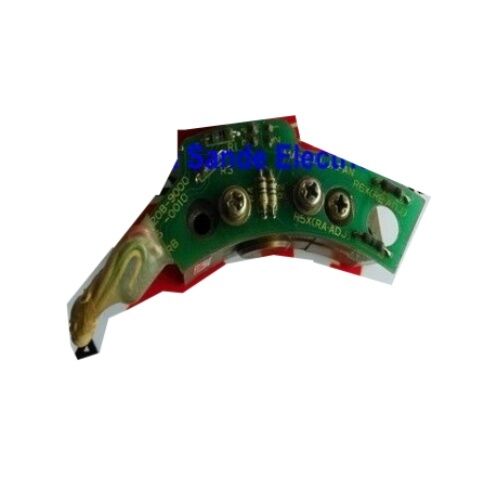
Absolute Fanuc Motor Encoder Board A20B-9000-0380
  • Absolute Fanuc Motor Encoder Board A20B-9000-0380

Absolute Fanuc Motor Encoder Board A20B-9000-0380

Place of Origin JAPAN
Brand Name FANUC
Certification CE ROHS
Model Number A20B-9000-0380
Product Details
Condition:
NEW / USED
Item No.:
A20B-9000-0380
Origin:
JAPAN
Certificate:
CE
Highlight: 

absolute fanuc motor encoder

,

A20B fanuc motor encoder

,

A20B-9000-0380

Payment & Shipping Terms
Minimum Order Quantity
1 pcs
Packaging Details
Original packing
Delivery Time
0-3 days
Payment Terms
T/T,PayPal,Western Union
Supply Ability
100 pcs/day
Product Description

FANUC A20B-9000-0380 — Spindle Motor Encoder Sensor Board

What This Part Is

Walk the floor of almost any machine shop running FANUC-controlled equipment from the 1980s through the early 2000s, and you'll encounter the A20B-9000 sensor series doing quiet, unglamorous work inside the spindle motor. The A20B-9000-0380 is a spindle motor sensor and signal converter PCB — a small but mechanically critical board that sits within the motor housing, reads the optical pickup signals generated by the spinning rotor, and converts those analogue sinusoidal waveforms into clean digital square-wave signals that the FANUC CNC control system can actually use.

Without this board functioning correctly, the control has no reliable picture of what the spindle is doing. Speed feedback collapses, spindle orientation fails, and rigid tapping — which depends entirely on knowing the exact angular position of the spindle at all times — becomes impossible. The machine may still run in some degraded mode, but any operation that depends on coordinated spindle-to-feed motion will either alarm out or produce scrap.


Function and Signal Path

The sensor assembly in a FANUC AC spindle motor works in two stages. The first stage is the optical pickup element itself — a photodetector array that reads a coded disk or ring on the rotor shaft, generating analogue sinusoidal outputs (sin/cos) as the shaft turns. These analogue signals carry position and speed information but cannot be read directly by the digital CNC controller.

The second stage is the A20B-9000-0380 signal converter PCB. It takes the raw sin/cos sensor output, processes it through its onboard circuitry, and produces:

  • Quadrature incremental pulse output — A and B phase square-wave signals from which the control calculates both speed and direction of rotation
  • Zero reference pulse (one-revolution pulse) — a marker pulse generated once per full revolution of the motor shaft, approximately 120 microseconds in duration, which the control uses to establish an absolute angular reference each time the spindle is homed

This combination is what makes spindle orientation, C-axis control (on machines where the spindle doubles as a positioning axis), and rigid tapping functions possible on legacy FANUC systems.


Part Information at a Glance

Attribute Detail
FANUC Part Number A20B-9000-0380
Also referenced as A20B90000380
Product type Spindle motor encoder / sensor signal converter PCB
Series A20B-9000
Country of manufacture Japan
Application FANUC AC spindle motors
Interface 12-pin feedback connector
Related sensor part A20B-9000-0300
Availability status Discontinued (available via specialist suppliers and surplus stock)

The A20B-9000 Series in Context

The A20B-9000 series spans several spindle sensor board variants that look superficially similar but are not interchangeable. The -0300 and -0380 are frequently listed together by FANUC parts specialists and serve comparable functions across different spindle motor generations. Other variants in the same family — including the -0120, -0180, and -0500 — cover different motor frame sizes, connector configurations, or revised circuit layouts introduced at different points in FANUC's spindle motor production history.

Getting the correct suffix is not optional. Substituting the wrong A20B-9000 variant will either prevent the board from fitting the motor's physical connector, produce incorrect pulse counts that cause position errors, or cause the CNC to alarm immediately on spindle enable. When ordering a replacement, always cross-reference the part number from the motor nameplate or the original sensor board label rather than relying on motor frame size alone.


When This Board Fails — Symptoms to Know

The A20B-9000-0380 is a passive PCB with no active cooling and no moving parts, so it tends to outlast many other components in the spindle system. When it does fail, the most common causes are contamination from oil mist ingress into the motor housing, vibration-induced solder joint fatigue, or age-related degradation of the optical components on the pickup side.

Typical CNC alarms associated with encoder board failure on FANUC systems include:

  • SP9001 / SP9002 — Spindle motor speed feedback error
  • SP9003 — Spindle position coder signal abnormality
  • 434 / 435 — Spindle sensor disconnection or signal loss (alarm number varies by CNC generation)

Before condemning the A20B-9000-0380 board itself, it is worth checking the connector between the board and the motor feedback cable, as the 12-pin interface is a known weak point on machines with high vibration or infrequent maintenance. A loose or corroded pin will produce identical symptoms to a failed PCB.


Procurement and Repair Considerations

FANUC no longer manufactures the A20B-9000-0380 as a new-production item. Genuine original units — often described as OEM Japan stock — circulate through the industrial surplus and CNC parts specialist market. Before purchasing, confirm with the supplier that:

  1. The unit has been electrically tested (not just visually inspected)
  2. The 12-pin connector and all through-hole solder joints are intact
  3. The optical pickup surface is clean and free of contamination

For machines where downtime cost is high, some CNC service companies offer board-level repair on A20B-9000 series components, restoring them to serviceable condition at considerably lower cost than sourcing a replacement from surplus stock. This is worth exploring if the optical pickup element itself is still intact and the failure is confined to the signal conversion circuitry.


FAQ

Q1: What FANUC spindle motors use the A20B-9000-0380 encoder board?

The A20B-9000-0380 is designed for early-generation FANUC AC spindle motors that use an internal optical pickup sensor with a 12-pin feedback interface. It is frequently paired alongside the A20B-9000-0300 in parts listings, indicating shared use across a common family of FANUC spindle motor frames produced during the same era. Because FANUC does not publish a comprehensive cross-reference table in the public domain, the most reliable way to confirm compatibility is to compare the part number printed on the existing sensor board inside your motor with the replacement unit before purchase. If the motor has been repaired or remanufactured previously, the original board part number may have already changed.

Q2: Can the A20B-9000-0380 be replaced with a different A20B-9000 variant if the exact part is unavailable?

Not without verification. The A20B-9000 series covers multiple spindle sensor variants that differ in connector pinout, pulse output count, and circuit design. A physically similar board from a different suffix may not produce the same pulse frequency or connect to the same 12-pin interface, leading to speed calculation errors or immediate alarm conditions on the CNC. If the exact -0380 suffix is unavailable, a FANUC-qualified service technician or an experienced CNC parts specialist should review the motor specifications before any cross-substitution is attempted.

Q3: What CNC control generations is this board compatible with?

The A20B-9000-0380 was produced to work with FANUC CNC systems that accept the spindle sensor feedback format used by early-generation FANUC AC spindle motors — covering systems such as the FANUC Series 0, Series 10/11, Series 15, and related control hardware from the corresponding production period. Machines running these controls with compatible spindle motors are the primary application. Later FANUC spindle systems moved to different encoder technologies (such as the αi and βi sensor families), which use entirely different boards and connectors. The A20B-9000-0380 does not apply to those motor generations.

Q4: Is this board the same as the spindle position coder (A860-series pulsecoder)?

No — these are two distinct components serving different roles in the FANUC spindle system. The A20B-9000-0380 is a sensor signal converter board mounted inside the spindle motor housing, converting the internal optical pickup output into digital feedback signals. The A860-series position coders (such as the A860-0309 or A860-0382 families) are external sensors typically mounted on the spindle nose or through a mechanical coupling, used specifically for high-resolution spindle orientation and C-axis control. On many machines both types of feedback exist simultaneously — the internal motor sensor handles speed regulation while the external position coder handles angular positioning.

Q5: How should the A20B-9000-0380 be handled and stored to prevent damage before installation?

Like all precision FANUC encoder PCBs, the A20B-9000-0380 should be handled with standard ESD precautions — grounded wrist strap and antistatic packaging. The optical pickup surface (if exposed) must be kept completely free of fingerprints, oil, and dust; even a thin film of contamination on the optical path will reduce signal quality and can cause intermittent alarms under vibration. Long-term storage should be in a sealed antistatic bag inside a dry, temperature-stable environment away from magnetic fields and direct sunlight. Before installation, inspect the 12-pin connector body for any deformed or pushed-back pins, as connector damage during shipping is the most common cause of problems with used boards arriving from surplus suppliers.


Contact Us at Any Time

+86 18620505228
10/F,Jia Yue Building, Chebei Road,Tianhe district,Guangzhou,China
Send your inquiry directly to us