logo
Send Message
Guangzhou Sande Electric Co.,Ltd.
Email Sales01@sande-elec.com TEL: 86--18620505228
Home > Products > CNC Circuit Board >
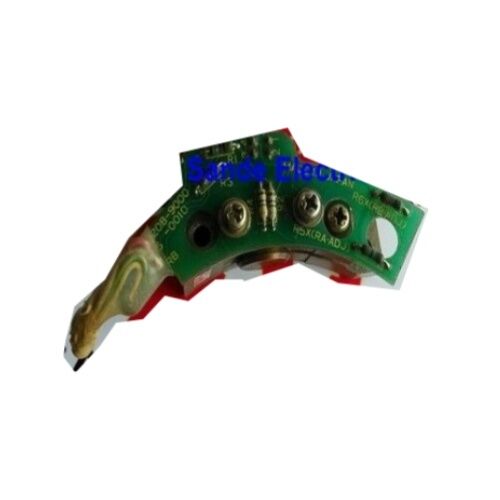
A20B-9000-0500 Fanuc Encoder Board A20B90000500 A20B-9000-0500
  • A20B-9000-0500 Fanuc Encoder Board A20B90000500 A20B-9000-0500

A20B-9000-0500 Fanuc Encoder Board A20B90000500 A20B-9000-0500

Place of Origin JAPAN
Brand Name FANUC
Certification CE ROHS
Model Number A20B-9000-0500
Product Details
Condition:
NEW / USED
Item No.:
A20B-9000-0500
Origin:
JAPAN
Certificate:
CE
Highlight: 

a20b a860-2150-v001

,

a20b servo motor encoder

,

fanuc a860-2150-v001

Payment & Shipping Terms
Minimum Order Quantity
1 pcs
Packaging Details
Original packing
Delivery Time
0-3 days
Payment Terms
T/T,PayPal,Western Union
Supply Ability
100 pcs/day
Product Description

FANUC A20B-9000-0500 Encoder — Spindle Motor Encoder Board for FANUC CNC Systems

What This Component Is — and Why It Matters

The A20B-9000-0500 is a FANUC spindle motor encoder board, part of the A20B-9000 series of feedback sensors used across FANUC CNC machining systems. Its job sits at the center of closed-loop spindle control: mounted to the spindle motor, it continuously measures rotational position and speed, feeding that data back to the spindle amplifier and CNC control so the system can regulate exactly how fast the spindle is turning and — crucially — where it is positioned at any given moment.

That last point deserves some emphasis. Spindle control isn't simply about reaching a target RPM. Operations like rigid tapping, thread cutting, and spindle orientation all require the CNC to know the precise angular position of the spindle shaft at any instant. The encoder board is what makes that position awareness possible. Without a functioning encoder, the spindle reverts to open-loop behavior at best — and more commonly, the CNC generates a spindle feedback alarm and refuses to run the program at all.

The A20B-9000-0500 is also cross-referenced as A20B90000500 in some parts catalogs — both designations refer to the identical component.


The A20B-9000 Encoder Series in Context

FANUC uses a structured part numbering system across its spindle encoder range. The A20B-9000 series encompasses a family of spindle motor encoder boards designed for integration into FANUC AC spindle motors. Each variant within the series — including the A20B-9000-0380, A20B-9000-0300, A20B-9000-0010, and A20B-9000-0500 — is matched to specific motor types and spindle amplifier configurations.

These encoder boards are distinct from the A860-series pulse coders used on FANUC servo feed axes. Where the A860 family handles the feedback requirements of linear and rotary feed axes, the A20B-9000 boards are specifically engineered for the higher-speed, higher-power demands of spindle motors — machines running continuous cutting operations at thousands of RPM, often with cooling and vibration conditions that a servo axis encoder would never encounter.

Understanding which variant is correct for a given machine requires matching the encoder to the specific motor model. Using the wrong encoder within the same physical form factor can result in miscounting, erroneous speed data, or control alarms even if the unit powers on normally.


Technical Role in the Spindle Control Loop

When a machinist enters an S-command — say, S3000 M03 — the sequence of events that follows is more involved than it appears. The spindle amplifier sends power to the motor, the spindle begins to accelerate, and the encoder board immediately begins generating feedback pulses proportional to actual shaft rotation. The amplifier compares those pulses against the commanded speed and adjusts its output continuously to close the gap.

At steady state, the encoder keeps the loop closed: any deviation from target RPM caused by cutting load variation, thermal effects, or supply fluctuation is detected and corrected in real time. This is what gives FANUC spindle drives their characteristic speed stability under varying chip loads — the encoder is updating the amplifier's control calculation continuously throughout the cut.

For operations requiring positional control — rigid tapping being the most common — the encoder also provides absolute phase reference. The CNC knows where the spindle is within one revolution, which is what allows it to synchronize spindle rotation with Z-axis feed to produce accurate thread pitch, even in the face of slight speed variations during the tapping cycle.


Physical Characteristics and Installation Location

The A20B-9000-0500 encoder board is designed to be mounted on the rear of the spindle motor, typically beneath the cooling fan assembly. On most FANUC spindle motor configurations, the blower fan mounts to the rear of the motor frame, and the encoder sits between the fan housing and the motor end-bell, attached to the motor shaft extension.

Physically, the unit consists of a sensing PCB (the stator element) and a rotor disc or target that mounts to the spinning shaft. The PCB detects the rotation of the target and generates the feedback signal. Because the rotor is mechanically coupled to the shaft, the encoder board requires careful alignment during installation — even a slight eccentricity in rotor mounting can cause noise in the feedback signal, which manifests as hunting, vibration, or intermittent speed irregularities during operation.

The output of the encoder connects to the spindle amplifier — typically through the JY2 or equivalent terminal — using a dedicated shielded cable. Cable integrity is a common source of encoder-related faults that doesn't involve the encoder board itself; this is worth checking before condemning the board during troubleshooting.


Common Failure Symptoms Pointing to This Component

Spindle encoder failure presents in several recognizable ways. Knowing these patterns saves diagnostic time and avoids unnecessary parts replacement.

Spindle feedback alarm on power-up or during acceleration. This is the most direct indication. On FANUC 0i, 16i, 18i, and similar controls, the alarm number will reference spindle speed deviation, encoder disconnection, or feedback signal abnormality.

Spindle hunts or oscillates at constant speed. If the motor reaches approximately the correct RPM but then surges and recovers rhythmically, the encoder is generating a noisy or intermittent signal rather than failing outright. This can be caused by a damaged rotor disc, loose mounting hardware allowing the rotor to wobble, or damage to the sensing elements on the PCB itself.

Rigid tapping produces inaccurate pitch or torn threads. Position-dependent operations are sensitive to even small counting errors in the encoder. Systematic pitch errors in tapped holes — where the thread is consistently over- or under-pitch — can indicate encoder wear that hasn't yet generated a hard alarm.

No spindle feedback at all, spindle runs in open loop or not at all. A complete encoder board failure typically causes the CNC to refuse spindle commands, displaying an alarm immediately.

Before replacing the encoder board, always verify the encoder cable and connector. Coolant ingress into the connector, cable damage near the motor end, and corroded pins cause symptoms identical to board failure at a fraction of the replacement cost.


Sourcing Considerations

The A20B-9000-0500 is an original FANUC component. For machines in active production, the choice between new-old-stock, professionally refurbished, and used-tested units is largely a risk management decision.

New OEM stock, where available, offers the highest confidence in service life — but FANUC encoder boards from older machine generations are not always readily available through standard channels, and when they are, they carry a premium. Refurbished units from reputable CNC component specialists who test on live spindle drive test equipment before shipping provide a practical alternative. The key qualifier is whether the supplier tests under dynamic load, not just power-on continuity.

Regardless of the unit's history, proper installation and cable inspection are as important as the quality of the component itself. Many "encoder replacement" situations resolve at the cable or connector stage without any board-level work required.


Frequently Asked Questions

Q1: What is the difference between the A20B-9000-0500 and other A20B-9000 series encoder boards such as the A20B-9000-0380 or A20B-9000-0300?

Each variant in the A20B-9000 series is matched to a specific FANUC spindle motor model or motor generation. The suffix number (0500, 0380, 0300, etc.) identifies the specific design revision and the motor type it is calibrated for. They share a common physical concept — encoder PCB mounted to the rear of the spindle motor — but differ in sensing geometry, pulse output, and electrical interface. Using the wrong variant on a motor will result in incorrect speed readings, spindle alarms, or silent counting errors. Always confirm the part number against the motor nameplate or the machine's parts list rather than assuming physical fitment means functional compatibility.


Q2: Can this encoder board be repaired, or does it need to be replaced outright?

Component-level repair is technically possible and practiced by specialist CNC repair companies with the correct equipment. The sensing PCB can suffer failures in the optical or magnetic detection circuit, the signal conditioning components, or the output driver stage — all of which are repairable in principle. However, the mechanical precision of the rotor-to-stator relationship is as important as the electronics, so any repair must also verify that mounting hardware and rotor condition are within tolerance. For a spindle encoder, where a subtle counting error causes real quality problems in the parts the machine produces, testing after repair must include dynamic verification at actual operating speeds — not just a static bench test.


Q3: The machine shows a spindle encoder alarm. How do I confirm it's the encoder board and not the cable?

Start with the cable before touching the encoder board. Disconnect the encoder cable at the spindle amplifier end and inspect the connector pins for corrosion, bent contacts, or coolant residue. Then check continuity of the cable between the amplifier connector and the encoder connector at the motor, looking particularly for intermittent opens in the shielded conductors — the most common cable failure mode. If the cable checks out, and the alarm persists with a known-good substitute cable, then the encoder board itself is the most likely fault. On some FANUC controls, the diagnostics page shows raw encoder feedback data; if that data is absent or erratic with a good cable connected, the encoder board has almost certainly failed.


Q4: Is the A20B-9000-0500 compatible with both FANUC 0-series and newer 16i/18i/0i series controls?

Compatibility is determined by the spindle motor and spindle amplifier in use, not directly by the CNC control series. The encoder board interfaces with the spindle amplifier — if the amplifier is unchanged and the motor is unchanged, replacing a failed A20B-9000-0500 with an identical unit will restore normal function regardless of which generation of CNC control sits upstream. Compatibility questions arise when a machine has been re-controlled or when a spindle amplifier has been replaced with a different-generation unit — in those cases, the encoder interface requirements of the new amplifier must be verified against what the A20B-9000-0500 provides.


Q5: How should the A20B-9000-0500 be stored if it cannot be installed immediately?

Store the unit in its original anti-static packaging or equivalent ESD-protective packaging, in a clean, dry environment with stable temperature — away from direct sunlight, humidity, and sources of vibration. The sensing PCB contains components sensitive to electrostatic discharge, and the rotor element (if included as an assembly) can be damaged by impacts that would not visibly mark the housing. Avoid storing the unit near strong magnetic fields. Most CNC component specialists recommend installation within 12–18 months of removal from storage for optimal reliability; units stored beyond this period should be functionally tested before installation on a production machine.


The A20B-9000-0500 encoder board must be matched to the correct FANUC spindle motor model. Always verify compatibility against the motor nameplate and machine documentation before installation. Encoder replacement should be carried out with the machine fully locked out and the spindle motor cooled to ambient temperature.

Contact Us at Any Time

+86 18620505228
10/F,Jia Yue Building, Chebei Road,Tianhe district,Guangzhou,China
Send your inquiry directly to us