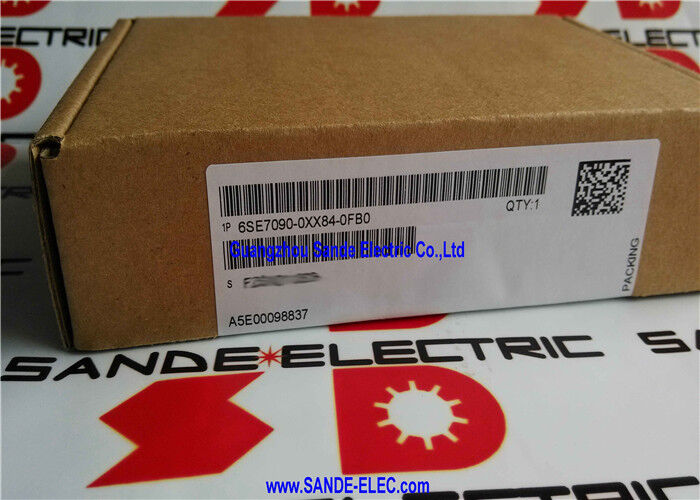
Siemens 6SE7090-0XX84-0FB0 | SIMOVERT MASTERDRIVES SBR1 Resolver Measuring Transducer — Without Pulse Encoder Simulation, Miniature Format, ADB Required
Overview
The Siemens 6SE7090-0XX84-0FB0 is the SBR1 — Resolver Measuring Transducer — for the SIMOVERT MASTERDRIVES Motion Control and Vector Control drive platform.
It is the optional board that enables a SIMOVERT MASTERDRIVES drive to use a resolver as its motor feedback device, receiving the resolver's analog sine-cosine signals and converting them to digital speed and position data that the drive's control unit can process for closed-loop velocity and position control.
Resolvers are wound transducers — essentially rotating transformers — that produce analog voltage signals whose amplitude and phase vary sinusoidally with rotor angle.
They generate no digital output; instead, they output two analog signals (sin θ and cos θ) that together uniquely define the shaft angle at any point in a full electrical revolution. These analog signals must be converted by a Resolver-to-Digital (R/D) converter circuit before the drive can use them, and that is the primary function of the SBR1 board.
The conversion happens on the SBR1 itself, relieving the main control unit from analog signal processing and delivering a clean digital position and velocity value via the drive's internal data bus.
Resolvers retain a significant advantage over incremental encoders in electrically hostile and mechanically harsh environments. With no internal electronics, no glass disc, and no LED, a resolver survives temperature extremes, shock loads, and electromagnetic interference that would destroy optical or magnetic encoder units.
This makes resolver-based feedback the traditional choice for severe-duty servo applications — traction drives, heavy machine tools, steel mill equipment, and defence and aerospace actuators — where long-term mechanical and electrical robustness matters more than the marginal resolution advantage of high-count incremental encoders.
The SBR1 (6SE7090-0XX84-0FB0) is the version without pulse encoder simulation.
This means the board processes the resolver signals for the drive's own closed-loop use, but does not generate a simulated incremental encoder output signal on an additional connector for use by external motion controllers or CNC systems that require encoder-format feedback from the drive's motor.
When that simulated encoder output is needed — for dual-loop control architectures, CNC interpolation, or multi-axis position synchronisation that runs through an external controller — the SBR2 (6SE7090-0XX84-0FC0) must be specified instead.
Key Specifications
| Parameter |
Value |
| Board Designation |
SBR1 — Resolver Measuring Transducer |
| Resolver Interface |
Analog sin/cos excitation and feedback |
| Pulse Encoder Simulation |
Not available (this variant) |
| Format |
Miniature-format board |
| ADB Required |
Yes (6SE7090-0XX84-0KA0) |
| Compatible Drive |
SIMOVERT MASTERDRIVES MC/VC |
| Delivery |
Without connector and without operating instructions |
| PLM Date |
30.09.2020 (discontinued) |
| Companion (with simulation) |
6SE7090-0XX84-0FC0 (SBR2) |
Resolvers vs Incremental Encoders — Why the SBR1 Exists
The choice between resolver and encoder feedback is a systems-level specification decision driven by the application environment and the motor's physical construction.
Many servo motors — particularly in the SIMOREG and SIMOVERT era — were wound with resolver feedback as standard, either because the machine's duty cycle was too severe for optical encoders, or because the application's temperature range exceeded what glass-disc encoders could handle (resolvers typically operate from −55°C to +150°C, while optical encoders are typically rated to +85°C).
A SIMOVERT MASTERDRIVES drive with its standard control unit (CUVC or CUMC) has no built-in resolver interface.
The drive natively accepts incremental encoder input (TTL or HTL square-wave) directly at its own encoder connector.
To connect a resolver-equipped motor, the SBR1 board is inserted into the drive's optional board slot via the ADB adapter, providing the resolver excitation output (the reference winding drive voltage) and the sin/cos signal reception.
The board's R/D converter processes the angle data and makes it available to the drive's velocity and position control loops.
For motion control applications requiring absolute position within one mechanical revolution — positioning axes that need to return to a defined zero without homing after a power cycle — the resolver's inherent absolute position within one electrical revolution is a functional advantage over incremental encoders, which lose position information on power loss and require a homing cycle to re-establish position.
SBR1 vs SBR2 — The Pulse Encoder Simulation Distinction
The SBR1 (this part) and the SBR2 (6SE7090-0XX84-0FC0) perform the same core resolver interface and R/D conversion function.
The difference is that the SBR2 additionally generates a simulated incremental encoder output — typically A/B quadrature pulse signals and a Z reference mark — on a separate connector, derived from the resolver-converted position data.
This simulated encoder output allows external systems to receive position feedback from the drive's motor in the standard incremental encoder format that most motion controllers and CNC systems expect, even though the motor itself has a resolver rather than an encoder.
Typical applications requiring the SBR2 include: CNC machine retrofits where the CNC controller expects encoder feedback from each axis; gantry synchronisation where a master controller closes the position loop across multiple axes; and retrofit installations where the original machine's motion controller requires encoder feedback but the replacement motor comes with resolver feedback.
For closed-loop drive applications where the MASTERDRIVES drive itself closes the velocity and position loop and no external controller needs to see the motor's position — such as standalone vector-controlled conveyor drives, pump or fan speed control with encoder feedback, or applications using the drive's own positioning controller — the SBR1 without pulse encoder simulation is the correct and more economical choice.
ADB Mounting — Installation Requirement
The SBR1 is a miniature-format board that cannot be installed directly in the drive's electronics enclosure without the ADB (Adapter Board, 6SE7090-0XX84-0KA0).
The ADB provides the physical slot connectors and the system bus interface that miniature-format optional boards — including the SBR1, SBR2, EB1, EB2, CBP2, and others — require for mechanical mounting and electrical connection within the drive.
Without the ADB, the SBR1 has no physical means of connecting to the drive's internal system bus.
When ordering a complete resolver interface assembly for a first-time SBR installation in a drive that has not previously had optional boards, the ADB must be included in the bill of materials.
Drives that already have optional boards fitted will have an ADB present — confirm before ordering.
The SBR1 is delivered without the cable connectors and without operating instructions, as indicated in the part description.
FAQ
Q1: The SBR1 is discontinued. What is the recommended approach for a drive system still using resolver-equipped motors?
For drives in active service, the SBR1 continues to be available from the industrial electronics surplus market, typically sourced from decommissioned MASTERDRIVES installations.
Board-level testing and repair is also available from specialist industrial electronics companies.
If the resolver-equipped motor itself is still in service and a full drive platform migration is not feasible, sourcing a tested SBR1 from the legacy market is the practical path.
If a full platform upgrade is being considered, Siemens' SINAMICS S120 series supports resolver feedback through its Sensor Module Cabinet-Mounted (SMC10) — providing a migration path that preserves resolver-equipped motors.
Q2: Does the SBR1 provide the excitation voltage for the resolver, or does that come from a separate power source?
The SBR1 provides the resolver excitation — the AC reference voltage applied to the resolver's primary winding.
The excitation frequency and amplitude are generated by the SBR1's own circuitry, powered from the drive's internal supply through the ADB bus connection.
No separate external excitation supply is required.
The resolver's sin and cos output signals return to the SBR1 through the same cable connection, making the complete resolver interface a self-contained function of the SBR1 board.
Q3: Can the SBR1 be used with all resolver types, or only specific Siemens motors?
The SBR1 is designed for standard two-pole resolvers (single-speed resolvers with one electrical revolution per mechanical revolution) with standard excitation voltage and sin/cos output amplitude specifications.
Most industrial resolvers from major manufacturers — including those from Siemens, Heidenhain (former Stegmann), and Tamagawa — conform to compatible electrical specifications.
For multi-pole (multi-speed) resolvers, which produce multiple electrical cycles per mechanical revolution, compatibility depends on whether the SBR1's R/D converter can handle the specific pole pair count.
Verify resolver specifications against the SBR1's operating instructions before assuming compatibility with non-standard resolver configurations.
Q4: What happens to position feedback if the SBR1 loses power or the resolver cable is disconnected during operation?
Loss of resolver feedback triggers a drive fault — the SIMOVERT MASTERDRIVES will detect the encoder fault (F083 or similar resolver-related fault code depending on firmware version) and initiate the configured fault response, which is typically to disable the output stage and coast the motor to stop.
The drive does not attempt to continue operation in open-loop mode automatically; restoration of resolver feedback and a fault reset are required before the drive returns to operation.
This protective response prevents uncontrolled motor motion when position feedback integrity is compromised.
Q5: The SBR1 is described as requiring an ADB. Can it share the ADB with other optional boards, such as an EB2 or CBP2?
Yes. The ADB provides multiple slots and can host several miniature-format optional boards simultaneously, subject to the total current consumption of all installed boards not exceeding the drive's internal supply capacity and the physical slot count of the specific ADB variant.
In a typical application, an SBR1 in the sensor board slot (slot C, which is reserved for sensor boards in most MASTERDRIVES configurations) can coexist with an EB2 expansion board or a CBP2 PROFIBUS board on the same ADB.
The sensor board slot allocation for the SBR1 should be confirmed against the drive unit's option board slot assignment table in the MASTERDRIVES options documentation.



 Your message must be between 20-3,000 characters!