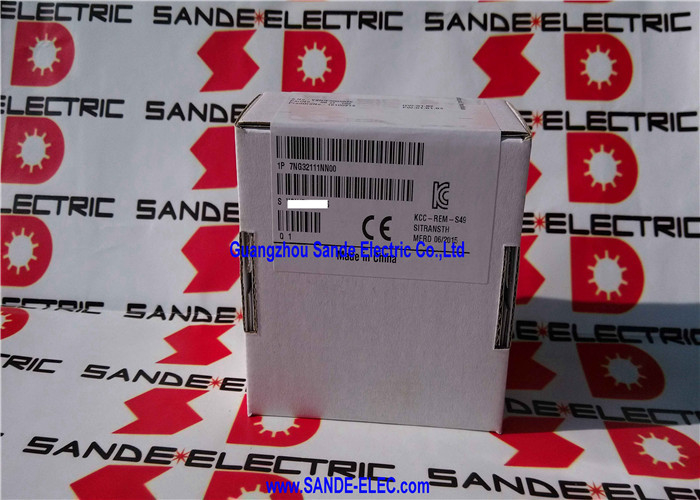
Siemens 7NG3211-1NN00 | SITRANS TH200 Temperature Transmitter — Connection Head Type B (DIN 43729), 4–20mA Two-Wire, Programmable, Galvanic Isolation, Universal Sensor Input
Overview
The Siemens 7NG3211-1NN00 is the SITRANS TH200 — a compact, head-mounted temperature transmitter that lives inside the connection head at the sensor installation point rather than in the control cabinet.
The TH200 concept is straightforward: rather than running the raw millivolt or resistance signal from the sensor all the way back to a panel-mounted transmitter or directly to the DCS input card, the transmitter converts the signal to a 4–20mA current right at the measurement point.
The 4–20mA loop signal then travels to the control room — a signal that is far more immune to electrical noise, cable resistance, and electromagnetic interference than the microvolt or low-resistance sensor signals that it replaces.
The DIN 43729 Type B connection head is the standard enclosure for process temperature sensors in European and many global process industries. It is the cylindrical metal head that caps the thermowell or cable gland at the measurement point, housing the sensor terminal block inside.
The SITRANS TH200's form factor is matched to this standard head — the transmitter PCB fits within the head's internal dimensions, clamps to the DIN rail or terminal block inside, and leaves the head's terminal strip accessible for both sensor and loop wiring.
No additional panel space, no additional enclosure, and no additional wiring run is needed — the transmitter is at the measurement point.
The universal input stage is what makes the TH200 genuinely flexible in process plant applications.
A plant may have RTD sensors (Pt100 for standard temperature measurements), thermocouples (Type K for higher-temperature applications), and legacy sensors from different manufacturers with different signal types — all connected to TH200 transmitters configured appropriately for each sensor type.
A single instrument type in the spare parts inventory covers the full range of sensor types on the plant, rather than requiring separate transmitter models for each sensor technology.
Key Specifications
| Parameter |
Value |
| Output |
4–20mA, two-wire |
| Installation |
Connection head, type B (DIN 43729) |
| Programmable |
Yes (SIPROM T software / HART modem) |
| Galvanic Isolation |
Yes (input to output) |
| Explosion Protection |
None (standard) |
| Sensor Input |
Universal (RTD, TC, mV, Ω) |
| Net Weight |
~120g |
| Status |
Discontinued |
Universal Sensor Input — Breadth of Compatibility
The TH200's universal input stage accepts the full range of temperature sensor types used in industrial process measurement:
RTD sensors (resistance temperature detectors): The most common type in industrial process temperature measurement.
Pt100 (the 100Ω platinum standard at 0°C) is dominant in European practice; Pt1000 (1000Ω) offers higher accuracy over short cable runs; Ni100 and Ni1000 nickel RTDs are used in specific applications.
The TH200 handles all standard RTD types including the less common Cu10 copper RTD and special linearisation curves.
Thermocouples: For higher temperatures where RTDs cannot operate (above approximately 600°C), or for cost-sensitive large sensor counts, thermocouples are standard.
The TH200 accepts all common thermocouple types: K (the most widely used general-purpose type, −200 to +1300°C), J (iron-constantan, general purpose), T (copper-constantan, low-temperature), E, N, R, S (platinum types for high precision and high temperature), B (for very high temperatures up to ~1800°C), and the speciality types L, C, D, and U.
Millivolt and resistance signals: Beyond named sensor types, the TH200 accepts raw millivolt and resistance inputs with custom linearisation — allowing it to interface with non-standard sensors, pressure-to-temperature transducers, and other process instruments whose output characteristic curves can be defined by up to 30 X-Y value pairs stored in the transmitter.
This input breadth means a stock of 7NG3211-1NN00 units covers a plant's complete temperature measurement infrastructure.
Galvanic Isolation — Why It Matters in Process Plants
The galvanic isolation between the TH200's sensor input circuit and its 4–20mA output loop is not a marketing feature — it is a measurement integrity requirement in many process plant applications.
Process temperature sensors often share the local ground reference of the equipment they measure — a thermocouple inserted into a grounded metal vessel is itself at the vessel's ground potential, which may differ from the control room's ground potential by several volts due to ground potential differences across large plant sites.
Without isolation, this ground potential difference injects a common-mode error voltage into the measurement, producing incorrect temperature readings.
With galvanic isolation, the TH200's input circuit floats electrically from the output loop — the sensor input and the 4–20mA loop operate on separate references, and ground potential differences between the sensor installation and the control room cause no measurement error.
Isolation also provides protection against surge voltages caused by lightning strikes, plant fault conditions, and large motor starting events that can cause destructive voltages to appear on sensor circuits in unprotected installations.
The TH200's isolated input protects both the transmitter itself and the downstream DCS input card from these transients.
Programmability — Configuring the TH200 for Each Application
The SITRANS TH200 stores its operating parameters — sensor type selection, measuring range (upper and lower limits), output signal characteristics, and fault response — in non-volatile memory.
These parameters are configured using SIPROM T software installed on a PC, connected to the TH200 via an RS-232 modem interfaced to the 4–20mA loop. Alternatively, a HART communicator (handheld or modem-based) can access the TH200's parameters through the HART protocol superimposed on the current output.
The configuration process defines the measuring range: for a Pt100 RTD measuring between 0°C and 150°C, the transmitter is configured to output 4mA at 0°C and 20mA at 150°C.
Any temperature between these limits produces a proportional current output that the DCS or controller reads as a temperature value.
The full-scale span can be adjusted within the limits of the sensor type's measurement range — narrowing the span to match the process variable's actual operating window increases the effective resolution of the 4–20mA output for that specific application.
FAQ
Q1: What is the minimum measuring span (temperature range) the TH200 can be configured for?
The minimum measurable span depends on the sensor type. For RTD sensors such as Pt100, the minimum span is typically 10°C to 50°C depending on the specific configuration and the required accuracy.
Very narrow spans increase sensitivity to ambient temperature effects and noise, which is why practical minimum spans are defined in the SITRANS TH200 technical data.
For most process applications, spans of 50°C or wider provide the best combination of resolution and stability.
Q2: Can the SITRANS TH200 operate with a three-wire or four-wire Pt100 connection, or only two-wire?
The SITRANS TH200 supports two-wire, three-wire, and four-wire RTD connections. Three-wire and four-wire configurations provide cable resistance compensation — the transmitter measures and subtracts the resistance of the connecting wires, eliminating the temperature measurement error that two-wire connections introduce when cable runs are long.
For Pt100 measurements where accuracy better than ±1°C is required over cable lengths exceeding a few metres, three-wire connection is the recommended minimum.
Four-wire connection provides the most accurate compensation and is used in laboratory-grade measurements.
Q3: The 7NG3211-1NN00 has no explosion protection. What is the correct part number for use in ATEX Zone 1 or Zone 2 hazardous areas?
For ATEX Zone 2 applications (gas atmosphere, not normally present), the appropriate variant is 7NG3211-1AN00 (ATEX intrinsic safety certification).
For FM/cFMUS (North American) approval, the 7NG3211-1BN00 is the equivalent variant.
Both provide identical measurement functionality to the standard 7NG3211-1NN00 but are certified for use in hazardous atmospheres under the respective regulatory frameworks.
The standard 7NG3211-1NN00 may only be installed in safe areas (no hazardous atmosphere classification).
Q4: How does the TH200 indicate a sensor fault — for example, an open-circuit thermocouple?
When the TH200 detects a sensor fault (open circuit, short circuit, or signal out of range), it responds with a defined fault output current configured during parameter assignment.
The standard options are: drive the output to 3.6mA (below the live zero of 4mA, indicating fault to the DCS input), drive to 21mA (above full scale, indicating upscale fault), or hold the last valid value.
The specific fault response is selected based on the plant's control system logic and the safety implications of a false reading versus a clearly flagged fault current.
Most DCS systems can detect both the upscale and downscale fault conditions and generate appropriate alarms.
Q5: What replaces the discontinued SITRANS TH200 in Siemens's current product range?
The SITRANS TH200 has been succeeded by the SITRANS TH300 (7NG3212-0NN00 for the non-Ex standard version) in Siemens's current temperature transmitter portfolio.
The TH300 provides the same connection head installation, 4–20mA two-wire output, and galvanic isolation as the TH200, with the addition of full HART communication capability for both parameterisation and status communication — a significant advantage over the TH200's proprietary modem-based parameterisation.
For existing TH200 installations requiring maintenance replacement, the surplus market provides 7NG3211-1NN00 units.
For new installations or system upgrades, the TH300 is the current Siemens recommendation.



 Your message must be between 20-3,000 characters!