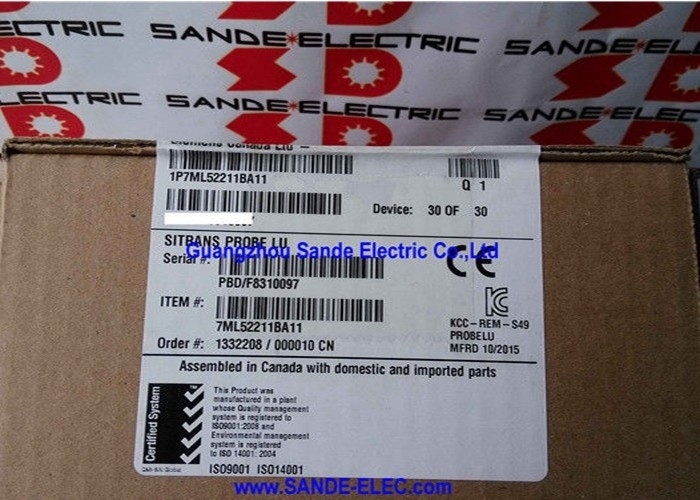
Siemens 7ML5221-1BA11 | SITRANS Probe LU Ultrasonic Level Transmitter — 6m PVDF, 2-Wire Loop Powered, 4–20mA / HART, 2" NPT, PBT Enclosure, FM / CSA / CE
Overview
The Siemens 7ML5221-1BA11 is the SITRANS Probe LU in its 6-metre PVDF copolymer configuration — a compact, 2-wire loop-powered ultrasonic level transmitter that has served the water, wastewater, and chemical storage industries for years as a practical, installation-friendly instrument for continuous non-contact level monitoring.
The Probe LU's fundamental design philosophy is simplicity without sacrificing measurement intelligence: it runs entirely from the 4–20mA loop current, requires no separate power supply cable, fits a standard 2" NPT nozzle that is already common on most industrial vessels, and commissions through a plain English local display with intuitive menu navigation that doesn't require referring to a manual for basic setup tasks.
The PVDF copolymer transducer in this variant distinguishes it from the ETFE-transducer version. Both PVDF and ETFE offer excellent resistance to a broad range of chemicals, but PVDF's higher chemical inertness and resistance to strong acids, bases, halogens, and oxidising agents makes it the specified choice when the process environment includes more aggressive media or when the vapour space above the liquid is corrosive.
Chemical storage applications — acid tanks, caustic vessels, solvent holding tanks, chemical process sumps — represent the natural home for the PVDF-equipped Probe LU.
The 2-wire loop-powered architecture carries a practical benefit that anyone who has wired industrial instrumentation will appreciate: the same two conductors that carry the 4–20mA measurement signal also power the transmitter electronics. Running a separate 24V power supply cable to the transmitter is not required.
This simplifies panel wiring, reduces cable costs on new installations, and makes retrofitting level measurement to existing analog 4–20mA instrument loops straightforward — the transmitter simply replaces whatever device was previously connected to the loop.
Key Specifications
| Parameter |
Value |
| Measurement Principle |
Ultrasonic, non-contact |
| Measuring Range |
Up to 6m (20 ft) |
| Transducer Material |
PVDF Copolymer |
| Process Connection |
2" NPT (ANSI/ASME B1.20.1) |
| Communication |
4–20mA analog + HART |
| Wiring |
2-wire, loop-powered |
| Enclosure |
PBT plastic, 2 × M20×1.5 |
| Accuracy |
0.15% of range or 6mm |
| Echo Processing |
Sonic Intelligence® + AFES |
| Temperature Compensation |
Internal, automatic |
| Approvals |
GM, CCSAUS, CE, UKCA, RCM, KC |
| Phase Status |
Phase-out (successor: Probe LU240) |
Sonic Intelligence — Echo Processing That Keeps Measurement Reliable
The Probe LU's signal processing engine is Siemens' Sonic Intelligence, a suite of algorithms that goes well beyond simple time-of-flight measurement to manage the complexities of echo signals in real industrial vessels.
An ultrasonic transmitter sends a pulse toward the liquid surface and measures how long it takes for the echo to return — straightforward in principle, but in practice the returned echo competes with reflections from vessel walls, internal structures, inlet piping, and standing waves created by turbulence.
Without intelligent processing, any of these competing echoes could be mistaken for the liquid surface.
Sonic Intelligence evaluates echo confidence — analysing the shape, strength, and consistency of candidate echoes to identify which represents the true liquid surface.
Combined with Auto False Echo Suppression (AFES), which maps and filters echoes from fixed vessel obstructions recorded during commissioning, the processing engine maintains reliable measurement even in cluttered vessels where simpler instruments would struggle.
The internal temperature sensor adds another layer of measurement integrity. The speed of sound in air — the medium the ultrasonic pulse travels through — changes with temperature.
A transmitter that assumes a fixed speed of sound at 20°C will accumulate error as ambient temperature changes.
The Probe LU's internal temperature sensor continuously measures the ambient temperature and corrects the time-of-flight calculation accordingly, keeping measurement accuracy within specification across the typical temperature range of an industrial installation.
Volume Calculation, Flow, and Open-Channel Measurement
Beyond simple level measurement, the Probe LU can calculate vessel volume directly — if the vessel shape (flat-bottomed cylinder, horizontal cylinder, conical, parabolic, or a custom breakpoint table) is programmed, the transmitter converts measured level to volume and outputs a 4–20mA signal representing volume rather than level.
This is particularly valuable in inventory management applications where operators track product quantity rather than fill height.
For flow measurement in open channels (flumes, weirs), the Probe LU can be installed above the flow structure and programmed with the appropriate level-to-flow conversion formula (rectangular weir, V-notch weir, Parshall flume, or other standard geometries).
The transmitter outputs a flow rate signal, turning a simple level measurement into a flow measurement instrument without any additional hardware or calculation.
PVDF vs ETFE — Transducer Material Selection
Both PVDF copolymer and ETFE (ethylene tetrafluoroethylene) are fluoropolymer-family materials with broad chemical resistance.
PVDF offers superior resistance to chlorine compounds, concentrated acids including hydrofluoric acid, and many organic solvents that attack ETFE at elevated concentrations.
It also has better UV resistance, which matters for outdoor installations where the transducer is exposed to sunlight.
ETFE, while slightly less chemically resistant than PVDF, handles a wide range of process chemicals encountered in general-purpose level measurement, and is less prone to certain mechanical fatigue mechanisms in high-frequency acoustic applications.
For aggressive chemical vapour environments, elevated acid concentrations, or applications where the transducer will be in frequent contact with the process liquid during vessel operations, PVDF is the conservative specification.
For general water, wastewater, and mild chemical applications, ETFE is a cost-effective alternative.
FAQ
Q1: The Probe LU is 2-wire loop-powered. What is the required loop supply voltage and current range?
The loop supply voltage for the SITRANS Probe LU is 14.5 to 35V DC (for non-hazardous applications).
The transmitter draws its operating power from the loop and varies the current between 4mA (representing 0% level) and 20mA (representing 100% level) to signal the measurement.
The loop power supply must be capable of supplying at least 20mA at the transmitter's minimum operating voltage — 14.5V — while accounting for the voltage drop across any series resistance (cable resistance, barriers, isolators) in the loop.
Standard 24V DC loop power supplies with appropriate loop resistance budgeting are compatible with the Probe LU.
Q2: How is the Probe LU programmed for a specific tank, and can it be done without a HART communicator?
Yes — the Probe LU's built-in display and pushbuttons provide complete access to the configuration menu without any external tools.
The programming procedure follows a simple, English-language guided sequence: the operator defines the empty distance (sensor face to tank bottom), the full distance (sensor face to the high-level setpoint), selects the measurement units, and optionally programs vessel shape for volume output.
The display confirms each entry and provides immediate feedback on the measured level throughout setup.
A HART communicator or PC with SIMATIC PDM can access additional parameters and diagnostics, but basic commissioning is entirely self-contained.
Q3: The Probe LU is in phase-out. Should I still specify it, or move directly to the successor Probe LU240?
For ongoing projects where the Probe LU has already been specified and the 7ML5221-1BA11 is still available to order, completing the order on the original specification is practical. For new project engineering, specifying the SITRANS Probe LU240 (7ML51 series) makes more sense — it is the current platform with updated electronics, continued software support, and a longer remaining product lifecycle.
The LU240 series is designed as a functional replacement for the Probe LU and covers the same core level measurement applications with compatible physical mounting dimensions.
Confirm the LU240 ordering code with Siemens for the equivalent 6m PVDF 2" NPT HART configuration.
Q4: Can the SITRANS Probe LU measure level in tanks with turbulent or aerated liquid surfaces?
Turbulence and aeration both affect ultrasonic level measurement.
Turbulent surfaces scatter the ultrasonic pulse and may reduce the strength of the return echo. Aeration — air bubbles dispersed in the liquid — does not significantly affect ultrasonic measurement as long as the measurement is made at the liquid-air interface above the aerated zone, which the Probe LU does from above.
Very heavy surface agitation, foam blankets that fully cover the liquid surface, or extremely turbulent inlet flows can challenge the echo processing.
In these cases, Sonic Intelligence's echo confidence evaluation and AFES help maintain a stable reading, but if turbulence is severe, increasing the damping setting and enabling additional averaging in the transmitter configuration improves stability at the cost of response time.
Q5: What is the minimum blanking distance below the Probe LU, and how does it affect high-level setpoint selection?
The SITRANS Probe LU has a blanking distance — the zone immediately below the transducer face within which echoes cannot be reliably processed.
For the 6-metre Probe LU, the blanking zone extends approximately 0.25m (10 inches) below the transducer face.
Any liquid surface within this zone cannot be measured accurately.
When positioning the transmitter, the maximum high-level alarm setpoint should be at least 0.25m below the transducer face, and the transmitter should be mounted high enough that the vessel's maximum fill level falls outside the blanking zone.
For very tall vessels, the blanking zone rarely constrains installation; for shallow vessels or sumps, it becomes an important siting parameter.


 Your message must be between 20-3,000 characters!