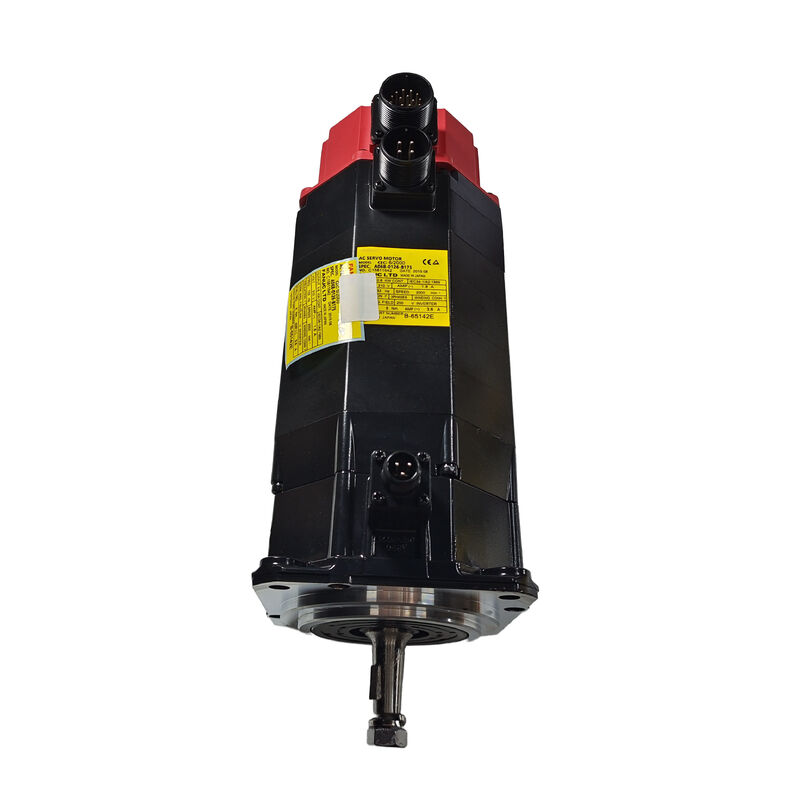
Fanuc A06B-0126-B175 AC Servo Motor -- Alpha C6/2000, Straight Shaft, Brake, IP67
Product Overview
Part Number: A06B-0126-B175
Also Searched As: A06B0126B175, FANUC A06B-0126-B175, Fanuc Alpha C6/2000 brake motor
Motor Model: αC 6/2000
Series: Fanuc Original Alpha C Series
Classification: Fanuc Alpha C Series AC Brushless Servo Motor -- 6 Nm Stall Torque, 0.6 kW, 2,000 rpm, Straight Shaft, Spring-Applied Brake, IP67 Sealed
Technical Specifications
| Parameter |
Value |
| Part Number |
A06B-0126-B175 |
| Motor Model |
αC 6/2000 |
| Rated Output |
0.6 kW |
| Stall Torque |
6 Nm |
| Stall Current |
3.5 A |
| Maximum Speed |
2,000 rpm |
| Motor Input Voltage |
210V (3-phase) |
| Frequency |
133 Hz |
| Shaft Type |
Straight |
| Electromagnetic Brake |
Spring-applied (B175) |
| Protection Rating |
IP67 |
| Insulation Class |
Class F |
| Compatible Amplifiers |
Fanuc original alpha series SVU amplifiers |
| Compatible Controls |
Fanuc Series 0, 15, 16, 18 (original alpha generation) |
| Origin |
Japan |
The αC 6/2000 -- A Specific Motor for a Specific Generation
Not every Fanuc alpha motor is interchangeable, and the αC series demonstrates why part number precision matters. The C designation within the original alpha family identifies a sub-series engineered for specific application requirements -- typically smaller format machine tools where 0.6 kW and 6 Nm of sustained stall torque at 2,000 rpm represent a correctly sized axis drive.
Six Newton-metres at 2,000 rpm suits the load profile of compact CNC lathes, small machining centres, and auxiliary axes on medium-format machines. On a 5mm pitch ball screw, 2,000 rpm delivers 10 m/min -- adequate rapid traverse for the machine class this motor serves.
The 0.6 kW rated output at 210V / 133Hz positions this motor clearly within the original alpha SVU amplifier platform. These are not αi series electrical characteristics. The A06B-0126-B175 requires an original Fanuc alpha SVU amplifier and is incompatible with αi or βi series drives.
IP67 -- More Than Marketing
The IP67 rating on the A06B-0126-B175 makes this motor suitable for machine tool installations where coolant exposure is routine. IP67 means the motor withstands temporary immersion to one metre depth -- providing resistance against direct coolant flood, high-pressure coolant jet impingement, and coolant accumulation in mounting pockets.
Red cap alpha series motors were produced in both standard and IP67-sealed configurations. The IP67 variant was specified when the motor would sit close to the cutting zone or in enclosures where coolant management is imperfect.
Spring-Applied Brake -- The B175 Suffix Explained in Practice
The B175 suffix identifies a motor with a spring-applied electromagnetic holding brake -- essential for any axis where this brake was part of the original design. Spring-applied brakes engage by default. The spring holds the shaft mechanically whenever the brake coil is de-energised -- including every planned shutdown, E-stop, amplifier fault, and power interruption.
For vertical axes, inclined feeds, and robot joints where braked motors are specified, this mechanical hold prevents the axis from moving under gravity when the servo is inactive. The A06B-0126-B075 -- the no-brake variant -- is identical in torque, speed, and electrical characteristics but lacks this mechanism.
Straight Shaft -- Coupling Compatibility
The straight shaft on the A06B-0126-B175 uses a split-hub friction clamp or equivalent coupling for torque transmission. At 6 Nm stall torque, the coupling must be correctly sized for peak torque demand including acceleration transients during rapid positioning moves.
When replacing the motor, transfer the hub from the failed motor using a proper gear puller. Inspect the hub bore and shaft OD for fretting or wear. Retighten the hub retention fastener to the coupling manufacturer's torque specification after reinstallation.
Amplifier and CNC Compatibility
The A06B-0126-B175 is designed for Fanuc original alpha series SVU amplifiers -- the SVM2 or SVU series modules current when this motor was produced. Compatible CNC platforms include Fanuc Series 0, 0C, 0D, 15, 16, and 18 on the original alpha generation, as well as equivalent vintage robot controllers.
This motor is not compatible with:
- Fanuc αiSV amplifiers (αi generation) -- different encoder interface protocol
- Fanuc βiSV amplifiers -- different encoder and motor type architecture
- Any amplifier requiring serial encoder feedback
A06B-0126 Series -- Configuration Reference
| Part Number |
Shaft |
Keyway |
Brake |
Encoder Type |
| A06B-0126-B075 |
Straight |
No |
None |
A64 / serial |
| A06B-0126-B077 |
Straight |
No |
None |
A64 serial |
| A06B-0126-B175 |
Straight |
No |
Yes (spring) |
Alpha series |
| A06B-0126-B577 |
Straight |
No |
None |
I64 incremental |
All variants share the αC 6/2000 body -- 6 Nm, 0.6 kW, 2,000 rpm, IP67. The brake is the defining difference between the B075/B077 and B175 variants.
Typical Applications
- Vertical axis drives on small CNC machining centres: Z-axis quill drives and vertical slide feeds on compact VMCs where spindle head assembly mass requires mechanical holding at servo-off
- CNC lathe axes with vertical or inclined components: Axes on gang-tool and slant-bed lathes where slide geometry has gravitational component and brake prevents axis drift
- Auxiliary and index axes on multi-axis machines: B-axis tilting, rotary table drives, and compound slide axes where αC 6/2000 torque class is correctly matched
- Like-for-like replacement on original alpha generation machines: Direct replacement for failed units on Fanuc Series 0, 15, or 16 controlled machines without drive system conversion
Frequently Asked Questions
Can the A06B-0126-B175 run on a Fanuc αiSV amplifier?
No. The A06B-0126-B175 uses the original alpha encoder interface specific to the original alpha SVU amplifier platform. Fanuc αiSV amplifiers expect the serial encoder protocol used by αiS and αiF motors, which is electrically and logically incompatible. This motor requires an original Fanuc alpha SVU amplifier.
Why is the brake essential on this motor -- can servo lock substitute?
Servo lock requires the amplifier to be active and powered to hold axis position. Any event that removes servo power immediately releases servo lock. The B175 spring-applied brake provides mechanical holding independent of amplifier power -- the spring engages when the brake coil is de-energised. For axes designed around the B175, there is no safe electrical substitute for this mechanical function.
What is the difference between the B075 and B175 variants?
The B075 is the no-brake configuration -- identical motor body with same 0.6 kW / 6 Nm / 2,000 rpm / IP67 specifications, but without the spring-applied holding brake. The B175 adds the brake mechanism, making the motor longer and slightly heavier. Specify B075 for horizontal axes with no gravitational load; specify B175 for vertical axes, inclined feeds, and applications requiring mechanical holding at servo-off.
How should the brake circuit be verified after fitting a replacement motor?
After wiring the replacement and before running the axis under CNC control: 1) With brake coil de-energised, confirm shaft is mechanically held and cannot be rotated by hand; 2) Apply 24V to brake coil and confirm shaft rotates freely; 3) Run machine through controlled E-stop sequence and verify axis holds position after servo de-energises. Any deviation indicates wiring issue or brake fault.
Is the A06B-0126-B175 repairable, and what typically fails?
Yes -- the αC 6/2000 motor body is fully serviceable by qualified Fanuc servo motor repair facilities. Common failure modes include bearing wear (leading to axis vibration and progressive noise), encoder degradation (producing intermittent position errors), and brake solenoid or disc wear (incomplete engagement or failure to release). Stator winding failures occur less frequently but are also repairable.



 Your message must be between 20-3,000 characters!