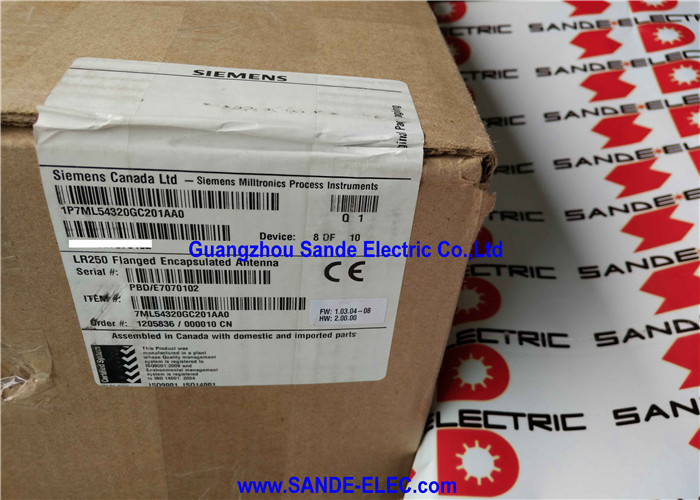
Siemens 7ML5432-0GC20-1AA0 | SITRANS LR250 25 GHz Pulse Radar Level Transmitter — Polypropylene Flanged Lens Antenna, DN100 PN10/16, 20m Range, 4–20mA / HART, Aluminum Enclosure
Overview
The Siemens 7ML5432-0GC20-1AA0 is the SITRANS LR250 configured with a DN100 PN10/16 polypropylene flanged lens antenna — a 25 GHz two-wire pulse radar level transmitter designed for continuous, non-contact measurement of liquids and slurries in industrial process and storage vessels.
In the LR250 product line, the polypropylene lens antenna variant is the specification of choice when the process medium is chemically aggressive enough to attack stainless steel but does not reach the temperature extremes that demand PTFE or TFM lens materials.
Polypropylene's broad chemical resistance to acids, alkalis, and many organic solvents — combined with its practical service limit around 80°C — makes this configuration the right tool for a wide band of chemical storage and process applications that fall outside the safe range of standard metallic-wetted instruments.
At 25 GHz, the SITRANS LR250 operates in the K-band, which provides a tighter beam angle and sharper signal focus than lower-frequency radar instruments.
The 10° beam angle of the polypropylene lens antenna constrains the emitted radar cone sufficiently to avoid internal vessel obstructions — agitators, ladders, heating coils, support columns — that would cause false echoes in wider-beam instruments, without requiring the narrow physical antenna apertures of millimetre-wave devices.
This practical beam geometry is one of the reasons the LR250 series sees such broad application in tanks that were not designed with radar measurement in mind.
The encapsulated horn design encloses the waveguide antenna completely within the polypropylene body.
This eliminates the antenna's exposure to process vapours and condensation that would attack an unenclosed metallic antenna in aggressive environments, and prevents process pressure from acting on the antenna structure — the flange face presented to the process is a flat polypropylene surface with no internal geometry visible to the medium.
The result is a mechanically robust interface that simplifies cleaning, resists chemical attack, and maintains accurate measurement even in applications with vapour condensation on the antenna face.
Key Specifications
| Parameter |
Value |
| Measurement |
25 GHz pulse radar, non-contact |
| Range |
Up to 20m (66 ft) |
| Antenna Type |
Polypropylene flanged lens (PLA) |
| Process Connection |
DN100 PN10/16 EN 1092-1 B1 raised face |
| Lens Material |
Polypropylene (PP) |
| Beam Angle |
10° |
| Max Process Temperature |
+80°C (176°F) |
| Communication |
4–20mA HART (<3.6mA start-up) |
| Enclosure |
Aluminum, 2 × M20×1.5 |
| Min. Blanking Distance |
50mm from antenna face |
| Approvals |
CE, UKCA, FM, CSA, FCC, RED, RCM |
| Country of Origin |
Canada |
Polypropylene vs PTFE Lens — Making the Right Material Choice
The LR250 polypropylene lens antenna and the PTFE/TFM lens variants serve overlapping but distinct application spaces. The polypropylene lens extends further into the vessel than the flush PTFE lens, which keeps its face level with the flange face.
This geometry gives the polypropylene variant its 50mm blanking distance measured from the antenna face — the zone closest to the antenna where reliable echo processing cannot be guaranteed.
In practice, the critical parameter for most storage tanks is the useful measurement range, and the 20m measurement depth of this configuration covers the full height of most bulk liquid storage vessels.
Where the two lens types diverge is temperature. PTFE and TFM lenses handle process temperatures to 170°C and are specified for steam, hot process fluids, and elevated-temperature chemical reactions. Polypropylene is limited to 80°C but brings cost and chemical resistance advantages in applications where temperature is not the constraint.
For acid storage, caustic tanks, wastewater collection basins, chemical holding vessels, and the majority of ambient-temperature process fluid applications, the polypropylene variant is the appropriate and cost-effective choice.
HART Communication and Process Integration
The 4–20mA HART output combines the simplicity of a conventional two-wire analog signal with the capability for digital communication over the same pair of wires.
The 4–20mA output drives the primary level indication directly — PLC analog input cards read level without any configuration — while the HART digital layer provides access to all transmitter parameters, diagnostic data, and secondary variables (echo strength, signal-to-noise ratio, temperature) to asset management software or a HART handheld communicator.
Configuration and parameterisation can be performed through the HART interface using Siemens' SIMATIC PDM or standard HART device management software, or locally using the transmitter's on-board display and pushbuttons.
The local interface is straightforward enough that a basic level installation — setting the empty and full distances, selecting the measurement units, and confirming the 4–20mA span — requires no external tool, which matters during initial commissioning in locations where laptop access is impractical.
The transmitter starts up at less than 3.6mA, below the 4mA zero-level output, ensuring that a cold-start condition at the beginning of a power-up sequence does not trigger a low-level alarm in the connected PLC or DCS before the transmitter has completed its initialisation and begun measuring.
Auto False Echo Suppression and Sonic Intelligence
One of the SITRANS LR250's most practically valuable features is its Auto False Echo Suppression (AFES) function, part of Siemens' Sonic Intelligence echo processing.
When a level transmitter is installed in a vessel that contains fixed internal structures — inlet piping, support brackets, heating coils, level gauge connections — these structures reflect radar pulses back to the antenna and can be misidentified as the liquid surface.
In conventional radar instruments, managing these false echoes requires careful antenna positioning and sometimes physical vessel modifications.
AFES works differently: during commissioning, the operator records the vessel's interference echo profile at a reference level.
The SITRANS LR250 maps these fixed echoes and filters them from subsequent measurements, treating them as background noise rather than valid level signals.
The recorded profile remains stable regardless of the actual liquid level changing within the vessel.
This means a vessel with multiple fixed obstructions — which would challenge a simpler radar instrument — can be commissioned without special siting requirements, and will measure reliably even when the liquid surface is close to one of the recorded obstruction positions.
FAQ
Q1: The DN100 PN10/16 flange is a European (EN 1092-1) standard. Can this transmitter be mounted on ASME B16.5 flanged nozzles?
No, not without an adapter. The DN100 PN10/16 EN 1092-1 Type B1 raised face flange bolts directly to European-standard counterpart flanges. ASME B16.5 4" Class 150 flanges have a different bolt circle diameter and number of bolt holes.
For ASME-flanged nozzles, the appropriate variant in the SITRANS LR250 polypropylene antenna range uses ASME B16.5 4" Class 150 flanged connections — a different ordering code within the 7ML5432 family.
Confirm the nozzle flange standard before specifying the transmitter.
Q2: What is the minimum dielectric constant (εr) required for reliable measurement with this transmitter?
The SITRANS LR250 requires a dielectric constant greater than 1.6 when measuring from above a liquid surface in an open vessel, or when installed in a stilling pipe (which concentrates the signal and improves performance on low-dielectric media).
For direct installation in a process vessel without a stilling pipe, a dielectric constant above 3 is recommended for reliable echo processing. Most water-based solutions, acids, alkalis, and organic solvents with high polarity have dielectric constants well above 3.
Light hydrocarbons and some solvents fall below this threshold and may require stilling pipe installation or an alternative measurement technology.
Q3: The blanking distance is 50mm from the antenna face. Does this limit the maximum level that can be measured?
Yes — the blanking zone (also called the near-zone dead band) represents the region immediately below the antenna where signal processing is not reliable. Any liquid surface within 50mm of the antenna face cannot be measured.
In most storage vessel applications, the transmitter is installed above the maximum high-level alarm point, so the liquid surface never approaches the blanking zone during normal operation.
However, in shallow tanks or vessels with very limited nozzle height, this parameter must be factored into the installation engineering to ensure the maximum measurement level falls outside the blanking zone.
Q4: The polypropylene lens has a temperature limit of 80°C. What happens if the process temperature occasionally exceeds this?
Polypropylene softens and loses mechanical integrity above approximately 80°C under the combination of process temperature and pressure.
Brief thermal excursions slightly above 80°C may be tolerated without damage depending on the pressure at that temperature, but sustained operation above the rated temperature risks deformation of the lens body, loss of the pressure seal at the flange, and degradation of measurement accuracy due to dimensional change in the antenna geometry.
For applications with process temperatures regularly above 80°C, the encapsulated horn variant with PTFE or TFM 1600 lens — rated to 170°C — is the appropriate specification.
Q5: Can the SITRANS LR250 measure the level of slurries containing solid particles, or only clear liquids?
Radar is unaffected by the optical clarity of the measured medium — it measures the dielectric interface at the liquid surface, not transmitted light or sound through the medium. For slurries, the relevant parameter is whether the surface presents a consistent dielectric interface for radar reflection.
Well-mixed slurries with a reasonably flat surface (not violently agitated) can generally be measured by the SITRANS LR250. Slurries with heavy foam formation on the surface may present a challenge, since foam layers can attenuate the radar signal or reflect from the foam surface rather than the true liquid level below it.
In foaming applications, the echo processing diagnostics — accessible via HART — help evaluate whether the measurement echo is stable and tracking the correct surface.


 Your message must be between 20-3,000 characters!