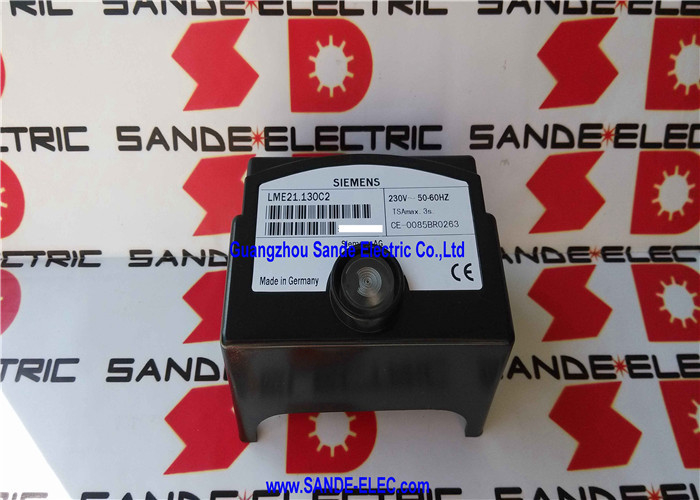
Siemens LME21.130C2 | 2-Stage Burner Control Unit — Ionization / QRA Flame Detection, t1=7s, TSA=3s, AC230V, Multicolour Fault Display, Air Pressure Supervision
Mains Voltage: AC230V
Pre-Purge Time (t1): 7 seconds
Safety Time (TSA): 3 seconds
Operation Mode: Intermittent (controlled restart after 24 hours of continuous operation)
Safety Features:
- Undervoltage detection
- Air pressure supervision with functional check of air pressure switch at startup and during operation
- Limitation of lockout repetitions
- Electrical remote reset facility
Overview
The Siemens LME21.130C2 is a microprocessor-based burner control unit — the electronic brain that governs the ignition sequence, monitors the flame throughout operation, and manages the safe shutdown of a 2-stage forced-draft gas or gas/oil burner. In combustion engineering, this class of device is called a flame safeguard or burner programmer: it follows a precisely timed sequence of operations from pre-purge through ignition and into stable operation, and it will lock out the burner — stopping all fuel supply and requiring a manual reset — whenever it detects a condition outside of safe operating parameters.
The LME21 series represents Siemens's microprocessor-based generation of burner controls, replacing the older electromechanical cam-timer designs.
Where a mechanical programmer relied on a rotating cam to open and close relay contacts in sequence, the LME21.130C2 performs the same sequence digitally, with the timing values fixed in firmware and verified internally by the microprocessor.
This digital approach eliminates the mechanical wear and timing drift that were inherent in cam-based controls, produces far more detailed diagnostic information through its multicolour LED display, and enables features — like continuous air pressure switch monitoring and lockout repetition counting — that would have required separate external components on older systems.
The 2-stage designation refers to the burner's output capacity control: rather than a single on/off burner (1-stage), a 2-stage burner has a low-fire stage and a high-fire stage.
The LME21.130C2 manages the transition between these stages — starting the burner in the first stage and enabling the second stage as demand requires — but without actuator control, meaning the stage changeover is on/off switching (relay contact closure to the second-stage gas valve or air damper switch) rather than proportional modulation.
This is appropriate for most commercial and small industrial burners where two heat output levels provide sufficient load-following capability.
Key Specifications
| Parameter |
Value |
| Burner Type |
1- or 2-stage gas / gas+oil |
| Actuator Control |
No |
| Flame Detection |
Ionization / QRA+AGQ3 |
| Mains Voltage |
AC230V |
| Pre-Purge Time (t1) |
7 seconds |
| Safety Time (TSA) |
3 seconds |
| Operation |
Intermittent |
| Undervoltage Detection |
Yes |
| Air Pressure Supervision |
Yes (with functional check) |
| Remote Reset |
Yes (electrical) |
| Diagnostics |
Multicolour LED display |
| Weight |
0.143 kg |
| Status |
Active product |
Startup Sequence — What Happens from Call-for-Heat to Stable Flame
The LME21.130C2 follows a defined sequence every time a heat demand signal arrives at its thermostat or controller input:
Pre-purge (t1 = 7 seconds): The burner fan runs at full speed for 7 seconds before any ignition or fuel admission.
This pre-purge clears the combustion chamber and flue of any residual unburned gas from a previous shutdown — eliminating the explosive hazard that would arise from igniting a fuel-air mixture that has accumulated during the off period. During pre-purge, the LME21.130C2 checks the air pressure switch to confirm adequate combustion air flow.
Ignition and fuel admission (safety time TSA = 3 seconds): After pre-purge, the ignition transformer activates and the first-stage fuel valve opens simultaneously.
The ionization probe or QRA detector monitors the combustion chamber for a flame signal. The safety time of 3 seconds is the window allowed for the flame to establish — if a valid flame signal is not detected within 3 seconds, the LME21.130C2 closes all fuel valves and locks out.
Flame supervision: With a stable flame established, the LME21.130C2 continuously monitors the flame detector signal. Loss of flame at any point during operation triggers immediate fuel valve closure and lockout. The 2-stage transition (energising the second-stage valve or damper switch) occurs on demand, with the controller confirming flame presence before and after stage change.
Shutdown and intermittent restart: After 24 hours of continuous operation — a safety requirement to prevent indefinite unattended operation — the LME21.130C2 forces a controlled shutdown and restarts the ignition sequence.
This controlled intermittent operation ensures that the pre-purge and ignition safety checks are repeated on a regular cycle rather than allowing the burner to run indefinitely without a supervised restart.
Flame Detection — Ionization and QRA Options
The LME21.130C2 supports two fundamentally different flame detection technologies, chosen to match the fuel type and flame characteristics:
Ionization probe: A metal rod inserted into the flame zone that conducts a small alternating current through the flame's ion cloud to ground.
Because only an active flame produces sufficient ionisation to pass this current, the presence of current flow confirms the flame.
Ionization probes are simple, inexpensive, and highly reliable — but they only work with gas flames, because oil flames produce a non-conductive soot zone around the probe tip.
For gas-only burners, ionization is the standard first choice.
QRA... series UV flame detectors with AGQ3...A27: Ultraviolet photocell sensors that detect the UV radiation produced by hydrocarbon combustion. Unlike ionization, UV detection works with both gas and oil flames, and it provides a faster response to flame loss.
The ancillary unit AGQ3...A27 interfaces the QRA detector's output to the LME21.130C2's flame signal input. Blue-flame detectors (QRC series) cover specific applications involving blue, near-invisible flames that do not emit significant UV — such as pure hydrogen or very lean gas combustion.
Air Pressure Supervision — More Than Just a Switch
A standard air pressure switch confirms that the combustion air fan has started and is delivering airflow above the minimum threshold.
The LME21.130C2's air pressure supervision goes further: it performs a functional check of the air pressure switch itself during each startup sequence, verifying that the switch opens and closes correctly rather than being stuck in one position.
A stuck-closed pressure switch that cannot detect fan failure would allow fuel admission without adequate combustion air — an extremely dangerous condition. The functional check catches this failure mode before each startup, not merely at the initial installation.
FAQ
Q1: What is the difference between t1 and TSA in the LME21.130C2 sequence?
t1 (7 seconds) is the pre-purge time — the duration the fan runs before any ignition attempt, clearing the combustion chamber of residual gas. TSA (3 seconds) is the safety time — the maximum time allowed after the fuel valve opens and the ignition transformer activates for a flame to be detected.
If no flame signal appears within the TSA, the control locks out.
The two timings serve different safety functions: t1 prevents pre-existing gas pockets from being ignited explosively, while TSA limits the total volume of unburned fuel that can enter the combustion chamber before a lockout stops the sequence.
Q2: The LME21.130C2 is described as "without actuator control." What does actuator control mean in this context?
Actuator control refers to modulating control of a servomotor-driven air damper or fuel valve — used in fully modulating burners that continuously vary fuel and air to match the exact heat demand rather than stepping between fixed stages.
The LME21.130C2 handles 2-stage operation (two discrete output levels) via relay contacts only, without the analogue or digital output signals that would drive a servo actuator.
Burners requiring proportional modulation need a different control unit — the LME22 or LME71 series, for example, which include actuator position control outputs.
Q3: The control specifies "intermittent operation after 24 hours of continuous operation." Is this mandatory, and what triggers it?
Yes, it is mandatory — it is a programmed function of the LME21's firmware that cannot be disabled. After the control has been in continuous operation (burner running) for 24 hours, it initiates a controlled shutdown and restarts the startup sequence from pre-purge.
This is a regulatory safety requirement in European gas appliance standards, ensuring that the ignition sequence and flame detector are tested at least daily even in applications where the burner runs continuously (like constant-temperature hot water systems).
The 24-hour timer resets each time a normal thermostat-commanded off/on cycle occurs during the day.
Q4: What does the multicolour LED diagnostic display indicate, and how is it read?
The LME21.130C2's multicolour LED displays the current phase of the control sequence and fault codes using different colours (green for normal operation phases, red or flashing red for lockout and fault conditions) and flash patterns.
Each colour-and-flash combination corresponds to a specific operational state or fault type documented in the LME21 data sheet: green continuous for operation, green flashing during specific sequence phases, red for lockout, and combinations indicating specific fault types (flame failure, air pressure fault, internal fault).
This on-device display allows a service engineer to diagnose the fault reason without requiring a separate diagnostic tool — the LED tells the story directly.
Q5: Can the LME21.130C2 directly replace an older LGB or LMG series control unit?
Siemens designed the LME21 housing to be physically identical to the older LGB and LMG series controls, specifically to allow drop-in replacement.
The mounting footprint, wiring terminal layout, and plug connector are compatible, so an LME21.130C2 can be installed in a burner that previously used an LGB or LMG control with minimal or no wiring modification.
The functional difference — digital processing replacing electromechanical timers, additional diagnostic features — comes with the same physical form.
However, the control sequence timing (t1, TSA) and approved detector types must be verified to match the specific burner manufacturer's requirements before substituting an LME21 for an LGB/LMG, as burner approvals are tied to specific control unit types.



 Your message must be between 20-3,000 characters!