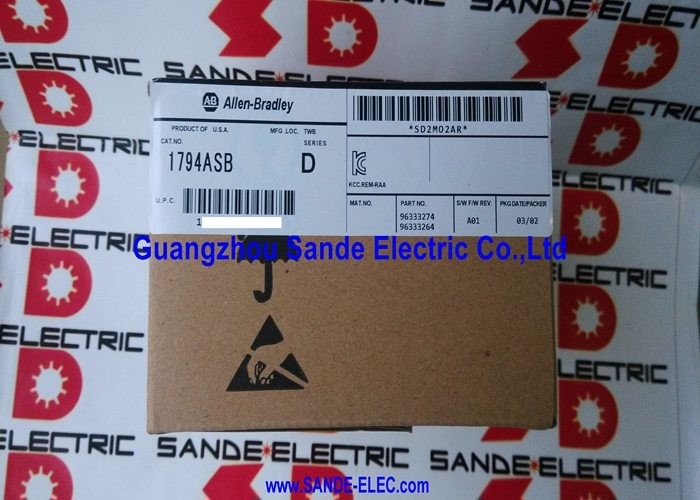
1794-ASB | FLEX I/O 1794 Remote I/O Adapter Module — 8 Modules / 5 Addressing Modes / 19.2–31.2VDC / 4.6W / FlexBus / 0.17kg
Adapter First — What the 1794-ASB Does
Every FLEX I/O assembly starts with an adapter module. It is the communication interface between the I/O modules on the FlexBus and the control system's network. Without an adapter, the I/O modules have no communication path to a PLC.
The 1794-ASB is the Remote I/O (RIO) variant. It connects a bank of up to eight FLEX I/O modules to a Remote I/O network — the serial I/O network used with PLC-5 and SLC-500 series controller systems. The adapter translates between the FlexBus (the local backplane connecting the FLEX I/O modules) and the RIO cable, carrying I/O data in both directions on each scanner update cycle.
For installations built around older PLC-5 or SLC-500 controllers with Remote I/O networks, the 1794-ASB is the adapter that allows FLEX I/O to participate in the same network alongside older 1771 fixed I/O racks or other RIO-connected devices.
Key Specifications
| Parameter |
Value |
| Network |
Remote I/O (RIO) |
| Module Capacity |
Up to 8 |
| Supply Voltage |
19.2–31.2V DC |
| Power Dissipation |
4.6W |
| Addressing |
Standard, Compact, Complementary, Standard-32, Complementary-32 |
| FlexBus Connector |
Included |
| Indicators |
Included |
| Weight |
0.17 kg |
Five Addressing Modes — Fitting Into Existing RIO Networks
Remote I/O networks were built around specific I/O addressing conventions that evolved over the life of the PLC-5 and SLC-500 platforms. The 1794-ASB supports all five addressing modes that these controllers recognised:
Standard: The classic RIO addressing format. Each rack address maps I/O data into 16-bit input and output image words.
Compact: A more compact image mapping that uses addressing space efficiently when I/O module counts are small.
Complementary: A variation that allows both input and output data to share a rack address in a complementary arrangement.
Standard-32 and Complementary-32: Extended addressing for 32-bit image formats used in higher-capacity PLC-5 configurations.
The adapter's addressing mode is set by DIP switches or rotary selectors on the 1794-ASB. When replacing an existing adapter in a running system, matching the address and mode setting to the original is essential — a mismatch causes the scanner to mismap I/O data, which can produce incorrect programme responses.
Application Scenarios
PLC-5 system with distributed I/O drops: A PLC-5 controller uses a Remote I/O network to reach I/O points at multiple machine stations. Each station has a 1794-ASB adapter terminating the RIO cable and up to eight FLEX I/O modules for local I/O connections. The PLC-5 scanner maps each station's I/O into its I/O image table.
SLC-500 with FLEX I/O expansion: An SLC-5/04 with the 1747-SN RIO scanner module extends I/O to a remote station via the 1794-ASB. Up to eight FLEX I/O analog and digital modules at the remote station bring the SLC's I/O reach beyond the local rack.
Maintenance replacement for existing RIO-networked stations: A 1794-ASB fails in a running distributed I/O station. A replacement 1794-ASB, configured to the same address and addressing mode as the original, restores the station's communication with the PLC scanner without network reconfiguration.
FAQ
Q1: What RIO network cables and devices does the 1794-ASB connect to?
The 1794-ASB connects to a Belden 9463 or equivalent shielded twin-axial cable used for Remote I/O (blue hose or equivalent) networks. It communicates with any Remote I/O scanner — PLC-5 processors with built-in RIO ports, SLC-5/02 and 5/03 with onboard RIO, SLC-5/04 and 5/05 via 1747-SN scanner, or standalone RIO scanner modules. The baud rate is set on the 1794-ASB to match the scanner's configured speed (57.6K, 115.2K, or 230.4K baud).
Q2: How is I/O addressing configured on the 1794-ASB?
Rack address and addressing mode are set via rotary dip switches or jumpers on the adapter body. The rack number (typically 1–7 in a standard PLC-5 network), the starting group (0, 2, 4, or 6 depending on module complement), and the addressing mode (Standard, Compact, Complementary, Standard-32, or Complementary-32) must all match the settings configured in the PLC scanner's I/O configuration. An incorrect setting results in communication failure or I/O data misalignment.
Q3: Can the 1794-ASB be replaced with a 1794-AENT EtherNet/IP adapter on the same FlexBus?
The FlexBus connector is physically compatible between FLEX I/O adapters, but a different adapter type changes the network interface entirely. Replacing the 1794-ASB (RIO) with a 1794-AENT (EtherNet/IP) requires the controlling PLC to support EtherNet/IP I/O scanning and requires a full I/O reconfiguration in the PLC programme. It is not a direct plug-in replacement — it is a network migration that requires engineering work.
Q4: How many FLEX I/O modules can the 1794-ASB support, and what types?
The 1794-ASB supports up to 8 FLEX I/O modules on its FlexBus. Compatible modules include 1794-series digital input, digital output, relay output, analogue input, analogue output, and combination analogue modules. Each module adds to the total I/O count; the eight-module limit is the hardware constraint. The available address space in the chosen addressing mode may limit the total number of modules before the eight-module physical limit is reached.
Q5: Is the 1794-ASB still in active production?
The 1794-ASB is a legacy product aligned with the RIO-based PLC-5 and SLC-500 controller ecosystem, which is itself in a late lifecycle stage. The adapter remains available through industrial spare parts channels for maintenance of installed systems. For new system designs, current FLEX I/O adapters with EtherNet/IP (1794-AENT) or ControlNet interfaces are the current platform direction.


 Your message must be between 20-3,000 characters!