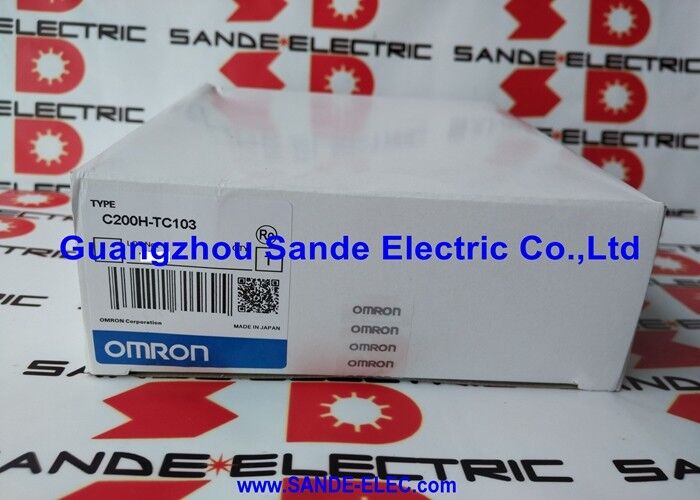
Omron C200H-TC103 | SYSMAC C200H Temperature Control Unit — 2 Loops, Pt100 RTD Input, Current Output, PID with Feed-Forward, Auto-Tuning
Overview
The Omron C200H-TC103 is a two-loop temperature control unit for the SYSMAC C200H programmable controller series — the module that handles precision closed-loop temperature regulation directly within the PLC rack, without requiring separate stand-alone temperature controllers.
In process and machine control applications where multiple temperature zones must be managed alongside the machine's standard I/O and sequencing logic, rack-mount temperature control units like the C200H-TC103 allow the engineer to integrate all control functions into a single C200H system rather than wiring external PID temperature controllers to the PLC's analog I/O cards.
The -TC103 designation places this module in the platinum resistance thermometer (Pt100) input family of C200H temperature modules — the series ending in -TC10X accepts Pt100 and JPt100 sensors, while the -TC00X series is designed for thermocouple inputs.
This distinction matters at the sensor selection stage: Pt100 RTD sensors offer better accuracy, better long-term stability, and more linear temperature-to-resistance characteristics than most thermocouples, making them the preferred choice for applications where absolute temperature accuracy and repeatability are priorities — pharmaceutical process equipment, food processing ovens, and laboratory temperature chambers, for example.
Two control loops in a single module means the C200H-TC103 manages two independent temperature measurement and control channels simultaneously.
Each loop reads its own Pt100 sensor, executes its own PID calculations, and drives its own current output to a heater, valve, or power controller.
For applications with two temperature zones — the two halves of an injection moulding barrel, the upper and lower platens of a press, the inlet and outlet zones of a conveyor oven — the two-loop architecture provides complete control without consuming two module slots.
Key Specifications
| Parameter |
Value |
| Control Loops |
2 (independent) |
| Sensor Input |
Pt100 / JPt100 RTD |
| Control Output |
Current output |
| Control Mode |
PID (with feed-forward) + ON/OFF |
| Auto-Tuning |
Yes |
| Current Consumption |
0.33A |
| PLC Interface |
21 instructions via C200H program |
| Weight |
~360g |
| Status |
Discontinued |
PID with Feed-Forward — What It Means for Temperature Stability
Standard PID temperature control corrects for temperature error reactively — the controller waits for a deviation between the measured process temperature and the setpoint, then calculates a correction based on that deviation (P), its accumulated history (I), and its rate of change (D).
Feed-forward control adds a proactive element: it anticipates a disturbance before the temperature sensor detects it, applying a correction signal in advance.
In a heating application, feed-forward commonly responds to changes in the heater's operating conditions — a sudden increase in the heat load when a cold workpiece enters the oven, or a reduction in ambient temperature that increases heat loss from the process.
By adding a feedforward correction when these conditions change, the temperature controller prevents the large temperature dip that pure PID control would experience while catching up to the disturbance.
The result is tighter temperature regulation with smaller deviations from setpoint, particularly during process transients.
For applications like injection moulding where material properties are highly temperature-sensitive — a 5°C deviation from the optimal barrel temperature can cause visible defects in the moulded part — this level of temperature stability directly translates to better product quality and lower scrap rates.
Auto-Tuning — Eliminating Manual PID Parameter Setting
Setting PID gains manually is a skill that requires understanding the process's thermal dynamics, running step-response tests, and iterating through gain adjustments while monitoring the temperature response. For many users without this background, manual PID tuning is a significant barrier to getting good temperature control performance.
The C200H-TC103's auto-tuning function automates this process.
When triggered, the auto-tuning routine performs a controlled test on the process — applying a step change or relay oscillation to the heater output and measuring the process temperature response.
From this response, the module calculates the proportional band, integral time, and derivative time values that will provide stable, responsive temperature control for this specific process and heater combination.
The calculated parameters are then automatically written into the module's control registers.
Auto-tuning should be run under representative process conditions — at the operating temperature and with the typical process load — to ensure the calculated parameters reflect the actual operating environment.
After initial auto-tuning, the parameters can be fine-tuned manually if needed, but for most applications, the auto-tuned values provide satisfactory control performance immediately.
PLC Program Integration — 21 Instructions for Full Data Access
The C200H-TC103 communicates with the C200H CPU through the rack's backplane, and the PLC program can interact with all of the module's operating data using 21 dedicated instructions. These instructions allow the program to:
Read the measured temperature (process value) from each loop for display, logging, or supervisory processing.
Write setpoint values to change the target temperature from the PLC program — enabling recipe-based temperature changes when the machine switches between products.
Read and write PID parameters for dynamic gain adjustment. Monitor loop status and alarm flags (high temperature alarm, low temperature alarm, sensor error).
Trigger auto-tuning from the PLC program rather than from the module's hardware interface.
This bidirectional data access through PLC instructions is the key advantage of the integrated rack-mount approach over standalone temperature controllers: the PLC program has full visibility and control over the temperature regulation, not just binary start/stop signals over relay contacts.
FAQ
Q1: Can the C200H-TC103 control both heating and cooling outputs, or only heating?
The standard C200H-TC103 with current output is designed for single-directional control — driving a heating output.
For heating/cooling control where both a heater and a cooling valve or chiller need to be modulated, Omron provided separate heat/cool temperature control modules in the C200H range (the C200H-TV series).
If an application requires both heating and cooling loops, the TV variant should be specified rather than the TC103.
Q2: What is the difference between Pt100 and JPt100 inputs, and which should be selected?
Pt100 and JPt100 (Japanese Pt100) are both platinum resistance thermometers with 100 ohms resistance at 0°C, but they use different linearisation curves — different resistance-vs-temperature relationships defined by different international standards (IEC 60751 for Pt100, JIS C 1604 for JPt100).
In practice, the resistance values differ by approximately 0.05% at most temperatures, which is within the measurement uncertainty of most field installations.
The choice depends on the sensor being connected — the sensor's manufacturer specification will state whether it conforms to Pt100 (IEC) or JPt100 (JIS) characteristics, and the C200H-TC103 must be configured for the matching standard via its DIP switch settings.
Q3: How many C200H-TC103 modules can be installed in one C200H rack?
The C200H rack can accommodate multiple TC103 modules alongside other I/O and special function modules, subject to the rack's total slot count (up to 10 slots for standard C200H backplanes) and the CPU's I/O allocation capacity.
Each TC103 occupies one slot and consumes 0.33A from the 5V backplane bus. The total current consumption of all modules installed in the rack must not exceed the power supply unit's rated 5V output — typically 2A to 5A depending on the PSU variant.
For a machine with many temperature zones, multiple TC103 modules can be used in one or more racks.
Q4: The C200H-TC103 is discontinued. What is the Omron recommended replacement for new designs?
For new system designs requiring temperature control within an Omron PLC rack, Omron recommends the CJ1W-TC series (for CJ1 and CJ2 series PLCs) or the CS1W-TC series (for CS1 PLCs) as the current-generation equivalents.
Both series provide equivalent or enhanced temperature control functionality — two or four control loops per module, RTD or thermocouple inputs, current or voltage outputs, and improved diagnostics.
For applications where the C200H platform is being maintained for the long term, the C200H-TC103 remains available through the industrial surplus market.
Q5: Can the C200H-TC103 detect a broken sensor (open-circuit RTD) and trigger an alarm?
Yes. The C200H-TC103 monitors each loop's sensor input and detects open-circuit conditions (disconnected or broken Pt100 sensor wire).
When a sensor error is detected, the corresponding sensor error flag is set in the module's data area, accessible by the PLC program via the 21-instruction interface.
The PLC program can monitor this flag and generate an operator alarm, stop the heating output, or switch to a safe fallback operating mode.
The sensor error detection is an important safety feature in temperature control applications where continued heating without valid temperature feedback could overheat the process or damage equipment.



 Your message must be between 20-3,000 characters!