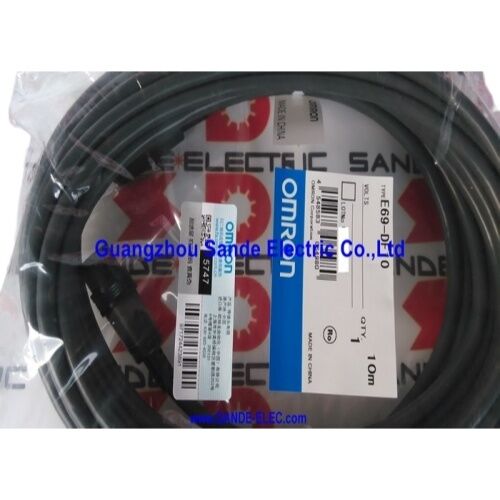
OMRON E69-DF10 Encoder Extension Cable
E69 Series | 10m Length | For E6C2-A / E6C3-A / E6CP / E6F Encoders | 12 VDC
Bridging the Gap Between Encoder and Controller
Machine layouts don't always cooperate. When an OMRON encoder is mounted on a shaft, spindle, or roller that sits further from the controller cabinet than the encoder's standard pre-wired cable can reach, the E69-DF10 extension cable is the engineered answer. It extends the signal path by 10 meters while maintaining signal integrity — no splicing, no improvised cable extensions, no guesswork about connector compatibility.
The E69-DF10 belongs to OMRON's E69 accessory series, designed specifically to work alongside the E6C2-A, E6C3-A, E6CP, and E6F absolute rotary encoder families. Both ends are terminated with matched connectors that mate directly with the encoder's output connector on one side and the next cable segment or controller input on the other, giving you a clean plug-and-play extension that fits within OMRON's documented system architecture.
Specifications at a Glance
| Parameter |
Value |
| Manufacturer |
OMRON |
| Part Number |
E69-DF10 |
| Series |
E69 |
| Cable Length |
10 m |
| Supply Voltage |
12 VDC |
| Compatible Encoders |
E6C2-A, E6C3-A, E6CP, E6F series |
| Package Weight |
Approx. 530.5 g |
| RoHS Compliant |
Yes |
| Application |
Encoder signal extension / encoder feedback cable |
The E69-DF Series — Know Your Length Options
The E69-DF range covers three standard lengths for different installation scenarios. The E69-DF5 (5m) suits moderate distances in compact machine cells. The E69-DF10 (this product) handles the majority of standard CNC machine and automation line configurations where the encoder and control cabinet are separated by a machine frame, a cable duct run, or a safety enclosure. The E69-DF20 and E69-DF30 are available for longer runs in large production lines or multi-bay systems.
Choosing the correct length before installation avoids the temptation to coil excess cable into a tight bundle near electrical noise sources — a practice that can introduce interference into the encoder signal through inductive coupling. Use the length that fits the actual cable path.
Compatible Encoder Families — What Gets Connected
The E69-DF10 is tested and documented for use with four OMRON rotary encoder series:
E6C2-A series — Absolute rotary encoders in the 50mm housing diameter class, available in 8mm shaft variants. Widely used in position tracking, cam controllers, and angle monitoring applications on machine tools and packaging lines.
E6C3-A series — Rugged absolute encoders with a 50mm diameter housing and 8mm solid shaft, IP65-rated with sealed bearings. Common in applications close to cutting fluid or washdown environments where the encoder body sees hostile conditions.
E6CP series — General-purpose absolute encoders with a 50mm housing, including variants specifically designed for use with OMRON's H8PS cam positioner. These encoders output Gray code and require a cable that correctly passes the multi-bit parallel output signals — which the E69-DF10 does.
E6F series — Rugged absolute encoders with a 50mm housing and 10mm solid shaft, used in applications requiring higher radial and axial shaft load capacity. Available in both incremental and absolute output variants.
Why Not Just Splice the Existing Cable?
The question comes up regularly during maintenance — particularly when the standard encoder cable has taken physical damage somewhere along its run. The answer is about signal quality and long-term reliability.
OMRON's E6C3-A, E6CP, and E6F absolute encoders output positional data in Gray code across multiple signal conductors simultaneously. Any splice point introduces resistance asymmetry between conductors, adds capacitance, and creates a potential ingress point for moisture. On a high-cycle machine where the encoder transitions millions of times per shift, even a marginal increase in signal rise/fall time at a poorly made splice can eventually cause Gray code reading errors — which in an absolute encoder means the controller silently reads a wrong position without generating an immediate alarm.
The E69-DF10 preserves the matched impedance and shielding continuity of the original cable run. It's the difference between a repair that works today and one that works reliably for the next several years.
Installation Considerations
A few things worth checking before running the cable:
Keep it away from power conductors. Route the E69-DF10 in a separate duct from motor power cables, inverter output lines, and solenoid wiring. If the runs must cross, cross them at 90° rather than running parallel.
Use cable ties at regular intervals. A 10m cable that isn't supported will eventually fatigue at the connector bodies from its own weight and machine vibration. Support every 0.5–1m in moving cable tracks, more often if the installation sees continuous flex cycles.
Don't exceed rated bend radius. Tight bends compress the shielding and can crack conductor insulation over time, particularly in low-temperature environments. Leave generous bend radius at both connector ends.
Check the connector latch on both ends. The encoder-side connector engages with a mechanical latch. A connector that isn't fully seated will produce intermittent dropout faults that are very difficult to trace without a cable tester.
Frequently Asked Questions
Q1: Can the E69-DF10 be used with OMRON incremental encoders like the E6B2 or E6C2-C series?
The E69-DF10 is specifically documented for the E6C2-A, E6C3-A, E6CP, and E6F absolute encoder series. The incremental encoder families (E6B2-C, E6C2-C, E6C3-C) use different connector types and cable configurations and are not compatible with the E69-DF series. Check OMRON's E69 accessory compatibility table for the correct extension cable model when working with incremental encoder variants.
Q2: Is it possible to daisy-chain two E69-DF10 cables to achieve a 20m run?
OMRON does not officially recommend daisy-chaining extension cables, as each connector junction introduces additional resistance and capacitance into the signal path. For a 20m run, use the purpose-built E69-DF20 instead. If a 20m option is unavailable, consult OMRON's documentation for the maximum permissible cable length for the specific encoder model being extended, and consider signal integrity carefully before proceeding.
Q3: Does the E69-DF10 affect the encoder's resolution or accuracy?
No. The extension cable is a passive interconnect — it carries the encoder's output signals without modification. Resolution, accuracy, and output code (Gray code) remain exactly as specified for the encoder itself. However, if the cable run passes through a high-interference environment and is improperly routed alongside power conductors, noise pickup could cause signal errors. Correct cable routing and shielding integrity are the practical factors that determine whether the encoder's rated performance is maintained at the controller end.
Q4: What is the voltage rating of the E69-DF10, and will it work with encoders powered at 24 VDC?
The E69-DF10 is rated at 12 VDC, matching the supply voltage of the compatible E6CP and E6F encoder families. Before using this cable with any encoder powered at a different voltage, verify both the encoder's and the cable's rated voltage against your specific installation. OMRON encoders in this family typically operate at 12–24 VDC supply ranges depending on the specific variant — confirm the cable rating matches your encoder's supply.
Q5: What is the difference between E69-DF10 and similar OMRON cable accessories in the E69 series?
The E69-DF series (DF2, DF5, DF10, DF20, DF30) are all extension cables for the absolute encoder families (E6C2-A, E6C3-A, E6CP, E6F), differing only in length. Other E69 accessories serve different functions: couplings (E69-C series) connect the encoder shaft to a machine shaft; flanges (E69-F series) provide adapter mounting faces; servo mounting brackets (E69-M series) adapt encoders to servo motor end faces. The DF suffix specifically identifies the extension cable function within the E69 accessory catalog.



 Your message must be between 20-3,000 characters!