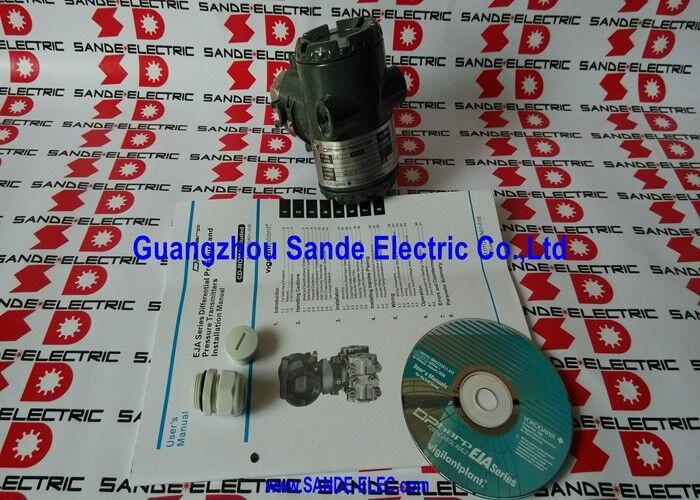
The Yokogawa EJA530A-EAS4N-00DNFU1 is an in-line mount gauge pressure transmitter from Yokogawa's EJA-A series, fitted with the E-range measurement capsule covering 0.5 to 10 MPa (72.5 to 1,450 psi).
It applies Yokogawa's DPharp silicon resonant sensor technology to deliver a 4–20mA DC output with superimposed BRAIN or HART digital communication, and carries the reference accuracy of ±0.065% of calibrated span that the EJA-A series is known for in demanding process measurement environments.
The "NSPP" designation confirms the New Surplus / Project-Pull supply condition — an instrument shipped from its original project procurement, unused and uninstalled, typically carrying full configuration capability and original factory settings.
This supply condition is common in the process industries where project overruns, plant scope changes, or instrument substitutions leave surplus stock of fully specified instruments in original packaging.
At the heart of the EJA530A is the DPharp resonant sensor — a monocrystal silicon element that responds to applied pressure by changing the resonant frequency of its vibrating structure. Because frequency is the primary output of the sensing element, and frequency can be counted digitally without analogue-to-digital conversion artefacts, DPharp transmitters avoid the conversion errors and drift that analogue sensing elements introduce.
The sensor directly generates a digital signal that the transmitter processes and converts to the 4–20mA loop output and the digital communication channel simultaneously.
| Parameter | Value |
|---|---|
| Measurement Capsule | E — 0.5 to 10 MPa (72.5 to 1,450 psi) |
| Calibrated Span Range | 0.5 MPa min to 10 MPa max |
| Maximum Working Pressure | 25 MPa (3,625 psi) |
| Output Signal | 4–20mA DC + BRAIN / HART digital |
| Reference Accuracy | ±0.065% of calibrated span |
| Long-Term Stability | ±0.1% URL/year |
| Power Supply | 10.5–42V DC |
| Response Time | 90 ms (standard) |
| Process Connection | 1/2 NPT female |
| Amplifier Housing | Cast aluminium alloy |
| Electrical Connection | 1/2 NPT, two conduit entries |
| Indicator | Digital LCD, push-button range setting |
| Wetted Parts | SUS316 SST / SUS316L SST |
| Ambient Temperature | −40°C to +85°C |
| Process Temperature | Up to +120°C |
| Housing Protection | IP67 (NEMA 4X equivalent) |
| Communication | BRAIN (BT200) / HART |
Yokogawa introduced the DPharp sensor in the early 1990s as a fundamentally different approach to pressure measurement.
Conventional pressure transmitters use a capacitive or piezo-resistive sensing element that produces an analogue voltage or current proportional to applied pressure — a signal that requires analogue-to-digital conversion before the transmitter's electronics can process it.
Every stage of that conversion chain introduces small errors: offset drift, gain drift, noise pickup, and non-linearity that the transmitter's signal conditioning must compensate for over temperature and time.
DPharp eliminates most of this chain. The monocrystal silicon sensor's resonant frequency changes in direct proportion to applied pressure, and frequency is counted digitally from the oscillator output without any analogue intermediate step.
The resulting measurement is inherently more linear, more stable, and less sensitive to temperature variations than competing analogue approaches.
The absence of hysteresis in the monocrystal silicon material is a further practical advantage: the sensor returns to exactly the same output at the same applied pressure regardless of whether pressure is rising or falling, which is not always guaranteed with deformable analogue sensing elements.
In the EJA530A, this DPharp core provides the ±0.065% reference accuracy and the ±0.1% URL per year stability that make it appropriate for process lines where accurate pressure measurement directly affects quality, safety, or energy consumption.
The E-range measurement capsule covers the 0.5 to 10 MPa gauge pressure range — a span that sits above the mid-range B and C capsules (2–200 kPa and 0.1–2 MPa respectively) and serves the medium-to-high pressure process applications most common in oil and gas pipelines, refinery process lines, steam generation and distribution, high-pressure chemical reactors, and hydraulic system monitoring.
Within the E capsule's 0.5–10 MPa range, the user configures the calibrated span at commissioning via the BRAIN terminal or HART handheld communicator.
The transmitter can be spanned anywhere from the minimum calibrated span of 0.5 MPa up to the maximum of 10 MPa — a turndown ratio that provides flexibility across a wide range of actual process operating pressures within the same instrument.
The maximum working pressure (MWP) of 25 MPa provides substantial overpressure tolerance above the measurement range, protecting the capsule and process connection against pressure spikes without sensor damage.
The process connection material — SUS316L stainless steel for the connector body and wetted internals — is appropriate for the majority of non-corrosive to mildly corrosive services encountered in general process plant applications.
For services requiring higher corrosion resistance, Hastelloy C-276 wetted parts are available in other variants of the EJA530A series.
The EJA530A-EAS4N-00DNFU1 outputs the standard 4–20mA DC analogue signal that represents the measured gauge pressure across the calibrated span. Simultaneously, digital communication data is superimposed on the same two-wire loop using either Yokogawa's BRAIN protocol (compatible with the BT200 BRAIN terminal) or the HART protocol (compatible with HART handhelds and any HART-capable host system).
BRAIN protocol was Yokogawa's proprietary digital fieldbus implementation developed in parallel with the HART standard, and it is supported throughout Yokogawa's instrument management infrastructure including the FieldMate configurator software.
HART compatibility ensures interoperability with third-party asset management systems, control system HART multiplexers, and portable HART communicators that site instrument engineers are most likely to carry.
Through either digital channel, operators can remotely configure the transmitter's zero and span, set engineering units and damping, read the process temperature from the capsule's built-in temperature measurement, retrieve diagnostic data, and perform calibration without removing the instrument from service.
The digital channel also carries self-diagnostic status information that the host system or asset management software can log for predictive maintenance purposes.
The cast aluminium amplifier housing provides the IP67 (NEMA 4X equivalent) environmental protection that field-mounted instruments in process plant environments require.
The housing's two-conduit 1/2 NPT electrical entries allow separated wiring routing for power/signal and conduit continuity as required by local installation codes, with one entry optionally sealed when a single conduit connection is sufficient.
The digital LCD indicator — with push-button range setting capability directly on the instrument — allows local zero and span adjustment and range configuration without connecting a BRAIN terminal or HART communicator. The display shows the measured pressure value in configurable engineering units, the percentage of range, and alarm status codes.
This on-instrument configuration capability reduces commissioning time and simplifies field calibration checks when portable communicators are not available.
The transmitter's housing cover is rotatable in 90° increments, allowing the indicator and terminal block to face the preferred direction after the instrument is mounted on the process connection — a practical installation benefit when mounting orientation is constrained by the adjacent pipework, structure, or access requirements.
The EJA530A's 0.5–10 MPa gauge pressure measurement range and SUS316L wetted parts make it applicable across a broad range of industrial process measurement points.
In oil and gas production and transmission, it serves wellhead pressure monitoring, pipeline pressure control, separator pressure measurement, and utility system monitoring.
In refining and petrochemical processes, it handles process line pressure measurement in streams compatible with 316L stainless steel wetted parts. Steam generation and distribution systems use the EJA530A for steam header pressure monitoring and boiler feedwater pressure measurement within the capsule's temperature and pressure limits. High-pressure hydraulic and pneumatic utility systems, water injection systems, and compressed gas distribution round out the common application base.
The 90ms response time makes the EJA530A appropriate for the pressure control loop applications where loop response speed matters — fast enough for pressure control in most process applications, without the overshoot risk that ultra-fast response can introduce in high-gain control loops.
Q1: What does the "E" capsule code mean, and what is the exact pressure range?
The E measurement span capsule on the EJA530A covers a calibrated span range of 0.5 MPa minimum to 10 MPa maximum (72.5 to 1,450 psi). The maximum working pressure (MWP) — the maximum static pressure the capsule can withstand without damage — is 25 MPa.
The instrument is calibrated at the factory or in the field to any specific span within the 0.5–10 MPa range.
Below the 0.5 MPa capsule, the D capsule (0.1–2 MPa) covers lower gauge pressure applications; above the E capsule, no standard higher-range capsule exists in the EJA530A — applications above 10 MPa require the higher-range EJA530A variants.
Q2: What is the difference between BRAIN and HART communication on the EJA530A?
Both protocols are superimposed digital signals on the same 4–20mA two-wire loop and carry the same configuration and diagnostic data. BRAIN is Yokogawa's proprietary protocol, compatible with Yokogawa's BT200 BRAIN terminal and FieldMate software — widely used in facilities with Yokogawa DCS or existing Yokogawa calibration infrastructure. HART is the open industry standard, compatible with any HART-compliant handheld communicator or host system regardless of manufacturer.
The choice between them depends on the existing site tooling. Both allow remote zero/span adjustment, engineering unit configuration, damping settings, diagnostic readout, and parameter logging without interrupting the analogue loop output.
Q3: Can the EJA530A-EAS4N-00DNFU1 be reconfigured for different calibrated spans in the field?
Yes. The calibrated zero and span can be set to any values within the E capsule's 0.5–10 MPa range using the BRAIN terminal BT200, a HART handheld communicator, or Yokogawa's FieldMate configuration software.
Engineering units, damping time constant, output direction (direct or reverse acting), digital indicator display format, and low-cut mode are all configurable parameters.
Local zero and span adjustment via the push-button on the digital indicator is also available for basic ranging tasks without a communicator. This field reconfiguration capability means a single instrument can cover multiple measurement points during its service life without returning to the factory.
Q4: What is DPharp and why does Yokogawa use it instead of a conventional capacitive sensing element?
DPharp is Yokogawa's proprietary pressure sensing technology based on a monocrystal silicon resonant sensor. Applied pressure changes the resonant frequency of the silicon vibrating element, and that frequency is counted digitally directly from the oscillator — no analogue-to-digital conversion step is needed.
This avoids the conversion errors, temperature drift, and hysteresis that capacitive sensing elements introduce through their analogue signal chain.
The result is better linearity, less temperature effect, and no hysteresis — the sensor returns to the same output at the same pressure regardless of the direction of pressure change. The ±0.065% reference accuracy and ±0.1% URL/year stability of the EJA530A are direct consequences of the DPharp sensor's characteristics.
Q5: What maintenance interval does the EJA530A require, and what does the long-term stability specification mean in practice?
The ±0.1% URL per year stability specification means the transmitter's calibration drift stays within that band under normal operating conditions for each year of service, without recalibration.
Many plants use this specification to extend calibration intervals beyond the traditional annual cycle — in applications where the process conditions are stable and the measurement is not safety-critical, calibration intervals of two to four years are supportable with this stability level, reducing the total cost of ownership.
The transmitter's self-diagnostic capability continuously monitors sensor and amplifier health and flags hardware faults through the digital communication channel and the indicator alarm display, so degradation that would affect measurement quality is detectable between scheduled calibration checks.
Contact Us at Any Time