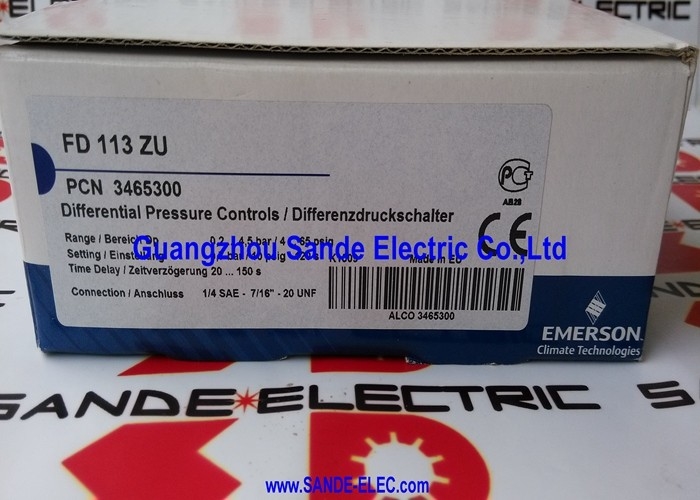
FD113ZU | ALCO Controls Oil Differential Pressure Safety Control — 4–65 PSI / 0.3–4.5 Bar / 20–150s Electronic Delay / 3A / 7/16"-20 UNF
What the FD113ZU Actually Measures — Net Effective Oil Pressure
A refrigeration compressor's lubrication system builds pressure through the oil pump. The pump draws oil from the crankcase (which is at suction pressure) and delivers it to the bearings at a higher pressure. The relevant measurement is not the absolute oil pump outlet pressure — it is the net effective oil pressure: the difference between oil pump outlet pressure and crankcase pressure.
This distinction matters because if suction pressure rises, crankcase pressure rises, and the net oil pressure available for lubrication falls even if the oil pump outlet pressure looks acceptable by itself. The FD113ZU measures across two pressure connections — the high-pressure (oil pump outlet) side and the low-pressure (crankcase) side — and its set point is calibrated to the differential, not to either absolute pressure alone.
Key Specifications
| Parameter |
Value |
| Pressure Range |
4–65 PSI / 0.3–4.5 bar |
| Time Delay |
20–150 sec (stepless) |
| Timer Type |
Electronic (ZU) |
| Max. Differential (PS) |
12 bar |
| Test Pressure (PT) |
25 bar |
| Electrical (AC inductive) |
3A @ 230VAC |
| Electrical (DC inductive) |
0.1A @ 230VDC |
| Thread |
7/16"-20 UNF |
| Connections |
1/4" × 1/4" flare |
| Indicators |
Oil pressure + Fault |
| Reset |
Manual |
Electronic Timer — What "ZU" Adds Over Standard FD113
The FD113 series exists in two timer variants. The standard FD113 uses a thermal timing mechanism. The FD113ZU (this unit) uses an electronic timer circuit.
The difference is accuracy and consistency. Thermal timers drift with ambient temperature — a delay set for 90 seconds in a warm engine room can behave differently in a cold start on a winter morning. Electronic timers maintain consistent delay regardless of ambient temperature. The ZU's 20–150 second range is set steplessly by an adjustment on the control body, and the delay holds its calibrated value across the operating temperature range.
For compressor protection where the delay must be accurate and consistent — starting from cold, running at high ambient temperatures, or after an emergency shutdown — the electronic timer provides more reliable trip-point behaviour than a thermal equivalent.
Application Scenarios
Hermetic refrigeration compressor protection: A refrigeration system's Copeland compressor has an oil pump. The FD113ZU monitors the net effective oil pressure across the oil pump. A bearing wear event causes oil pump output to drop. The 90-second delay timer expires, the FD113ZU trips, the compressor contactor opens, and the "Fault" indicator lamp activates. Manual reset after investigation prevents restart until the fault is resolved.
Air conditioning system compressor: A screw compressor in a commercial air conditioning system uses the FD113ZU for oil pressure monitoring. On cold morning start, oil pressure builds within 30 seconds — inside the set delay window — and the control does not trip. On an afternoon start after a refrigerant loss event causes unusual crankcase pressure, the net oil pressure differential is outside specification for longer than the delay, triggering protection.
Legacy compressor maintenance: An FD113ZU has been in continuous service on an existing compressor installation. After years of operation, the control's accuracy is questioned. A replacement FD113ZU at the same delay setting restores the calibrated protection without changes to the compressor or control panel wiring.
FAQ
Q1: How is the pressure set point adjusted on the FD113ZU?
The pressure differential set point is adjusted via a calibration disc on the FD113ZU body. The disc is marked with the pressure values and rotated to the desired cut-out differential. A piece of tape is recommended over the adjustment disc after commissioning to prevent unintentional tampering during operation. The set point represents the net effective oil pressure differential below which the control starts its timer.
Q2: What does the manual reset requirement mean for operations?
After the FD113ZU trips on a low oil pressure condition, it holds the fault state (open compressor circuit) until manually reset by pressing the reset button on the control body. Automatic reset is not available — this is intentional, to prevent a compressor from automatically restarting into a condition that may still present a lubrication risk. Before pressing reset, the reason for the trip (insufficient oil pressure) should be investigated and resolved.
Q3: What is the compatible compressor list for the FD113ZU's 1/4" × 1/4" flare connections?
The Copeland version with 1/4" × 1/4" flare fittings fits Copeland hermetic and semi-hermetic compressor oil pressure port configurations. For other compressor brands and manufacturers, the FD113ZU may be available in alternate connection configurations. The instruction sheet for the FD113 series identifies the correct variant by compressor brand — confirm the connection size and port type before ordering a replacement.
Q4: What happens if the FD113ZU is wired with the high-pressure and low-pressure connections reversed?
The FD113ZU will read the inverted differential — net effective pressure will appear negative relative to the intended measurement, and the control will trip immediately or behave unpredictably. Always connect the oil pump outlet (high) to the HP connection and the crankcase (low) to the LP connection as marked on the control body. Verify connections against the compressor manufacturer's oil pressure port labelling before first start.
Q5: Can the FD113ZU be bench tested before installation?
Yes. Testing simulates a low oil pressure condition by pressing the test lever downward for longer than the set delay time (20–150 seconds as set). If the unit is functional, it will trip within the delay time. After testing, press the reset button to restore the control to its run state. The test procedure is described in the FD113 instruction sheet and should be performed at regular maintenance intervals to confirm the control remains operational.


 Your message must be between 20-3,000 characters!