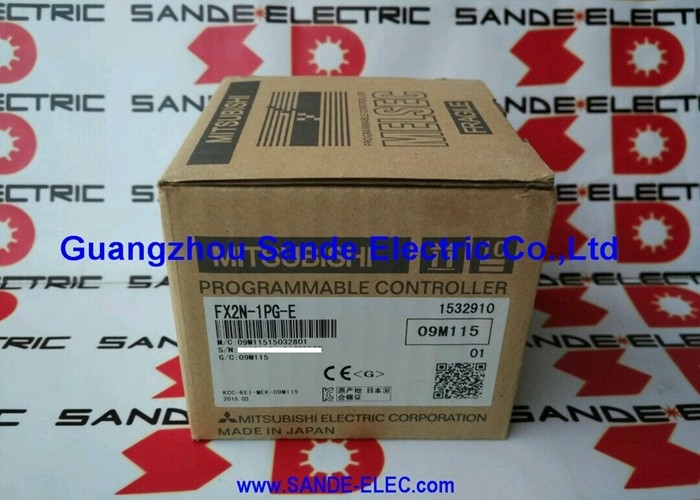
Mitsubishi FX2N-1PG-E | Pulse Generator Unit — 1-Axis Positioning, 100kHz Max, 7 Operation Modes, Absolute & Relative Positioning, FX2N / FX3U / FX2NC / FX3UC Compatible
Overview
The Mitsubishi FX2N-1PG-E is the pulse generator unit that gives FX-series PLCs the ability to control servo and stepper motor drives through a dedicated pulse output hardware interface — independent of the PLC's own built-in pulse output capability.
Where the FX2N's built-in Y0 and Y1 transistor outputs can generate pulse trains for one or two axes, the FX2N-1PG-E adds a dedicated positioning processor for one additional axis, with its own position counter, velocity ramp generator, and operating mode logic running independently of the PLC's scan cycle.
Multiple FX2N-1PG-E units extend this to as many as eight fully independent controlled axes from a single FX2N or FX3U PLC.
The design philosophy behind the FX2N-1PG-E reflects how Mitsubishi approached compact PLC motion control in the FX2N era: rather than putting motion programming inside the PLC's instruction set (the approach taken by dedicated motion controllers), the FX2N-1PG-E handles its own position control logic internally and communicates with the PLC through buffer memory (BFM) accessed via FROM/TO instructions in the PLC's ladder program.
The PLC writes target position, target speed, and mode selection into the module's BFM; the module executes the positioning move autonomously while the PLC continues its scan cycle; and the PLC reads back actual position, status words, and completion flags from the BFM when it needs to respond to the move's completion.
This BFM-based architecture means the positioning move runs at hardware speed — the module generates pulse trains at up to 100kHz without any dependency on the PLC's scan time.
A PLC scanning every 10ms manages its own logic at scan speed while the FX2N-1PG-E simultaneously drives a motor axis at 100,000 pulses per second without any timing degradation from the PLC's program execution.
Key Specifications
| Parameter |
Value |
| Axes per Unit |
1 |
| Max. Pulse Output |
100 kHz |
| Speed Range |
10 Hz – 100 kHz |
| Position Range |
0 to ±999,999 |
| Operation Modes |
7 |
| Positioning |
Absolute and relative |
| Pulse Format |
FP/RP or PULSE/SIGN |
| Output |
Open collector, 5–24V DC, 20mA max |
| Occupied I/O Points |
8 |
| Supply (from PLC) |
5V DC, 150 mA |
| Weight |
~0.2 kg |
| Max. Units (FX2N/FX3U) |
8 |
| Max. Units (FX2NC) |
4 |
Seven Operation Modes — What Each Does
The FX2N-1PG-E's seven operation modes cover the complete range of single-axis positioning tasks that arise in practical machine design:
1. Machine Home Position Return: The module drives the axis to a mechanical home position defined by a near-point (DOG) sensor and a zero-mark (ZRN) signal input.
The homing sequence — high-speed approach, deceleration at the DOG input, creep speed to the zero mark — establishes the position reference from which all subsequent absolute positioning moves are measured.
2. Single-Speed Positioning: The module moves to a target position at a fixed speed, decelerating automatically as the target approaches. This is the simplest and most common positioning mode for point-to-point table movements.
3. Variable-Speed Positioning: The axis speed can be changed during the move — the PLC writes a new speed value to the BFM while the move is in progress and the module accelerates or decelerates to the new speed without stopping.
4. Two-Speed Positioning: The module executes the move at a high speed initially, then automatically switches to a lower speed at a programmable intermediate position before reaching the final target. This mode is used for applications requiring fast approach and slow final settling — tool approach to a workpiece, for example.
5. Interrupt Single-Speed Operation: The axis moves at constant speed until an interrupt input (hardware signal) is received, at which point the module records the current position, decelerates to a stop, and optionally continues to a new target. This mode supports registration-mark-triggered cut-off, flying cut, and synchronised label application where the actuation point is defined by a physical sensor rather than a programmed position.
6. Constant-Speed Operation (JOG): The axis moves continuously at a commanded speed without a defined position target. Used for manual jogging during machine setup, belt drive constant-speed operation, and test movements.
7. External Command Operation: The module receives its operating commands (start, stop, deceleration) from external hardware inputs rather than BFM register writes — useful for safety-critical stop requirements and for machines where hardware-level control override is required.
Multi-Axis Configuration — Scaling from 1 to 8 Independent Axes
A single FX2N-1PG-E controls one axis. A machine requiring multiple independently controlled positioning axes adds one module per axis, up to the PLC type's limit. For FX2N and FX3U, eight modules provides eight simultaneous independent axes — each with its own pulse output, position counter, homing capability, and seven-mode operation — from a single PLC.
Each module occupies 8 I/O points in the PLC's I/O count, and the FROM/TO instruction addressing uses the module number (K0 for the first module, K1 for the second, etc.) to direct reads and writes to the correct module's BFM. All eight axes can be simultaneously executing independent positioning moves, because each module's positioning processor runs autonomously — the PLC initiates moves by writing to each module's BFM and monitors completion by reading status words, but the pulse generation happens in each module's own hardware, completely decoupled from the PLC scan cycle.
For FX2NC PLCs (which use a compact connector format), the FX2NC-CNV-IF interface adapter is required between the PLC and each FX2N-1PG-E, with a maximum of 4 units. For FX3UC PLCs, the same adapter is required and up to 7 or 8 units can connect depending on the specific FX3UC configuration.
Pulse Output Format and Drive Compatibility
The FX2N-1PG-E outputs pulse trains through two terminals: FP (Forward Pulse) and RP (Reverse Pulse), or equivalently as PULSE and SIGN in some connection configurations. The open-collector outputs work with drive amplifiers that accept either:
Two-pulse input (FP/RP): Pulses on the FP terminal drive forward rotation; pulses on the RP terminal drive reverse rotation. Many stepper motor drivers and older servo amplifiers use this interface.
Pulse + Direction input (PULSE/SIGN): The PULSE terminal generates the pulse train regardless of direction; the SIGN terminal carries a direction signal (high = forward, low = reverse). More recent servo amplifiers, including Mitsubishi's own MR-J and MR-JE series, commonly use this format.
The output operates at 5V to 24V DC supply, with the actual output voltage set by the connected drive's input circuit requirements — the open-collector output is pulled up to the drive's input supply through an appropriate resistor or the drive's own pull-up circuit.
FAQ
Q1: The FX2N-1PG-E uses FROM/TO instructions. Does this mean the positioning move is limited by the PLC scan cycle?
No. The FROM/TO instructions only transfer command data (target position, target speed, mode) from the PLC's data registers into the module's buffer memory, and read back status information.
The actual pulse generation — the 100kHz pulse train — is produced by the module's own dedicated hardware processor independently of the PLC scan cycle. Once the PLC writes the command and sets the start flag via a TO instruction, the module executes the entire positioning move autonomously.
The PLC can be executing other ladder logic at its normal scan rate; the module's pulse output is unaffected.
Q2: How does the FX2N-1PG-E handle position tracking — does it read back encoder feedback?
The FX2N-1PG-E does not have an encoder input. It maintains position tracking by counting the pulses it outputs — each output pulse increments or decrements the module's internal position counter, which is readable by the PLC via FROM instructions.
This is an open-loop position tracking method: the position counter reflects what the module commanded, not what the motor actually achieved.
For servo drives with their own encoder closed-loop control, the servo amplifier handles position accuracy within the drive; the FX2N-1PG-E's position counter provides the command reference.
For stepper motor applications without encoder feedback, position accuracy depends on the stepper motor not losing steps under load.
Q3: What signals connect to the DOG and ZRN terminals, and are they required for all operation modes?
The DOG (near-point) and ZRN (zero-return) terminals are used specifically for the Machine Home Position Return operation mode. DOG is typically a proximity switch or limit switch that signals the module to decelerate from high-speed homing to creep speed as the axis approaches the mechanical zero position.
ZRN is the final zero mark signal (often the servo amplifier's encoder Z-pulse or a separate precision switch) that signals the exact home position.
Both inputs are required for reliable homing. For operation modes that do not involve homing (single-speed positioning, JOG, etc.), these terminals are unused and the mode can operate without these inputs connected.
Q4: Can the FX2N-1PG-E be used with FX1S or FX1N PLCs?
The FX2N-1PG-E is compatible with FX2N, FX3U, FX2NC (via FX2NC-CNV-IF), and FX3UC (via FX2NC-CNV-IF or FX3UC-1PS-5V).
It is not compatible with FX1S or FX1N PLCs, which have a different expansion bus architecture and do not support special function module communication via FROM/TO instructions in the same way as the FX2N/FX3U series.
For FX1N applications requiring single-axis pulse positioning, the FX1N-1PG-E is the appropriate module.
Q5: How is the acceleration and deceleration ramp configured on the FX2N-1PG-E?
Acceleration and deceleration ramps are configured by writing the appropriate values to the module's BFM registers before or during operation.
The ramp can be set either as a time value (the time from start to maximum speed, and from maximum speed to stop) or as a number of pulses over which the ramp occurs.
Both automatic ramp control (the module calculates the ramp based on the start speed, maximum speed, and configured ramp time) and manual ramp speed change (the PLC writes new speed values during the move and the module tracks the commanded speed) are supported.
The starting speed (speed at which the first pulse is issued) is also configurable, allowing the ramp to begin from any speed that the drive and motor combination can handle without stalling.


 Your message must be between 20-3,000 characters!