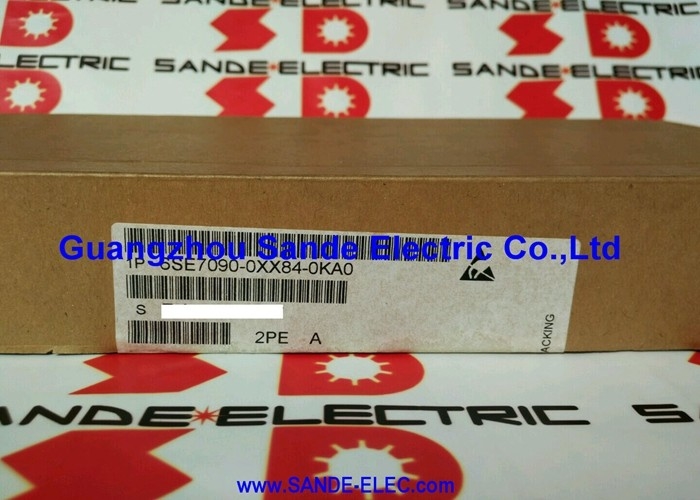
Siemens 6SE7090-0XX84-0KA0 | SIMOVERT MASTERDRIVES Motion Control ADB Adapter Module — For Compact and Chassis Units, Spare Part, Discontinued 2020
Overview
The Siemens 6SE7090-0XX84-0KA0 is the ADB (Adapter Board) for SIMOVERT MASTERDRIVES Motion Control drives — a hardware interface module within the drive unit's electronics box that allows specific option boards to be installed in compact and chassis-type MASTERDRIVES MC drive units.
In the MASTERDRIVES modular electronics architecture, the internal electronics slot accommodates different option boards depending on the application requirements.
The ADB provides the mechanical carrier and electrical connectors needed to fit a particular class of option or interface board into this slot in a physical drive unit that was not originally equipped with that board type.
The MASTERDRIVES Motion Control platform represents the higher-end variant of the MASTERDRIVES family — where the standard Vector Control (VC) variant handles general-purpose variable-speed drive applications, the Motion Control (MC) variant adds position control capability, synchronisation functions, and the software features required for CNC and multi-axis coordinated motion.
MC drives interface directly with SINUMERIK CNC controls and SIMATIC PLCs to execute axis position commands, synchronise multiple drive axes for electronic gearing, and implement cam profile functions for printing and packaging machines.
The ADB adapter module's role in this system is enabling the correct physical board installation — without the appropriate adapter, some option boards cannot be mechanically fitted or electrically connected within specific drive unit variants.
This makes the ADB a component that is necessary for certain configuration combinations but that is not visible in the drive's normal operation — it is infrastructure, not functional circuitry itself.
Key Specifications
| Parameter |
Value |
| Product Designation |
ADB (Adapter Board) |
| Drive Compatibility |
MC compact + chassis units |
| Weight |
~132g |
| Discontinued |
30 September 2020 |
| Status |
Spare part / surplus |
SIMOVERT MASTERDRIVES MC — The Platform Context
Understanding the ADB's role requires a clear picture of the MASTERDRIVES Motion Control architecture it belongs to.
The MASTERDRIVES MC system is Siemens's second-generation motion control drive platform — the successor to the SIMODRIVE 611 for applications requiring a single drive platform to handle both feed axes and spindle drives in CNC machines, and for non-CNC multi-axis synchronised production machinery.
A MASTERDRIVES MC drive unit consists of a power section (inverter bridge with gate drivers and DC link interface), a basic electronics unit (the CUMC control board as the MC equivalent of the CUVC), and a variable set of option boards selected for the specific application.
The option boards expand the basic control unit's capabilities: encoder boards add additional feedback interfaces for different encoder types, communication boards add PROFIBUS DP or other fieldbus interfaces, technology boards add specialised positioning and synchronisation functions.
The option boards install into defined slots within the drive unit's internal electronics box.
The physical arrangement of these slots — and the connectors available at each slot position — differs between compact drive units (which are self-contained, space-optimised packages) and chassis units (which are larger modules designed for installation in a central drive cabinet).
The ADB adapter module provides the mechanical and electrical bridge that allows a given option board to be correctly installed in a drive unit type whose slot geometry it would not otherwise physically match without the adapter.
Compact vs Chassis Units — Why the ADB Matters
The MASTERDRIVES range encompasses drive units across a wide power range. At the lower end are compact units — self-contained inverters in housing that include their own ventilation, DC link filtering, and electronics enclosure, designed for distributed installation.
At the higher end are chassis units — large inverter power sections designed for installation in centrally managed drive cabinets, where the cabinet provides the shared DC link, the electronics enclosure, and the cooling infrastructure.
These two physical form factors, despite sharing the same control electronics and firmware platform, have different internal layouts in their electronics boxes.
The connector positions, board dimensions, and mounting arrangements optimised for the compact unit's space constraints differ from those of the chassis unit's electronics cage.
When an option board designed for one environment must be installed in the other — or when the board geometry requires a physical intermediary to align with the available connectors — the ADB adapter provides this interface.
For maintenance engineers supporting installed MASTERDRIVES MC fleets, the ADB is the kind of component whose absence only becomes apparent when a drive is being rebuilt after repair — the correct adapter board must be present for the option board to install correctly, and ordering the wrong or missing adapter during a repair delays the machine's return to service.
Legacy Maintenance — Sourcing the ADB After Discontinuation
Siemens formally discontinued the 6SE7090-0XX84-0KA0 on 30 September 2020 — reflecting the broader end-of-life transition of the MASTERDRIVES platform as the installed base ages and the SINAMICS S120 drive system has become the current-generation replacement. Siemens's own spare parts supply for MASTERDRIVES components continues for a defined period after discontinuation, but availability progressively tightens.
For maintenance of MASTERDRIVES MC systems where the ADB is required for a drive repair, the options available to the maintenance team are:
Industrial surplus market: A network of specialist automation distributors maintains stocks of discontinued Siemens drive components, including MASTERDRIVES electronics option boards.
These stocks typically include both new-old-stock (unused boards from original production) and refurbished boards that have been tested and cleaned.
Component-level repair: For drives where the ADB itself has developed a fault, specialist Siemens drive repair services can often repair the board at component level — a technically demanding but economical option when new-old-stock is unavailable or priced beyond the machine's economic service life.
Drive system migration: For machines where multiple MASTERDRIVES components require replacement simultaneously — a situation that occurs when an older drive cabinet suffers a fault that cascades across several drive units — a migration to SINAMICS S120 may be more economical than sourcing multiple discontinued spare parts for a drive platform that Siemens no longer actively supports.
FAQ
Q1: What is the specific function of the ADB adapter — does it add any drive control functionality, or is it purely a mechanical/electrical interface?
The ADB is an interface and adapter module — it does not execute control algorithms, process signals, or add drive functionality by itself. Its function is to provide the correct physical and electrical interface between a specific option board and the drive unit's internal electronics slot.
Think of it as the hardware equivalent of a software adapter or shim: it bridges a dimensional or connector mismatch between an option board's form factor and the drive unit's slot geometry.
The functionality that the ADB enables comes from the option board it supports, not from the ADB itself.
Q2: Can the ADB be shared between compact and chassis-type MASTERDRIVES MC units, or is it specific to one type?
The Siemens datasheet description for the 6SE7090-0XX84-0KA0 specifies it as compatible with both compact and chassis units — this is precisely what makes it the adapter that it is. Without this compatibility, separate adapter versions for each unit type would be required.
When ordering a replacement ADB, confirming the specific drive unit type (compact or chassis) against the Siemens MASTERDRIVES option board ordering documentation ensures the correct adapter is specified for the application.
Q3: How is the ADB installed in the drive unit — does installation require specialised tools or access to Siemens service?
The ADB installation is a mechanical assembly operation: the board is positioned in the drive unit's electronics box, aligned with the mounting standoffs and connectors, and secured with the appropriate fasteners (typically M3 or M4 screws).
No specialised soldering or electrical calibration is required for the ADB installation itself.
However, disassembling a MASTERDRIVES drive unit to access the internal electronics box requires following the safety procedures in the MASTERDRIVES operating manual — the DC link capacitors must be fully discharged before working inside the unit, which requires waiting the specified discharge time after power removal and verifying zero voltage with a voltmeter.
Q4: The part is listed with "0.29 lbs" weight. Does this refer to the bare board weight or the packaged weight?
The 0.29 lbs (approximately 132g) figure refers to the module's own weight — the adapter board assembly without outer packaging.
The shipping weight, which includes Siemens's protective packaging for the electronics board, would be higher.
For logistics and import documentation purposes, the packaged weight in the original Siemens packaging is the relevant figure and can vary from the net weight by a factor of 3 to 8 for small electronic boards.
Q5: What current Siemens drive system replaces the SIMOVERT MASTERDRIVES Motion Control for new installations?
Siemens's current replacement for MASTERDRIVES Motion Control is the SINAMICS S120 drive system, which provides equivalent and significantly extended motion control capability with DRIVE-CLiQ communication, PROFINET integration, Safety Integrated functions, and the current SIMOTION or TIA Portal engineering environment.
For existing MASTERDRIVES MC installations, Siemens offers migration support through its Digital Industries Service division, including retrofitting SINAMICS S120 into existing machine frames while reusing field wiring, motors, and cabinet infrastructure.
The transition preserves the machine's mechanical assets while updating the electronics to current-generation technology with full Siemens support.



 Your message must be between 20-3,000 characters!