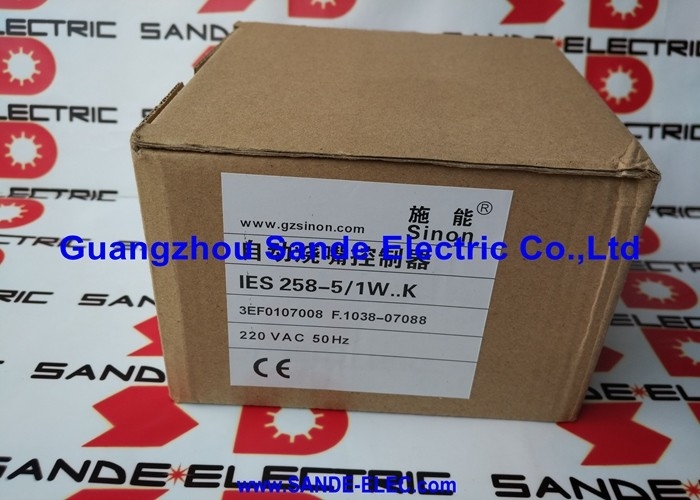
Sinon IES 258-5/1W..K Burner Controller
Overview
The IES 258-5/1W..K is a burner controller sold under the Sinon name for 220/240 V, 50/60 Hz applications. Published product listings describe it with IP40 protection, an operating range of around -20°C to +60°C, and compatibility with flame rod, ignition rod, or UV sensor input methods.
The same listings also show a ts 5/1 s timing value, which places the unit in the category of compact flame-safeguard style burner-control hardware rather than general-purpose automation relays.
What makes this controller commercially useful is its direct role in burner supervision and ignition-sequence handling.
A part like this is normally selected because the combustion system already depends on a matching burner-control unit, not because a buyer simply needs “some control box” with the same voltage.
In real heating and combustion equipment, the control unit sits at the center of startup timing, flame detection, and shutoff behavior, so exact fit matters more than broad similarity. This is an engineering inference based on the unit’s published burner-controller identity, sensor options, and timing notation.
Technical Data
| Parameter |
Value |
| Part Number |
IES 258-5/1W..K |
| Brand |
Sinon |
| Product Type |
Burner Controller |
| Supply Voltage |
220/240 V |
| Frequency |
50/60 Hz |
| Operating Temperature |
-20°C to +60°C |
| Timing Value |
ts 5/1 s |
| Protection Class |
IP40 |
| Sensor Inputs |
Flame Rod, Ignition Rod, UV Sensor |
| Application Focus |
Burner ignition and flame supervision |
Application Value
The IES 258-5/1W..K is well suited to industrial burners, heating systems, combustion skids, thermal-process equipment, and burner control panels where a dedicated flame-monitoring controller is already part of the design.
Because the published listings specifically mention support for flame rod, ignition rod, or UV sensor input, the unit is especially relevant in installations where burner supervision may vary by sensing method while the control platform remains the same.
This application view follows directly from the product descriptions and sensor-input options shown in the listings.
It also has practical maintenance value. In older burner panels, a correct controller replacement often preserves the original sequence logic, sensor method, and panel wiring better than trying to adapt an unrelated flame-control unit.
That usually reduces recommissioning time and helps keep the existing combustion control layout intact.
This is an engineering inference based on the unit’s burner-controller role and its recurring appearance in replacement-market listings.
Replacement and Selection Perspective
For service work, the IES 258-5/1W..K should be treated as a combustion-control component, not just a voltage-matched module. Buyers should verify the installed part number, input sensor method, timing requirement, supply class, and protection requirement before ordering.
On burner systems, those details directly affect startup behavior, flame supervision, and shutdown response, which is why exact replacement is usually the safer path.
This is an engineering recommendation based on the published sensor options, voltage class, timing value, and protection rating.
FAQ
Q1: What kind of product is IES 258-5/1W..K?
It is a burner controller used in combustion systems where ignition sequence and flame supervision are part of the control chain.
Published listings describe it as a Sinon burner-control unit with multiple flame-sensing options.
Q2: Why do the sensor input options matter?
Because the sensor method determines how the controller confirms flame presence during burner operation.
A unit that supports flame rod, ignition rod, or UV sensor input is useful in systems where the combustion setup may vary but the controller platform remains similar.
Q3: What types of equipment can use this controller?
It is best suited to burners, heating systems, and thermal-process equipment that already use a dedicated ignition and flame-monitoring controller.
That application fit follows directly from the way the model is presented in burner-component listings.
Q4: Why is exact replacement important on a burner controller?
Because timing, sensor compatibility, and supply class all influence how the burner starts, proves flame, and shuts down.
In practice, changing to a loosely similar controller can create avoidable commissioning issues. This is an engineering inference based on the model’s published timing and sensor options.
Q5: What should be checked before ordering?
Check the installed part number, supply voltage, sensor method, timing requirement, and panel protection needs.
On combustion controls, these checks usually matter much more than appearance alone.


 Your message must be between 20-3,000 characters!