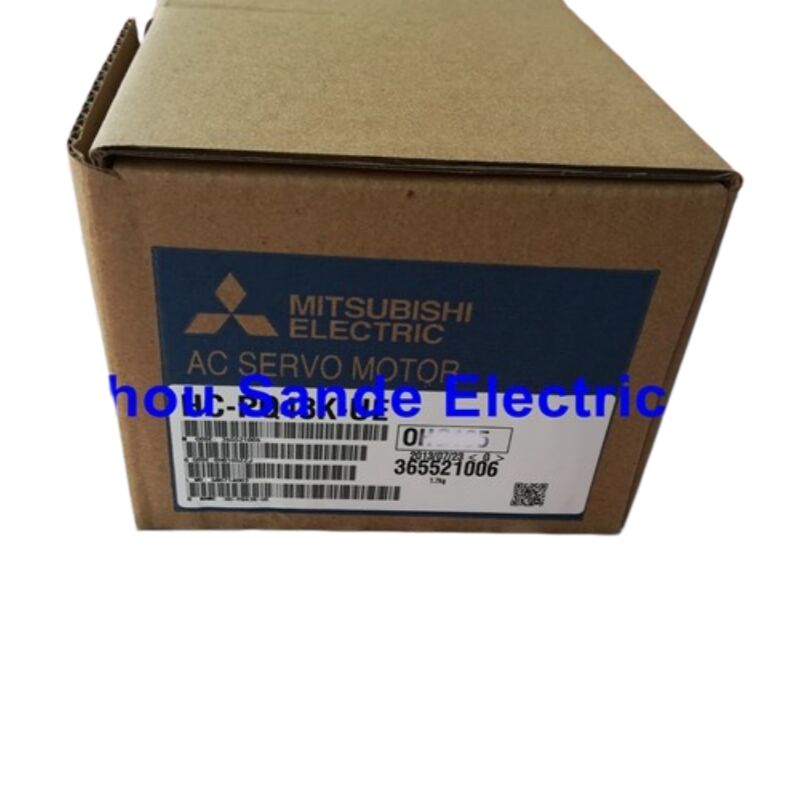
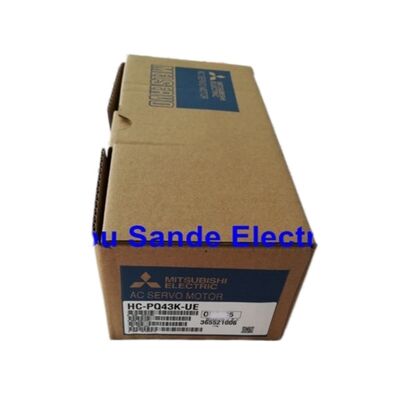
Mitsubishi HC-PQ43K-UE — MELSERVO HC-PQ Series 400 W AC Servo Motor, 3000 r/min, Keyed Shaft, North America Version
Overview
The HC-PQ43K-UE is the 400 W member of Mitsubishi Electric's HC-PQ family — a series designed from the outset as a direct challenger to micro-stepper and 5-phase stepper technology in the small-capacity, high-cycle-rate segment of machine automation. Where a stepper motor trades position accuracy for mechanical simplicity, the HC-PQ delivers closed-loop velocity and position control at the same compact footprint, eliminating missed steps and reducing tuning time through Mitsubishi's patented real-time adaptive tuning built into the matched MR-C amplifier family.
At 400 W and 3,000 r/min, this motor sits at the top of the HC-PQ range, suited to the kind of tasks where earlier 200 W or sub-200 W entries run out of torque headroom: horizontal conveyors with variable loads, multi-axis gantry positioning, label applicators, dispensing systems, and any mechanism where consistent positioning under inertia changes is non-negotiable. The "-UE" designation identifies this as the North American compliance variant, meeting UL and CE marking requirements and packaged with English-language documentation.
Electrical and Mechanical Specifications
| Parameter |
Value |
| Rated output |
400 W (0.4 kW) |
| Rated speed |
3,000 r/min |
| Maximum speed (intermittent zone) |
4,500 r/min |
| Rated torque |
184 oz·in (approx. 1.30 N·m) |
| Rated current |
2.8 A |
| Supply voltage (from amplifier) |
3-phase AC, 122 V |
| Encoder resolution |
10,000 pulses/revolution |
| Rotor inertia |
0.793 oz·in² |
| Shaft configuration |
Keyed straight shaft (K suffix, standard on 200 W and 400 W models) |
| Electromagnetic brake |
None |
| IP rating |
IP65 (excluding shaft-through and connector) |
| Insulation class |
Class B |
| Vibration class |
V-15 |
The HC-PQ Design Concept: Why It Replaced Steppers in High-Cycle Applications
Stepper motors were the workhorse of small-axis automation for decades, but they carry a fundamental limitation — they operate in open loop. The motor either holds its position or it doesn't, and when load conditions change mid-cycle, there is no correction mechanism. In high-cycle or variable-load applications, this results in lost position, system halts, and production downtime.
Mitsubishi developed the HC-PQ series to fill the gap between stepper technology and larger, more complex servo systems. Three specific design decisions define the HC-PQ:
Encoder-first architecture. Every HC-PQ motor ships with a 10,000 pulse/revolution encoder as standard equipment, not as an option. Position is continuously fed back to the amplifier at every moment of operation.
Low rotor inertia. The 400 W model's rotor inertia of 0.793 oz·in² keeps the load-to-motor inertia ratio manageable across a wide range of light-to-medium machinery. In practice, this translates to faster acceleration, shorter settling times, and less aggressive gain requirements — all of which reduce tuning complexity on the machine builder's side.
Compatible mounting footprints. The -NK variants in the HC-PQ family use NEMA 34 mounting adapters (available for 200 W and 400 W models), easing retrofits on machines that were originally built around stepper frames. The standard HC-PQ43K-UE uses Mitsubishi's native servo mounting dimensions.
Torque Characteristics
The torque curve for the HC-PQ43 tells the story that the nameplate data alone cannot. At rated speed (3,000 r/min), the motor produces its continuous rated torque of 184 oz·in — steady, sustainable output for the full thermal duty cycle. Dropping into the intermittent operating range, peak torque reaches approximately 414 oz·in — more than twice the continuous rating — for short-duration acceleration bursts. This peak torque capability is what makes servo motors effective in high-inertia start-stop cycles where steppers tend to stall.
The continuous operating range extends to 4,500 r/min with reduced torque at higher speeds, giving machine designers flexibility to run the axis faster than the nameplate speed when peak-torque events are infrequent and thermal limits allow.
Compatible Amplifiers
The HC-PQ43K-UE was introduced alongside the MR-C series amplifiers and remained in production through the MR-J2 and MR-J2-Super eras. Verified compatible amplifiers include:
MR-C Series (primary match):
- MR-C40A-UE — Single-phase 230 V AC input, 24 VDC interface pulse voltage
- MR-C40A-L-UE — Single-phase 230 V AC input, 5 VDC interface pulse voltage
MR-J2 / MR-J2-Super Series:
- MR-J2-40A / MR-J2S-40A — General-purpose pulse/analogue interface, 400 W class
- MR-J2S-40B — SSCNET fibre-optic bus version for Mitsubishi motion controller networks
All MR-C amplifiers are configured for pulse-train position control with an electronic gear function (A/B ratio from 1/50 to 20), accepting command pulse frequencies up to 200 kpps and supporting CW/CCW, sign+pulse, and A/B quadrature input formats. The maximum positioning feedback pulse count at the amplifier is 4,000 pulses/rev (the amplifier's internal resolution), driven by the 10,000 P/rev physical encoder through the signal processing chain.
RS-232C communication to the MR-C amplifier is handled via an optional MR-C-T01 adaptor and MR-Configurator Windows software, enabling parameter editing, waveform monitoring, alarm history review, and auto-tuning operations from a standard PC.
Encoder Cable and Accessory Reference
| Item |
Model Number |
| Encoder cable, 2 m |
MR-JCCBL2M-L |
| Encoder cable, 5 m |
MR-JCCBL5M-L |
| Encoder cable, 10 m |
MR-JCCBL10M-L |
| Terminal block cable, 0.5 m / 1 m |
MR-CTBL05M |
| Terminal block |
MR-TB20 |
| RS-232C adaptor |
MR-C-T01 |
| Encoder connector kit (field assembly) |
MR-J2CNM |
| CN1 I/O connector kit |
MR-J2CN1 |
Note: Motor power is connected via separate wiring to the amplifier — the HC-PQ43K-UE ships with 0.3 m pigtail leads with ring-type terminals for the power and earth connections.
Product Condition and Availability
This listing covers the HC-PQ43K-UE supplied as New In Box, with a one-year warranty. New-in-box condition means the motor has never been installed, carries its original factory packaging, and retains the original nameplate data verifiable on receipt. The one-year warranty covers manufacturing defects and ensures replacement or repair support within the warranty period.
The HC-PQ43K-UE was discontinued by Mitsubishi Electric as part of the broader MR-J2/HC-series end-of-life transition. New stock is no longer produced. For existing machines built around MR-C or MR-J2 amplifiers and HC-PQ motors, new-in-box units available through the industrial surplus market are the preferred solution for maintaining original machine performance without the engineering cost of a drive system migration.
For new machine designs, Mitsubishi's current equivalent in the 400 W / 3,000 r/min segment is the HG-KR43 (MELSERVO-J4 platform), which requires the MR-J4-40A or MR-J4-40B amplifier. The HC-PQ43K-UE is not mechanically or electrically interchangeable with J4-era motors without a full system review.
FAQ
Q1: What is the difference between HC-PQ43K-UE and HC-PQ43NK-UE?
The two models are electrically identical — same 400 W rating, same 2.8 A / 122 V electrical specifications, same 10,000 P/rev encoder, same shaft dimensions and keyway. The distinction is in the mounting interface. The HC-PQ43K-UE uses Mitsubishi's native servo motor mounting flange dimensions, designed for direct installation on Mitsubishi-specified mounting plates or custom machine frames built to the motor's own flange drawing. The HC-PQ43NK-UE includes a NEMA 34 mounting adapter, dimensioned to fit the standard NEMA 34 bolt pattern — useful when retrofitting a machine originally designed around a NEMA 34 stepper motor. If the machine frame was not originally built for NEMA dimensions, the HC-PQ43K-UE is the cleaner choice.
Q2: Which Mitsubishi servo amplifier should be paired with the HC-PQ43K-UE?
The intended amplifier pairing is the MR-C40A-UE (single-phase 230 VAC, North American version). The MR-C40A-UE is the 400 W member of the MR-C amplifier family, which was developed specifically for use with the HC-PQ motor range. For installations already using MR-J2-Super amplifiers, the MR-J2S-40A (general-purpose pulse/analogue interface) is also compatible and supports the same HC-PQ43 motor. Mixing with MR-J3 or J4 amplifiers is not supported — those generations use a different encoder interface protocol and would require a different motor series.
Q3: Does the HC-PQ43K-UE have an IP65 rating, and what does that mean for installation environments?
Yes — the HC-PQ43K-UE carries an IP65 rating, which means the motor body is fully protected against dust ingress and against direct water jet from any direction. This makes it suitable for installation in environments with wash-down spray, coolant mist, or significant airborne contamination. The two exclusions are the shaft-through opening (where the shaft exits the front face) and the cable connector end — those areas are not IP65 rated. For applications involving immersion or sustained high-pressure water contact, additional sealing at the shaft opening would be required. Motors with an oil seal option in Mitsubishi's line address this for higher-protection demands.
Q4: Can the HC-PQ43K-UE be used for vertical-axis applications?
The HC-PQ43K-UE has no electromagnetic brake — the K suffix indicates a keyed shaft, not a brake. For vertical axes where the load could fall under gravity when the servo is de-energized or when an alarm occurs, this motor on its own is not sufficient. A vertical axis application with this motor requires either an external mechanical brake on the driven mechanism or a substitution to the HC-PQ43BK-UE (same motor with an integrated spring-applied, electrically-released electromagnetic brake). The brake variant requires a 24 VDC power supply for brake release and adds approximately 0.247 oz·in² to the total rotor inertia figure. If the machine design cannot accommodate a brake motor, a counterweight or lead-screw with sufficient self-locking capability may also be acceptable — but that is a mechanical design decision that must be evaluated per application.
Q5: How does the HC-PQ43K-UE compare to the current Mitsubishi HG-KR43, and is a direct replacement possible?
Both motors are rated at 400 W and 3,000 r/min, but they are not direct drop-in replacements for each other. The HC-PQ43K-UE was designed for the MR-C and MR-J2 amplifier generations and uses an older encoder interface; the HG-KR43 is designed for MR-J4 amplifiers with a modern 18-bit (262,144 count/rev) absolute encoder. Their physical mounting dimensions also differ — the flange size and bolt pattern changed between generations. A migration from HC-PQ43K-UE to HG-KR43 requires a new amplifier (MR-J4-40A or -40B), new encoder and power cables, remapping of all parameters, and verification of the mechanical interface before the new motor can be mounted. For machines where a like-for-like repair is the objective, sourcing a new-in-box HC-PQ43K-UE is substantially faster and less costly than a platform migration.



 Your message must be between 20-3,000 characters!
 English