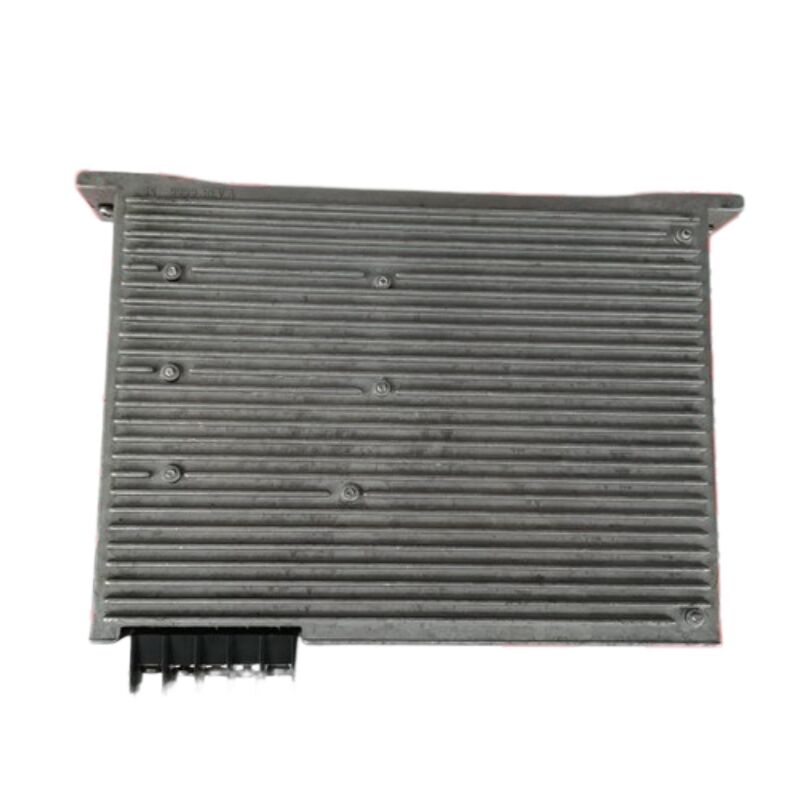
HAAS 93-32-3551J — BL Smart Servo Amplifier, 45A, NGC Axis Drive
Overview
The HAAS 93-32-3551J is a 45-amp Brushless Smart Servo Amplifier — the mid-range axis drive module in HAAS Automation's NGC (Next Generation Control) servo amplifier family. Bearing HAAS's own part description "AMP, 45A BL SMART," it sits between the 30A module and the heavier-duty 60A and 90A units, and it is the amplifier of choice for the medium-load feed axes that appear most frequently across HAAS's VMC and lathe product range.
This unit is offered in used / surplus condition and is presented as-removed from a HAAS NGC machine. Buyers seeking a cost-effective path to restoring an axis on an NGC-control HAAS machine will find this a direct functional replacement for any 93-32-3551J or the superseded 32-3551J that it was itself designed to replace.
Verified Specifications
| Parameter |
Value |
| HAAS Part Number |
93-32-3551J |
| Supersedes |
32-3551J |
| HAAS Description |
AMP, 45A BL SMART |
| Continuous Output Current |
45 A |
| DC Bus Input |
~320–340 V DC (from Vector Drive or Minimill Power Supply) |
| Motor Output |
Three-phase (U / V / W) to brushless servo motor |
| Control Interface |
Digital communication — NGC control |
| Cooling Method |
Passive (heat sink; no fan on amplifier body) |
| Status Indicators |
Green LED: Power ON; Red LED: FAULT |
| Over-temperature Trigger |
195°F / 90°C |
| Compatible Control |
HAAS NGC (Next Generation Control) |
| Condition |
Used |
Where the 93-32-3551J Fits in the HAAS NGC Architecture
HAAS NGC machines distribute motion control across individual axis amplifier modules, each powered from a shared 320 V DC bus. That bus is maintained by the Vector Drive assembly — the machine's central power conversion unit — which rectifies the incoming three-phase mains supply to a stable high-voltage DC rail and distributes it to every servo amplifier in the cabinet.
The 93-32-3551J taps into this rail directly. When the NGC control commands a move on the axis the amplifier serves, the amplifier's power stage switches that DC bus energy into a variable-frequency, variable-amplitude three-phase output to the servo motor. The motor encoder feeds back position and velocity data to close the loop, and the amplifier's digital communication line to the control continuously reports axis status, fault conditions, and thermal state.
Within the NGC electrical cabinet, four amplifier sizes are used: 30A, 60A, and 90A alongside this 45A unit. All four are architecturally identical and operate by the same logic. The difference is purely in the current rating of the power stage — which determines which axes and which motor frame sizes each amplifier can support.
The "Smart" Distinction: Digital Communication to the NGC Control
The "BL Smart" designation is not just a product name. It identifies the communication architecture that separates this amplifier generation from HAAS's earlier analog amplifiers. In the Smart amplifier design, each module maintains a live digital data link to the NGC control. This link carries not just motor command signals but also continuous diagnostic information: overcurrent events, bus voltage status, thermal load, and fault codes.
When an axis fault occurs, the NGC control's alarm display reflects specific, code-identified faults sourced directly from the amplifier's own internal monitoring — rather than requiring a technician to infer cause from generic axis error messages. That diagnostic granularity is one of the practical day-to-day advantages of the Smart amplifier architecture for maintenance personnel.
The "BL" prefix stands for Brushless, confirming this amplifier is designed for and should be paired with HAAS's brushless AC servo motors. The three-phase motor connections (U, V, W) and the motor encoder feedback cable are both connected at the amplifier's front face, keeping wiring orderly and connection verification straightforward during installation or replacement.
Passive Cooling: What It Means for the Installation
Unlike some servo amplifiers that incorporate their own internal cooling fans, the 93-32-3551J uses passive thermal management through its heat sink body. The NGC electrical cabinet handles airflow at the enclosure level. HAAS's service documentation identifies a cabinet cooling fan as part of the amplifier system; that fan should operate at 120 V AC and must be confirmed functional whenever amplifier overtemperature conditions are investigated.
The over-temperature sensor in the amplifier triggers at 195°F (90°C). In practice, that threshold is rarely approached under normal duty cycles when cabinet airflow is unobstructed. Overtemperature faults in the field are almost always associated with blocked vent paths, a failed cabinet fan, or sustained high-duty-cycle machining with inadequate dwell time for heat dissipation.
HAAS NGC Machine Compatibility
The 93-32-3551J is used across a wide cross-section of HAAS NGC machines wherever a 45A axis amplifier is specified. Typical axis applications include:
Vertical Machining Centres (VMC): X, Y, Z and rotary axes on VF-series mills where motor sizing falls within the 45A amplifier envelope.
Turning Centres: Z-axis and X-axis drives on ST-series lathes, as well as live tooling and C-axis orientating drives on mill-turn configurations.
Horizontal Machining Centres: Feed axes on EC-series horizontals requiring medium-power axis drives.
Rotary and Trunnion Tables: HRT and TRT rotary products paired with NGC controls where the rotary axis motor matches this amplifier's current rating.
Always verify the amplifier current rating specified for the specific axis on a specific machine serial number — HAAS's own parts lookup is serial-number-indexed for this reason. A 30A or 60A axis on the same machine is not served by this unit; only the 45A-designated axes are.
HAAS Smart Amplifier Family — Current Rating Comparison
| HAAS Part Number |
Current Rating |
Type |
| 93-32-5550J |
30A |
BL Smart |
| 93-32-3551J |
45A |
BL Smart |
| 93-32-5552G |
60A |
BL Smart |
| 93-4988 |
60A |
BL Smart |
| 93-4989 |
90A |
BL Smart |
| 93-5088 |
30A |
Digital Amp |
| 93-5089 |
45A |
Digital Amp |
Cross-generation compatibility note: HAAS has confirmed in its NGC service documentation that the newer Digital Amplifiers (93-5088 series) are fully backward compatible with BL Smart Amplifiers. This means a 93-5089 (45A Digital Amp) can replace a 93-32-3551J in an NGC machine if the Smart Amplifier is unavailable, without requiring any other changes to the machine configuration.
Safety Requirements for Replacement
The 320 V DC bus that powers this amplifier presents a fatal electrocution hazard during and immediately after machine operation. HAAS's own service manual is direct on the required procedure: after pressing [POWER OFF] and locking out the main circuit breaker, wait a minimum of five minutes before opening the electrical cabinet. The High Voltage indicator light on the Vector Drive must be confirmed fully extinguished before any contact with amplifier terminals or bus connections. This waiting period is not optional — the bus capacitors in the Vector Drive retain lethal stored charge after power removal and discharge progressively over several minutes.
When replacing the amplifier, always download and complete HAAS's Amplifier Inspection Report Checklist before disconnecting any components. This structured check distinguishes an amplifier fault from a motor short or cable fault — which, if unresolved before installing the replacement, will immediately damage the new unit.
FAQ
Q1: What does the "93-" prefix on part number 93-32-3551J mean, and is it different from the original 32-3551J?
The "93-" prefix on HAAS part numbers identifies parts that may include a quantity of remanufactured components — this is stated directly on HAAS's official parts portal. The 93-32-3551J is HAAS's current replacement part for the original 32-3551J, which has been discontinued. The two are functionally interchangeable: the 93-32-3551J installs directly in any machine position that previously held a 32-3551J with no configuration changes required. When sourcing a replacement, the 93-32-3551J is the correct current reference regardless of which variant the machine was originally built with.
Q2: The red FAULT LED is illuminated on the amplifier. Does this mean the amplifier needs replacing?
Not necessarily — and HAAS's service documentation recommends a structured fault investigation before condemning the amplifier. A red FAULT LED can be triggered by several conditions external to the amplifier itself: a shorted motor winding, a damaged motor power cable, a mechanical blockage on the axis that caused an overload event, or low bus voltage from a Vector Drive issue. The correct diagnostic sequence is to check the machine's alarm history for overload alarms preceding an over-current event (which suggests a crash rather than an amplifier failure), then perform a resistance check between the motor cable terminals and ground to rule out a motor or cable short. Only after eliminating external causes should the amplifier itself be suspected. Replacing an amplifier on a machine with an unresolved motor short will immediately damage the replacement unit.
Q3: Can the 93-32-3551J be used on any HAAS axis, or does it have to match the original axis specification?
It must match. HAAS assigns specific amplifier current ratings to specific axes based on the servo motor fitted to that axis. Installing a 45A amplifier on an axis that was designed around a 30A or 60A amplifier will either underperform (if undersized) or be an unnecessary cost without functional benefit (if oversized). Critically, the NGC control communicates digitally with each axis amplifier and configures it at startup using parameters that include the expected axis and amplifier type. Always confirm the amplifier rating for the specific axis on the specific machine serial number — either via the machine's electrical schematic or the HAAS serial-number-indexed parts lookup — before ordering.
Q4: This unit is listed as used. What should be checked before installing a used 93-32-3551J?
Visual inspection first: look for burn marks, swollen or cracked capacitors, heat damage around the power transistor area of the heat sink, and any signs of contaminated coolant intrusion. Check that the motor output terminal block (U/V/W) and the DC bus connection points show no signs of arcing or overheating. Before installation, perform a resistance check from the RED terminal on the amplifier to ground with the motor disconnected — an amplifier with a shorted output stage will show near-zero resistance, indicating internal power transistor failure. If the unit passes visual and resistance checks, install it, power up, and confirm that the green POWER ON LED illuminates and no FAULT LED appears in the ready state before commanding axis motion.
Q5: Is the 93-32-3551J compatible with both VMC and lathe NGC machines?
Yes, the amplifier hardware is the same regardless of machine type. The 93-32-3551J is a general-purpose axis amplifier module used in any NGC-platform HAAS machine where a 45A amplifier is specified — VF-series vertical machining centres, ST-series turning centres, EC-series horizontals, and rotary table axes all use the same amplifier family. The NGC control configures the amplifier's behaviour for the specific axis through its digital communication link, so the physical module itself has no machine-type restriction. What matters is that the current rating (45A) matches the axis specification in the specific machine, which is confirmed by serial number or machine electrical drawings.



 Your message must be between 20-3,000 characters!