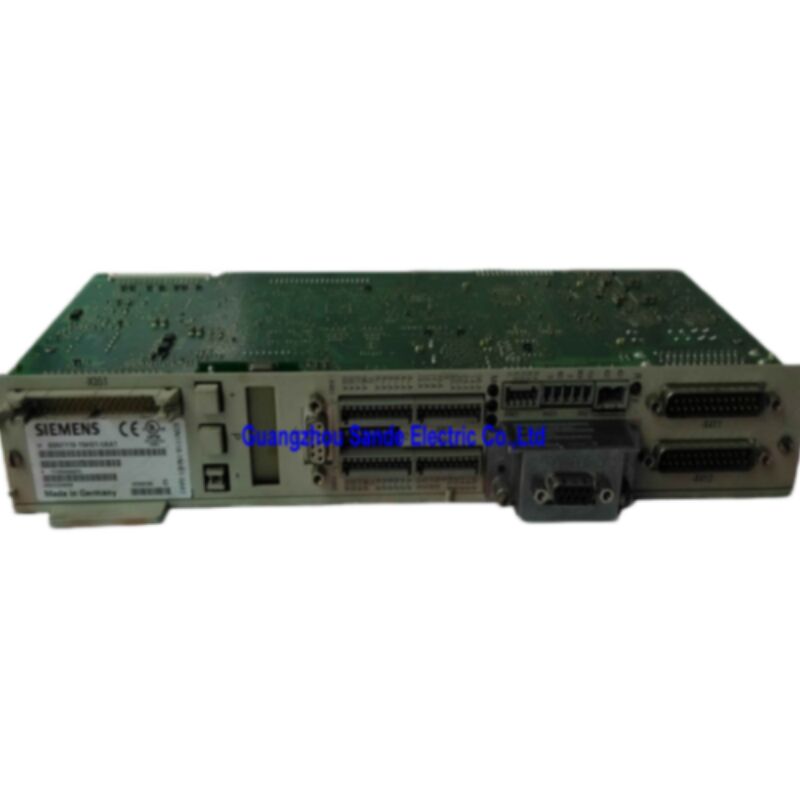
Siemens 6SN1118-1NH01-0AA1 — SIMODRIVE 611 Universal HRS 2-Axis Control Loop Module, Sin/Cos 1 Vpp / EnDat
Product Identity
The Siemens 6SN1118-1NH01-0AA1 is a two-axis closed-loop control board (plug-in unit) for the SIMODRIVE 611 drive system. Siemens' full description for this order number reads: SIMODRIVE 611 Universal HR 2-Axis Control-Loop Block, Incremental Encoder SIN/COS 1 Vpp, Absolute Value Encoder EnDat, Speed/Torque Setpoint, Positioning, Expandable by Options.
This module belongs to the Universal HRS generation — the "HRS" designation indicating the High-Resolution variant with an encoder interpolation factor of 2048 (the preceding generation used a factor of 128). The jump from 128 to 2048 internal interpolation effectively multiplies the resolution of a connected sin/cos 1 Vpp encoder by the same ratio, delivering substantially finer positional granularity without any change to the encoder hardware on the machine.
Verified Specifications
| Parameter |
Value |
| Siemens Order Number (MLFB) |
6SN1118-1NH01-0AA1 |
| Series |
SIMODRIVE 611 Universal |
| Generation |
HRS (High Resolution Standard) |
| Number of Axes |
2 |
| Encoder Interface — Incremental |
Sin/Cos 1 Vpp |
| Encoder Interface — Absolute |
Sin/Cos 1 Vpp / EnDat |
| Internal Interpolation Factor |
2,048 |
| Operating Modes |
Speed/Torque Setpoint; Positioning (onboard) |
| Option Slot |
Yes — Terminals module or PROFIBUS-DP module |
| Safe Standstill |
Supported |
| Protection Degree |
IP20 |
| Ambient Operating Temperature |
0°C to +50°C |
| Storage Temperature |
−25°C to +80°C |
| Compatible Motors |
1FT6, 1FK, 1FN1, 1FN3, 1FE1, 1PH, 1PM, 1FM6, 2SP1 |
| Commissioning Software |
SimoCom U |
The SIMODRIVE 611 System and Where This Module Fits
The SIMODRIVE 611 is Siemens' modular drive converter system for CNC machine tools and industrial automation, developed to serve as the motion control backbone for SINUMERIK-based machining centres, turning cells, grinding machines, and production machinery. Within the cabinet, individual drive modules — each covering one or two motor axes — are powered from a shared DC bus supplied by a central infeed/regenerative module. The control board is the intelligence inside each drive module: it performs the closed-loop current, speed, and position calculations and communicates with the CNC or external controller.
The 6SN1118-1NH01-0AA1 is the control board. It slides into the drive power section as a plug-in unit, and the physical assembly of power section plus control board constitutes a complete drive axis. Replacing a faulty control board without touching the power stage is therefore a viable and common maintenance strategy — it avoids full module replacement and reduces cost significantly.
Two Axes, One Board
Packing two independent axes of closed-loop drive control onto a single plug-in board is one of the design advantages of the Universal HR series. In a five-axis machining centre, for example, three two-axis boards handle six potential axes — leaving the sixth slot free for a main spindle or a rotary axis. The efficiency of a two-axis board over two separate single-axis modules extends to cabinet space, wiring terminations, and the number of individual components to stock and manage for spares.
Each axis operates fully independently. The two drive channels share the board's digital processor and communication interface to the drive bus, but each has its own current controller, speed controller, and encoder interface. Operating mode and gain parameters are set and stored separately for each axis.
Encoder Compatibility: Incremental and Absolute on the Same Board
The 6SN1118-1NH01-0AA1 accepts two encoder types in parallel on the same hardware, allowing different encoder types to be used on each axis as the machine demands.
Sin/Cos 1 Vpp Incremental Encoders produce sinusoidal differential signals at 1 Vpp amplitude. These are the standard encoder signals on Siemens 1FK and 1FT6 servo motors. The HRS board interpolates each signal period in 2,048 steps internally — a substantial resolution enhancement over the original 128-step interpolation of earlier Universal HR boards. Additionally, pulse multiplication (doubling) and pulse division (1:2, 1:4, 1:8) at the angular incremental encoder interface are both possible for incremental encoders, giving the commissioning engineer considerable flexibility when configuring position feedback for specific drive parameters.
EnDat Absolute Encoders (sin/cos 1 Vpp with EnDat interface) allow absolute shaft position to be read directly on power-up, without a reference return. The EnDat protocol is a serial interface standard that transmits position data digitally over the same cable as the analog sin/cos signals. For machine axes where a reference run at startup is operationally unacceptable — or where the absolute position must be preserved across power cycles — EnDat encoders on the HRS board deliver this without additional hardware. Pulse multiplication (doubling) is supported at the angular incremental encoder interface for absolute encoders as well.
Maximum motor cable length with sin/cos 1 Vpp signals is 50 metres per axis.
Operating Modes: Setpoint Interface and Onboard Positioning
The board's firmware supports two distinct operating modes, which can be configured independently for each axis.
Speed/Torque Setpoint Mode is the conventional drive interface: the control board accepts an analog ±10 V speed setpoint (or a torque setpoint) from an external source and regulates the motor accordingly. This is the standard mode for integration with a SINUMERIK 810D or 840D CNC, where the CNC's position controller outputs speed reference signals over the drive bus to each axis.
Onboard Positioning Mode is a significant additional capability. In this mode, the 6SN1118-1NH01-0AA1 executes a library of positioning programs stored in its own memory without depending on an external CNC for position loop closure. Traversing blocks — target position, velocity, acceleration — are stored and activated by digital I/O signals. This mode makes the board valuable not only in full CNC machine configurations, but also in standalone machine axes, transfer lines, rotary indexing machines, and any application where a simple external controller needs to trigger pre-defined move profiles without running a continuous position control loop.
Expandability: Terminal Module and PROFIBUS-DP Options
A single option slot on the front panel of the board accepts one of two expansion modules, multiplying the board's interfacing capability:
Terminal Module (6SN1114-0NB01-0AA1): Adds 8 digital inputs and 8 digital outputs. In Positioning Mode, these extra I/Os are used to select and trigger traversing blocks, enabling a PLC or simple relay-based controller to activate stored move sequences without complex communication protocols.
PROFIBUS-DP Module (6SN1114-0NB00-0AA1 / 6SN1114-0NB01-0AA0): Connects the control board directly to a PROFIBUS-DP network, enabling cyclic and acyclic data exchange with a SIMATIC PLC or other PROFIBUS master. This is particularly useful in production cells where multiple SIMODRIVE 611 drive axes need to be coordinated by a PLC over a single fieldbus cable. The PROFIBUS-DP option supports synchronous motion profiles for up to two axes on the same board.
Safe Standstill Function
The 6SN1118-1NH01-0AA1 supports Siemens' Safe Standstill function — a hardware-based safety feature that provides a certified safe state for the drive axis without requiring a separate safety relay module in many configurations. When the Safe Standstill function is activated, the drive's firing pulses are inhibited by a monitored hardware path, preventing the motor from generating torque or rotating even if the control electronics were to develop a fault. This function is documented in Chapter 8.5 of the SIMODRIVE 611 Universal Description of Functions manual.
Compatible Motor Families
This control board is designed for use with the following Siemens servo and spindle motor series in the SIMODRIVE 611 system:
- 1FT6 / 1FT5 — synchronous servo motors for feed drives
- 1FK6 / 1FK7 — compact synchronous servo motors
- 1FN1 / 1FN3 — linear motors
- 1FE1 — built-in synchronous motors
- 1PH / 1PM — asynchronous spindle motors
- 1FM6 — frameless torque motors
- 2SP1 — motor spindles
Variant Comparison — 6SN1118-1NH01 Series
| Order Number |
Generation |
Positioning |
Notes |
| 6SN1118-0NH01-0AA0 |
Universal HR |
No |
Setpoint/speed only, no positioning |
| 6SN1118-0NH01-0AA1 |
Universal HR |
No |
Updated revision, no positioning |
| 6SN1118-1NH01-0AA1 |
Universal HRS |
Yes |
Interpolation ×2048, positioning included |
| 6SN1118-1NH01-0AA0 |
Universal HRS |
Yes |
Earlier revision of -0AA1 |
The "1" in the fifth character position of the order number (1NH vs 0NH) identifies the HRS generation with onboard positioning capability. The trailing version digit (-0AA0 vs -0AA1) indicates a hardware revision — the -0AA1 is the later revision and includes the enhanced interpolation factor and pulse multiplication/division features described above.
FAQ
Q1: What is the difference between the 6SN1118-1NH01-0AA1 and the 6SN1118-0NH01-0AA1, and are they interchangeable?
The key difference is the presence or absence of the onboard positioning function and the encoder interpolation factor. The 6SN1118-1NH01-0AA1 (HRS generation, indicated by the "1" in position 5 of the order number) includes built-in traversing block positioning mode and uses an interpolation factor of 2,048 for sin/cos 1 Vpp encoder signals. The 6SN1118-0NH01-0AA1 (the earlier HR generation) operates only in setpoint/speed control mode and uses the lower interpolation factor of 128. In a pure CNC-integrated application where the SINUMERIK handles all positioning — and where the higher encoder resolution is not required — the two boards are functionally compatible in the setpoint operating mode. However, if the machine uses onboard positioning or if the application depends on the higher-resolution encoder interpolation, the HRS (1NH) version is required and the 0NH version cannot substitute for it.
Q2: Does this board work with a SINUMERIK 840D or 810D CNC, or only in standalone configurations?
Both. The 6SN1118-1NH01-0AA1 is fully compatible with SINUMERIK 840D and 810D powerline CNC systems as a standard drive axis control board. In this configuration, the SINUMERIK downloads firmware into the control board at every power-up via the drive bus, and the CNC's axis controllers command the board over the same bus in real time. The board also operates as a standalone positioning controller — without a CNC — when the PROFIBUS-DP or Terminal Module option is fitted and the onboard positioning mode is activated. The same hardware board serves both roles; the operating mode is a configuration parameter, not a hardware difference.
Q3: The machine uses 1FT6 motors with sin/cos 1 Vpp encoders. Does changing from a 0NH board to a 1NH board require encoder replacement?
No. The 1FT6 servo motor family uses sin/cos 1 Vpp encoder signals as standard, and this is exactly the signal the 6SN1118-1NH01-0AA1 is designed for. The encoder hardware on the motor does not need to change. What does change is the effective position resolution delivered by the control system: the higher interpolation factor (2,048 vs 128) of the HRS board produces finer position feedback from the same physical encoder, which may require minor adjustment to position controller gain parameters (P-gain, velocity feedforward) during recommissioning. The encoder cable type and wiring remain unchanged; maximum cable length is 50 metres.
Q4: What option module should be fitted if the machine needs this drive axis to communicate over PROFIBUS-DP with a SIMATIC PLC?
The PROFIBUS-DP option module — Siemens order numbers 6SN1114-0NB00-0AA1 or 6SN1114-0NB01-0AA0, depending on the PROFIBUS version required — inserts into the option slot on the front of the control board. Once fitted and configured using SimoCom U commissioning software, the drive axis becomes a PROFIBUS DP standard slave, exchanging cyclic and acyclic data with the PLC master. This allows the PLC to issue speed, torque, or position setpoints and to read back actual values and diagnostic information directly over the fieldbus — without needing analog wiring from the PLC to the drive. If additional digital I/O is needed instead (to select traversing blocks from a relay or simple PLC without a fieldbus), the Terminal Module (6SN1114-0NB01-0AA1) is the appropriate option, adding 8 inputs and 8 outputs.
Q5: The "Safe Standstill" function is listed as supported. Does this mean the board meets the requirements of a safety-rated STO (Safe Torque Off) function per IEC 61800-5-2?
The Safe Standstill function in the SIMODRIVE 611 Universal HRS hardware is a hardware-inhibit of the drive firing pulses, implemented via a monitored hardware path and documented under the relevant Siemens safety documentation for that series. Whether a specific installation meets the IEC 61800-5-2 STO requirements depends on the full system implementation — the wiring, the external safety relay or safety PLC used to activate the function, and the overall machine safety architecture — not on the control board alone. For a safety-critical replacement or new installation involving Safe Standstill, the relevant Siemens SIMODRIVE 611 safety documentation and the machine's specific safety assessment must be consulted. The board supports the hardware mechanism; compliance at the machine level requires the complete safety circuit to be validated by a qualified safety engineer.


 Your message must be between 20-3,000 characters!