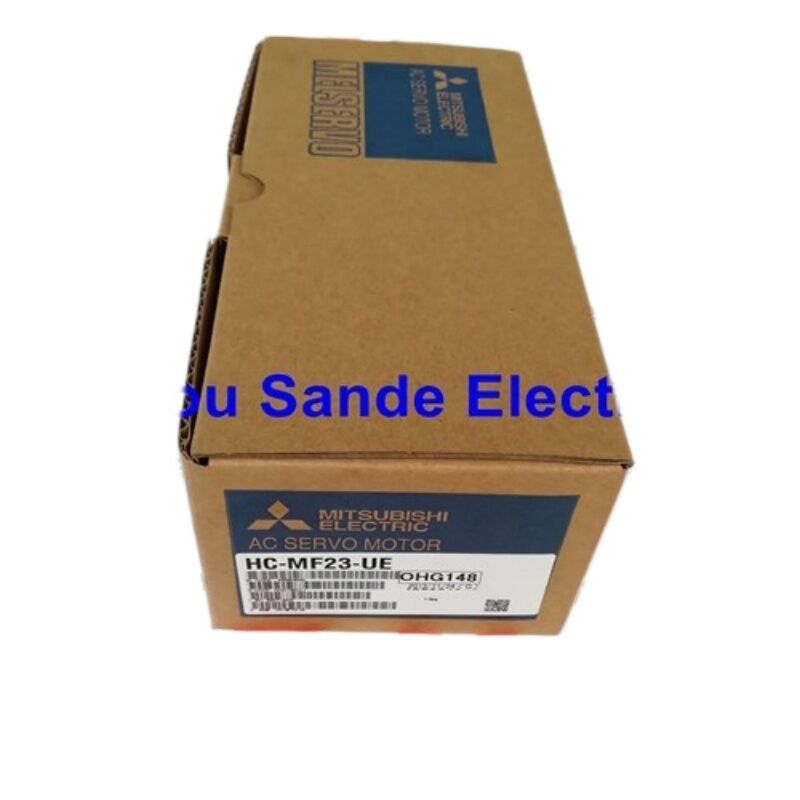
Mitsubishi HC-MF23-UE AC Servo Motor — 200W, Ultra-Low Inertia, EN/UL Standard, MR-J2 Series
Brand: Mitsubishi Electric
Series: MELSERVO HC-MF
Platform: MR-J2
Part Numbers: HC-MF23-UE / HCMF23UE
New in Original Packaging | Free Expedited Shipping | In Stock
Small Motor, Serious Motion Control Credentials
The HC-MF23-UE does not stand out on the basis of its power rating. At 200W, it is a compact, low-capacity servo motor by any measure — and that is exactly the point. In precision automation, the ability to position a small load quickly, accurately, and repeatedly thousands of times per shift is rarely a function of raw power. It is a function of how fast the motor can respond to a change in commanded position, how faithfully it tracks the velocity profile the controller has calculated, and how little it deviates from the commanded path when the cycle begins again.
The HC-MF23-UE was built around those priorities. It belongs to Mitsubishi Electric's HC-MF family — a servo motor series developed specifically for ultra-low inertia, small-capacity applications within the MR-J2 servo platform. The motor carries no electromagnetic brake and uses a standard straight shaft, making it the base configuration for horizontal axis positioning, lightweight pick-and-place heads, and high-frequency indexing mechanisms where the application does not require axis holding under power-off conditions.
The -UE suffix designates compliance with both EN (European) and UL/C-UL (North American) international standards, making this motor suitable for machine builders shipping equipment into North American and European markets without requiring separate compliance modifications to the servo motor itself.
Technical Specifications
| Parameter |
Value |
| Rated Output |
200W (0.2 kW) |
| Supply Voltage |
200V AC class (3-phase) |
| Rated Current |
1.5A |
| Rated Torque |
0.64 N·m |
| Peak Torque |
1.9 N·m |
| Rated Speed |
3,000 r/min |
| Encoder Type |
Serial absolute / incremental |
| Electromagnetic Brake |
None |
| Shaft |
Straight (standard) |
| Flange Size |
60 × 60 mm |
| Ambient Temperature (Operation) |
0°C to +40°C |
| Altitude |
Max. 1,000m above sea level |
| Standards Compliance |
EN Standard, UL/C-UL Standard |
| Compatible Amplifiers |
MR-J2-20A / MR-J2-20A1 / MR-J2-20B / MR-J2-20C / MR-J2-20CT |
| Series |
HC-MF, ultra-low inertia / small capacity |
| Platform |
MELSERVO MR-J2 |
| OEM Status |
Discontinued |
Specifications sourced from Mitsubishi Electric MELSERVO HC-MF Series documentation, MR-J2-CT Servo Amplifier Instruction Manual, and verified product listings on Mitsubishi Electric Factory Automation Americas.
Ultra-Low Inertia in a 200W Frame
The defining characteristic of the HC-MF series — including the HC-MF23-UE — is the relationship between its output power and its rotor inertia. Mitsubishi Electric designed this family around a rotor optimized for dynamic response rather than thermal capacity. The result is a motor that can accelerate and decelerate a small load extremely quickly without requiring oversized drive hardware to manage the dynamics.
Why does rotor inertia matter at 200W? Because the applications that use a 200W servo motor on a 60mm flange are almost never doing slow, steady-state work. They are doing rapid, repetitive positioning: a gripper finger opening and closing, a small rotary stage indexing between stations, a lens positioning mechanism making sub-millimeter corrections dozens of times per second. In these use cases, the motor's ability to settle quickly at the commanded position — and do so without hunting or overshoot — determines machine throughput far more than rated wattage.
Ultra-low inertia motors achieve this by minimizing the rotational mass that must be overcome with every direction reversal. Every watt of available torque goes toward changing the motion state of the load, rather than being spent overcoming the motor's own mechanical resistance to change.
The -UE Suffix: What International Compliance Actually Means
The suffix attached to this part number is not a trivial detail — it determines whether the motor can be legally installed in equipment destined for certain markets.
Mitsubishi's -UE designation means the motor has been manufactured and tested to comply simultaneously with two standards frameworks:
EN Standard — the European Norm requirements for electrical rotating machinery, including the IEC/EN 60034 series. Equipment sold within the European Economic Area bearing CE marking must include compliant components, and the servo motor is within scope of this requirement. An EN-compliant motor has been tested to European electromagnetic compatibility, low voltage, and machinery directive requirements.
UL/C-UL Standard — Underwriters Laboratories and its Canadian equivalent (CSA). UL listing is required or strongly preferred for equipment installed in the United States and Canada, particularly in commercial and industrial facilities where insurance, building codes, or customer procurement policies mandate listed components.
For machine builders and system integrators working in global markets, the -UE version eliminates the need to qualify separate motor variants for North American versus European installations. The same HC-MF23-UE can be designed into equipment shipping to either market. The standard HC-MF23 (without -UE) does not carry these certifications — this is not a cosmetic difference.
Compatible Servo Amplifiers — MR-J2 Family
The HC-MF23-UE pairs with the MR-J2-20 amplifier family. The amplifier model determines the control interface and communication architecture of the servo axis:
| Amplifier Model |
Interface / Notes |
| MR-J2-20A |
General-purpose pulse train / analog input |
| MR-J2-20A1 |
General-purpose (1-phase 100–120V input variant) |
| MR-J2-20B |
SSCNET serial bus (multi-axis network) |
| MR-J2-20C |
CC-Link |
| MR-J2-20CT |
CC-Link with built-in positioning functions |
In an existing machine, the amplifier is already installed and configured. The motor replacement task is simply matching the part number on the nameplate to the replacement motor. The amplifier does not need to be changed when the motor is replaced with an identical HC-MF23-UE. If the existing amplifier is also being replaced or if the machine is being re-engineered, select the interface variant that matches the machine's control bus architecture.
HC-MF23 Variants at a Glance
The HC-MF23 base motor was produced in several configurations to cover different shaft and brake requirements. All carry the same 200W, 0.64 N·m, 3,000 r/min core specifications:
| Model |
Brake |
Shaft |
Standards |
| HC-MF23 |
No |
Straight |
None (standard) |
| HC-MF23-UE |
No |
Straight |
EN, UL/C-UL |
| HC-MF23B |
Yes (electromagnetic) |
Straight |
None |
| HC-MF23B-UE |
Yes (electromagnetic) |
Straight |
EN, UL/C-UL |
This listing is the HC-MF23-UE — straight shaft, no brake, EN/UL/C-UL compliant. The correct variant for your application depends on whether an electromagnetic holding brake is required and whether international standards compliance is needed for your target market.
Application Profile
The HC-MF23-UE is purpose-built for a specific type of machine. Not heavy-duty machining. Not multi-kilowatt drive axes. The domain of a 200W ultra-low inertia servo on a 60mm flange is compact, fast, precision automation:
Electronic assembly equipment — component pick-and-place mechanisms, PCB handling, fine-pitch connector insertion. Cycle rates in these applications can exceed several hundred operations per minute, and the mass being moved is light enough that motor inertia is the limiting factor for settling time.
Semiconductor and flat panel display manufacturing — wafer handling, stage positioning, and transport mechanisms where contamination control, compact footprint, and positioning accuracy are equally important constraints.
Packaging and labeling machinery — label applicator heads, registration control for web-fed processes, and small-format filling or capping mechanisms where the axis must stay synchronized with a product stream.
Medical and laboratory automation — pipetting robots, slide handlers, and analytical instrument positioning stages. The serial encoder's absolute feedback capability is relevant here, where loss of position reference during power cycling could affect process integrity.
Multi-axis assembly fixtures — individual axes in a larger system where each axis carries a small mechanical payload and the overall system performance depends on all axes completing their moves within a tight cycle budget.
Shipping and Condition
This unit ships new, in original Mitsubishi Electric factory-sealed packaging. Free expedited shipping is included. International orders are dispatched via DHL Express, FedEx International Priority, or UPS Express with full tracking provided from dispatch through delivery. In-stock units are prepared for same business day dispatch for orders placed before the daily carrier cutoff.
FAQ
Q1: The HC-MF23-UE is listed as discontinued. Can I still find new units, and is a new surplus unit equivalent to a new OEM unit?
Mitsubishi Electric discontinued the HC-MF series as part of the broader transition away from the MR-J2 servo platform. The part is no longer manufactured and is unavailable through active Mitsubishi authorized channels. However, new-in-box surplus stock from the original production run continues to circulate through the industrial spare parts market. A new surplus unit — factory sealed, unopened, with original Mitsubishi packaging and labeling intact — is in every functional and mechanical respect identical to what was originally supplied through authorized distribution. It has never been installed, powered up, or serviced. For a machine that was designed around the HC-MF23-UE, this is the straightforward maintenance path. The alternative — using a repaired or refurbished unit — introduces an unknown service history and typically requires performance verification after installation.
Q2: What is the difference between the HC-MF23-UE and the newer HC-MFS23? Can the MFS version substitute for the MF version?
The HC-MF and HC-MFS series are different product generations from different servo platforms. The HC-MF23-UE belongs to the MR-J2 platform; the HC-MFS23 belongs to the MR-J2S (Super) platform. Both motors are rated at 200W with the same rated torque of 0.64 N·m and rated speed of 3,000 r/min, and both use a 60×60mm flange. The difference lies in the encoder interface: the HC-MF23 uses a serial absolute/incremental encoder compatible with MR-J2 amplifiers, while the HC-MFS23 carries a 17-bit absolute encoder designed for MR-J2S amplifiers. These encoder interfaces are not directly interchangeable — connecting an HC-MFS23 to an MR-J2 amplifier without adaptation will not work correctly. If the machine uses MR-J2 amplifiers, the replacement motor must be an HC-MF23-UE, not an HC-MFS23.
Q3: No electromagnetic brake is included on this model. Is it appropriate for a vertical axis application?
The HC-MF23-UE is a no-brake variant, which means axis position is maintained solely through active servo control while the amplifier is enabled. If the amplifier faults, powers down, or is intentionally disabled, there is no mechanical restraint preventing the axis from moving under gravity. For a horizontal axis or a vertical axis carrying a load light enough that gravity-driven movement is acceptable in the event of a power loss, the no-brake version is operationally suitable. For a vertical axis where uncontrolled downward movement would damage the machine, the tooling, or the workpiece — or where safety regulations require a mechanical restraint — the correct choice is the HC-MF23B-UE, the electromagnetically-braked variant that mechanically locks the shaft when the brake supply is removed.
Q4: What does the serial absolute/incremental encoder in the HC-MF23-UE provide, and how does it affect machine startup?
The serial encoder in the HC-MF23-UE is a combination absolute/incremental type, communicating position data to the MR-J2 amplifier via a serial protocol rather than conventional A/B quadrature pulse signals. In absolute mode (when a battery-backed absolute position is configured in the amplifier), the motor retains its position reference through power cycles, and the machine can resume operation after a power-off event without performing a reference return. In incremental mode, a reference return is required at each startup. Which mode is active depends on the servo amplifier's parameter configuration and whether a battery for absolute position retention is connected to the amplifier. This is not a hardware difference in the motor itself — it is a system configuration choice made during machine commissioning.
Q5: Can the HC-MF23-UE be driven by a more modern Mitsubishi amplifier such as the MR-J4 series?
The HC-MF23-UE and the MR-J4 series amplifiers are not directly compatible without additional adaptation hardware. The MR-J4 uses a different encoder communication protocol than the HC-MF23-UE's serial encoder, and a direct cable connection between the two will not produce a functional servo axis. Mitsubishi Electric developed renewal tool kits — specifically the MR-J4-DU_B-RJ020 amplifier combined with MR-J2S renewal cables — as a documented migration path from MR-J2S to MR-J4. However, note that this path was developed primarily for MR-J2S (not MR-J2) motors. For HC-MF series motors on the original MR-J2 platform, compatibility with renewal tools should be confirmed with Mitsubishi Electric technical support before committing to an amplifier upgrade. For straightforward motor replacement in an existing machine, replacing the HC-MF23-UE with another HC-MF23-UE driven by the original MR-J2-20 amplifier remains the simplest and most reliable approach.



 Your message must be between 20-3,000 characters!