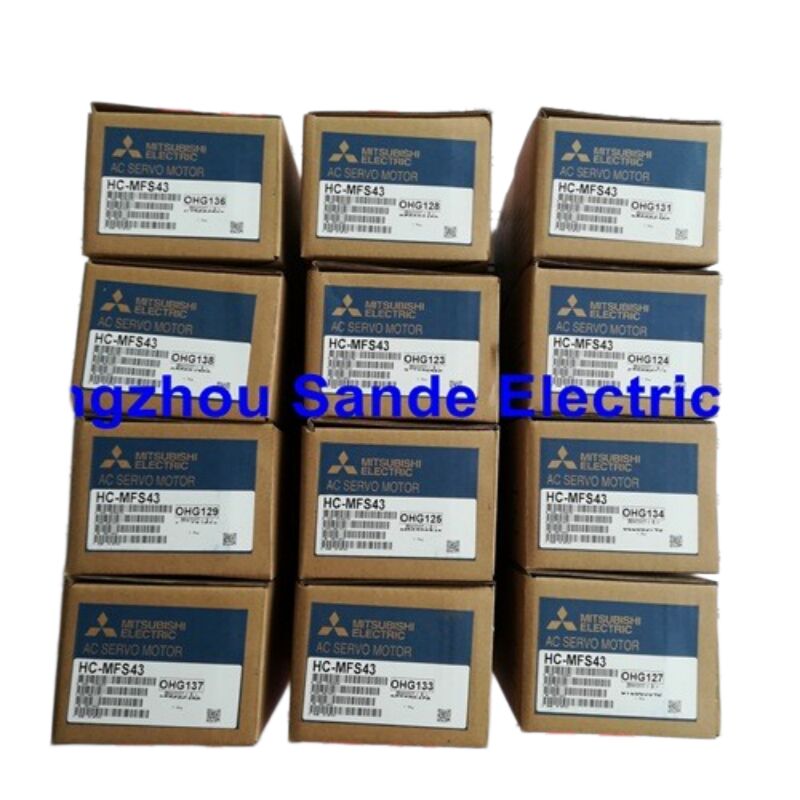
Mitsubishi HC-MFS43 AC Servo Motor — 400W, Ultra-Low Inertia, 17-Bit Absolute Encoder, MELSERVO MR-J2S
Brand: Mitsubishi Electric
Series: MELSERVO HC-MFS
Platform: MR-J2S
Part Numbers: HC-MFS43 / HCMFS43
New in Original Packaging | Free Expedited Shipping | In Stock
Four Hundred Watts in a 60mm Frame
The HC-MFS43 occupies an interesting position in the HC-MFS lineup. At 400W in a 60×60mm flange footprint, it is not a high-capacity motor by industrial standards — but it was never designed to be. What it was designed for is something more specific: delivering fast, accurate, repeatable motion in compact machine envelopes where larger motors physically cannot go, and doing it with the resolution and dynamic response that automation engineers working on high-cycle or multi-axis equipment actually need.
This is a servo motor from Mitsubishi Electric's MELSERVO J2S platform, part of the HC-MFS family characterized by ultra-low rotor inertia and small physical form factor. Low inertia in this context means the rotor itself resists changes in velocity less than a conventional motor would at equivalent power — which translates directly into faster acceleration, shorter settling time, and more responsive position control. In a machine that performs hundreds of cycles per hour, those advantages compound.
The HC-MFS43 ships with a straight shaft and no brake — this is the base configuration of the motor, suitable for horizontal axes or applications where position-holding under power loss is managed externally by the machine design. It carries a 17-bit absolute encoder as standard, a built-in feedback device that retains full position information even through power-off cycles.
Verified Technical Specifications
| Parameter |
Value |
| Rated Output |
400W (0.4 kW) |
| Supply Voltage |
200V AC class (3-phase, 122V) |
| Rated Current |
2.8A |
| Peak Current |
9.0A |
| Rated Torque |
1.3 N·m |
| Peak Torque |
3.8 N·m |
| Rated Speed |
3,000 r/min |
| Maximum Speed |
4,500 r/min |
| Instantaneous Maximum Speed |
5,175 r/min |
| Encoder Type |
Absolute, 17-bit (131,072 ppr) |
| Moment of Inertia |
0.143 × 10⁻⁴ kg·m² |
| Flange Size |
60 × 60 mm |
| Protection Rating |
IP55 |
| Cooling Method |
Totally enclosed, self-cooled |
| Insulation Class |
Class B |
| Electromagnetic Brake |
None (standard version) |
| Shaft |
Straight, no keyway |
| Ambient Temperature (Operation) |
0°C to +40°C |
| Altitude |
Max. 1,000m above sea level |
| Weight |
1.45 kg |
| Compatible Amplifiers |
MR-J2S-40A / MR-J2S-40B / MR-J2S-40CL / MR-J2S-40CP |
| Series |
HC-MFS, ultra-low inertia / small capacity |
| Platform |
MELSERVO MR-J2S |
| OEM Status |
Discontinued |
Specifications sourced from Mitsubishi Electric Factory Automation Americas official product page and cross-referenced with published distributor technical documentation.
Ultra-Low Inertia — Why It Matters More Than Peak Power
A motor's nameplate power rating tells you how much energy it can continuously deliver. Its rotor inertia figure tells you something equally important: how quickly it can respond to a change in commanded velocity or position. These two properties are related but not the same, and for many automation applications the inertia characteristic has more practical impact on machine performance than the rated wattage.
The HC-MFS43's rotor moment of inertia is 0.143 × 10⁻⁴ kg·m² — a deliberately low value achieved through rotor design optimized for dynamic response rather than thermal mass. When a controller commands the motor to start, stop, or reverse, the rotor resists that change proportionally to its inertia. A lower-inertia rotor accelerates faster, decelerates in less distance, and reaches commanded position sooner. Over thousands of cycles per shift, a motor that settles to target position 5 milliseconds faster than its alternative is a motor that improves machine throughput in a measurable way.
This is why the HC-MFS series was developed as a distinct product family rather than simply being a scaled-down version of a larger Mitsubishi servo. The physical and electromagnetic design reflects an optimization for dynamic, high-cycle motion — the 400W HC-MFS43 and the 750W HC-MFS73 share the same architecture philosophy even though they differ in output capacity.
60×60mm Flange — Fitting Where Others Don't
The 60mm square flange size of the HC-MFS43 is not simply a matter of the motor being small. It is a standardized mechanical interface dimension that determines which mounting patterns and coupling designs the motor is compatible with. For machine designers who laid out an axis around the 60mm flange form factor, a replacement must carry the same flange geometry to mount without modification to the machine frame.
Larger servo motors in Mitsubishi's own lineup — including the HC-MFS73 at 80mm flange — are physically incompatible with a mounting designed for 60mm. This is a straightforward mechanical constraint, not a performance trade-off. Equipment that was built around HC-MFS43 motors requires HC-MFS43 or an exact dimensional equivalent, and since this part is discontinued, surplus new stock of the original part number is typically the most direct replacement path available.
17-Bit Absolute Encoder — Precision That Persists
Most servo motors used in production automation today carry incremental encoders — feedback devices that count pulses from a reference point established at startup. The controller knows where the motor is relative to where it started, but nothing more. If power is interrupted, that reference is lost and a homing sequence is required before normal operation can resume.
The HC-MFS43's built-in encoder is absolute type, operating at 17-bit resolution. With 131,072 distinct positions per revolution, it provides both fine angular resolution and true absolute position knowledge — the controller knows exactly where the axis is at the moment power is applied, without any homing motion. For multi-axis machines or processes where homing all axes on every startup introduces cycle time or safety concerns, the absolute encoder is a genuine operational advantage built directly into the motor.
Compatible Servo Amplifiers
The HC-MFS43 pairs with the MR-J2S-40 amplifier family, available in four interface variants:
| Amplifier |
Control Interface |
| MR-J2S-40A |
Pulse train (position / speed / torque modes) |
| MR-J2S-40B |
SSCNET serial bus (multi-axis network) |
| MR-J2S-40CL |
CC-Link |
| MR-J2S-40CP |
PROFIBUS-DP |
The correct amplifier depends entirely on the control architecture of the machine being maintained. SSCNET-based multi-axis controllers require the MR-J2S-40B. Standalone or pulse-train-driven axes use the MR-J2S-40A. If the existing amplifier in the machine is already functional, it does not need to be replaced when swapping only the motor — the motor replacement is a direct physical and electrical exchange provided the full part number matches.
Model Variants in the HC-MFS43 Family
Several suffix variations of the HC-MFS43 were produced to cover different shaft and brake requirements:
| Model |
Brake |
Shaft |
| HC-MFS43 |
No |
Straight |
| HC-MFS43K |
No |
Keyway |
| HC-MFS43B |
Yes (electromagnetic) |
Straight |
| HC-MFS43BK |
Yes (electromagnetic) |
Keyway |
| HC-MFS43-UE |
No |
Straight (UL/cUL compliant) |
Each variant carries the same core electrical and performance specifications. The brake and shaft configuration determine physical fitment and application requirements — a machine designed for a keyway coupling requires the K variant; a vertical axis or position-hold application requires the B variant. This listing covers the HC-MFS43 standard variant with straight shaft and no brake.
Where the HC-MFS43 Typically Gets Used
The motor's combination of compact size, ultra-low inertia, and high-resolution feedback makes it well-suited to a predictable range of applications. Robotic end-of-arm wrist axes and lightweight joint actuators — where physical size and inertia both matter because the motor is part of the moving mass. Pick-and-place equipment where cycle rate is a performance objective and servo response speed directly limits throughput. CNC multi-axis secondary positioning axes, such as tool changers, rotary fixtures, and sub-spindles in smaller machining centers. Semiconductor handling equipment where cleanliness, precision, and compact form factor are all simultaneous requirements. Conveyor and indexing table drives in assembly machines with constrained space envelopes.
In all of these cases, the HC-MFS43 is typically not the motor doing the primary heavy work. It is the motor responsible for a precise, fast, secondary motion — and in that role, low inertia and high resolution count more than rated power.
Sourcing Note — Discontinued OEM Part
Mitsubishi Electric discontinued the HC-MFS series along with the broader HC motor family. The HC-MFS43 is no longer manufactured and is unavailable through authorized Mitsubishi distribution channels. What remains in circulation is original factory production stock held by industrial surplus suppliers — units that were warehoused before the line closed and have never been installed or used.
For maintenance of equipment that was built around this motor, new surplus stock is the correct procurement path. A repaired or refurbished unit introduces an unknown service history into a critical machine axis. A new-in-box unit from original production is a known quantity: same factory assembly, same quality standard, same mechanical dimensions and electrical characteristics as the motor it replaces.
This listing ships from original Mitsubishi Electric factory-sealed packaging.
FAQ
Q1: The HC-MFS43 has no brake. Is it safe to use on a vertical axis?
A servo motor without a brake can be used on a vertical axis, but it requires careful engineering consideration. Without a holding brake, the axis relies entirely on the servo amplifier and motor torque to maintain position when the machine is stopped or power is cut. If the servo is actively enabled and functional, the motor holds position normally. If power is lost or the amplifier faults, there is nothing mechanically preventing the axis from moving under gravity. For vertical loads where uncontrolled downward motion would damage tooling, product, or create a safety hazard, the correct choice is the HC-MFS43B — the electromagnetically-braked variant that mechanically locks the shaft on power loss. The standard HC-MFS43 is suited to horizontal axes or vertical axes where the load is balanced, light enough that gravity-driven motion is acceptable, or where separate external mechanical braking is provided by the machine design.
Q2: What is the difference in performance between the HC-MFS43 and the larger HC-MFS73?
The HC-MFS73 is rated at 750W versus the HC-MFS43's 400W — roughly 87% more continuous power output. The 73's rated torque is 2.4 N·m compared to the 43's 1.3 N·m, and peak torque scales similarly. Both motors share the same 17-bit absolute encoder architecture and the same ultra-low inertia design philosophy, and both run at 3,000 r/min rated speed. The key physical difference is flange size: the HC-MFS73 uses an 80×80mm flange, while the HC-MFS43 uses 60×60mm. This means the two motors are not mechanically interchangeable in most machine installations — mounting holes, coupling dimensions, and available space all differ. The choice between them is almost always determined by the original machine design, not by a free selection between equivalent options.
Q3: Can the HC-MFS43 be driven by a newer MR-J4 series amplifier?
Not directly in a standard configuration. The MR-J4 amplifier family uses a different encoder interface protocol than the HC-MFS43's built-in encoder, so a direct cable connection between a J4 amplifier and an HC-MFS43 motor does not work without additional adaptation. Mitsubishi Electric developed a set of renewal tools — specific cabling kits used in conjunction with MR-J4-DU_B-RJ020 amplifiers — to enable MR-J4 drives to control older HC-series motors. This is a documented migration path, but it is not a plug-and-play swap: it requires the correct renewal cable set and specific parameter configuration on the J4 amplifier side. If you are maintaining an existing machine and simply need to replace a failed HC-MFS43 motor, replacing it with another HC-MFS43 driven by the original MR-J2S-40 amplifier is the simpler and more reliable path.
Q4: The listed weight is 1.45 kg. Does this include packaging weight for shipping purposes?
The 1.45 kg figure is the motor's net weight as specified in Mitsubishi Electric product documentation — the motor unit alone, without packaging. Actual shipping weight including the original factory packaging materials is higher. For international shipping purposes, the gross packaged weight is used by the carrier to calculate freight charges. If you need the precise shipping weight for import duty calculations or freight booking, contact us directly before placing your order and we can provide the actual packaged weight for the specific unit being shipped.
Q5: What happens if the load inertia on the HC-MFS43 is too high relative to the motor inertia?
Mitsubishi's guidelines for the HC-MFS43 recommend that the load inertia moment connected to the motor shaft should not exceed 30 times the motor's own rotor inertia moment. The motor's rotor inertia is 0.143 × 10⁻⁴ kg·m², so the recommended maximum load inertia is approximately 4.29 × 10⁻⁴ kg·m². Exceeding this ratio does not necessarily cause immediate failure, but it degrades the servo system's dynamic behavior: the controller's tuning parameters, which assume a certain inertia ratio range, become less effective. Symptoms typically include overshoot on position moves, resonance or oscillation during deceleration, and difficulty achieving stable gain settings. If your application places a load inertia above the recommended ratio, consult Mitsubishi Electric's servo selection tools or technical support before finalizing the motor selection, as a different motor or a geared configuration may be more appropriate.



 Your message must be between 20-3,000 characters!