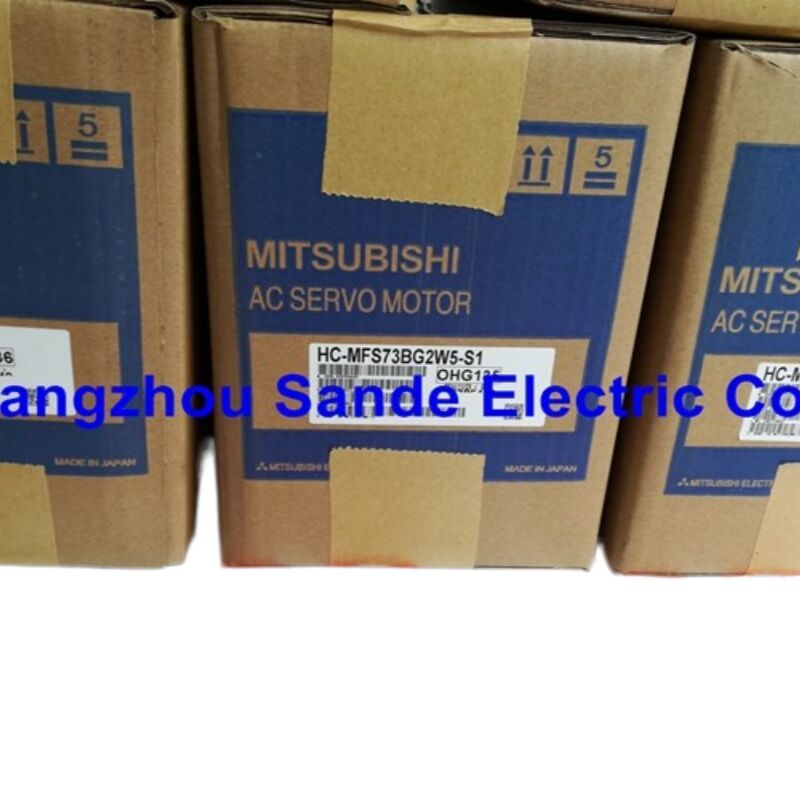
Mitsubishi HC-MFS73BG2W5-S1 AC Servo Motor — 750W, Brake, 1/25 Precision Reduction Gear, Special Shaft
Brand: Mitsubishi Electric
Series: MELSERVO HC-MFS
Platform: MR-J2S
Part Numbers: HC-MFS73BG2W5-S1 / HCMFS73BG2W5S1
New in Original Packaging | Expedited Shipping Available | In Stock
Built for Precision Motion That Can't Afford Compromise
There's a reason the HC-MFS73BG2W5-S1 represents one of the more specified configurations in the Mitsubishi HC-MFS product family. It combines four distinct design elements into a single unit: a 750W ultra-low inertia servo motor, a built-in electromagnetic holding brake, a precision reduction gear at a 1/25 ratio, and a special shaft output with a custom shaft end geometry. Each of these features is available separately in simpler variants. Having all four together in one motor assembly reflects a very deliberate engineering decision — typically driven by an application that simultaneously demands controlled positioning, compact power transmission, high output torque at low speed, and a specific mechanical interface that the standard shaft geometry cannot accommodate.
The base motor is the HC-MFS73B, part of Mitsubishi's MELSERVO J2S platform. The HC-MFS family was designed around the concept of ultra-low inertia combined with small physical form factor, making these motors particularly well-suited to high-cycle automation tasks where rapid acceleration and deceleration are central to machine throughput. At 750W continuous rated output with an 80×80mm flange, the torque-to-size ratio was — and still is — genuinely competitive for its class.
Fitted with the G2 precision reduction gear (1/25 ratio) and the electromagnetic brake, this configuration transforms the base motor into something categorically different: a low-speed, high-torque servo actuator that holds position without power and interfaces with the machine via a purpose-specified shaft. For the equipment it was designed into, there is no generic substitute.
Technical Specifications
| Parameter |
Value |
| Rated Output |
750W (0.75 kW) |
| Supply Voltage |
200V AC class |
| Rated Current |
5.1A |
| Peak Current |
18.0A |
| Rated Torque (motor shaft) |
2.4 N·m |
| Peak Torque (motor shaft) |
7.2 N·m |
| Rated Speed |
3,000 r/min |
| Maximum Speed |
4,500 r/min |
| Instantaneous Maximum Speed |
5,175 r/min |
| Encoder Type |
Absolute, 17-bit (131,072 ppr) |
| Moment of Inertia |
0.6 × 10⁻⁴ kg·m² |
| Reduction Gear Ratio |
1/25 (G2) |
| Reduction Gear Section Protection |
IP44 |
| Motor Body Protection |
IP55 |
| Flange Size |
80 × 80 mm |
| Electromagnetic Brake |
Built-in (holding type) |
| Shaft Specification |
Special shaft (W5) + Special shaft end (S1) |
| Ambient Temperature (Operation) |
0°C to +40°C |
| Altitude |
Max. 1,000m above sea level |
| Compatible Amplifiers |
MR-J2S-70A / MR-J2S-70B / MR-J2S-70CL / MR-J2S-70CP |
| Series Platform |
MELSERVO MR-J2S |
| OEM Status |
Discontinued |
Motor body specifications sourced from Mitsubishi Electric Factory Automation Americas official product listings and the Mitsubishi General-Purpose AC Servo Instruction Manual (SH030052). Reduction gear IP rating per Mitsubishi Electric Servo System catalog.
The Reduction Gear — What 1/25 Does to Output Torque
Pairing a 750W servo motor with a 1/25 precision reduction gear produces a fundamental shift in how the unit behaves at the output shaft. The motor continues to spin at its normal operating speed range — the gearhead, positioned between the motor and the load, steps down that speed and multiplies the available torque in the same proportion. At a 1/25 ratio, the output shaft turns at one twenty-fifth of the motor shaft speed while the torque at the output increases by the same factor, reduced only by mechanical losses within the gearhead itself.
In practical terms: an application that needs high holding torque in a compact envelope, or that must position a significant mechanical load with high angular resolution, benefits precisely from this kind of integrated motor-gear arrangement. The reduction gear is a precision type — not a standard spur gear reduction — which means backlash is controlled to levels appropriate for positioning and feedback-critical applications. The gear housing carries an IP44 protection rating, sealing it against solid particle ingress and splash water from any direction, which is suited to industrial environments where the motor may be exposed to coolant or process fluids during operation.
Because the gearhead is factory-integrated and the motor is rated as a complete assembly under this part number, users do not need to source, align, or couple a separate gearbox to the motor shaft. The alignment and coupling are done at the factory, eliminating the mechanical variables that come with field assembly.
Electromagnetic Brake — Holding Position Without Continuous Power
The "B" designation in HC-MFS73B signifies a built-in electromagnetic holding brake. This is a safety and holding device, not a dynamic braking mechanism for stopping the motor under power. When the brake coil is energized, the brake releases and the motor shaft turns freely. When power to the brake is removed — whether intentionally or due to power loss — the brake engages mechanically and holds the shaft in position.
This architecture is standard in servo applications where gravitational load or external force would cause undesired motion if the motor were de-energized or lost servo control. Vertical axes, clamp mechanisms, rotary indexing tables, and any load that must stay exactly where it is when the machine stops are the natural domain of a brake-equipped servo motor.
One installation note worth following: when the motor is mounted with the shaft end pointing upward, Mitsubishi's own instruction manuals specify that the brake plate may produce a slight sliding sound during operation — this is a normal characteristic of the design, not a fault condition.
17-Bit Absolute Encoder — Position Retained Through Power Cycles
The 17-bit absolute encoder fitted to this motor provides 131,072 distinct positions per revolution. More importantly, it is an absolute type — not incremental. The distinction matters considerably for the type of applications this motor configuration typically serves.
An incremental encoder can only track changes in position from a known starting reference. If power is lost or the machine is stopped and restarted, the controller must re-home the axis to re-establish a position reference before normal operation can resume. An absolute encoder retains full position information even through power cycles — when power is restored, the controller immediately knows where the axis is. No homing cycle required.
For machines with multiple axes, complex fixtures, or safety-critical processes where a missed home position could damage tooling or product, the absolute encoder is a meaningful operational advantage. It's also one of the features that distinguishes the HC-MFS73 series from lower-cost servo products — the 17-bit resolution and absolute feedback are characteristics of a motor built for precision industrial duty, not for commodity automation.
Compatible Servo Amplifiers
The HC-MFS73BG2W5-S1 operates on the MELSERVO MR-J2S platform. The four amplifiers confirmed compatible with the HC-MFS73B motor are:
| Amplifier Model |
Interface Type |
| MR-J2S-70A |
Pulse train (position/speed/torque) |
| MR-J2S-70B |
SSCNET (I/O link serial bus) |
| MR-J2S-70CL |
CC-Link |
| MR-J2S-70CP |
PROFIBUS-DP |
The correct amplifier selection depends on the control architecture of the machine this motor is being maintained in. On machines originally built around SSCNET multi-axis control, the MR-J2S-70B is the appropriate match. Standalone or pulse-train-controlled axes use the MR-J2S-70A. If you are uncertain which amplifier was original to the machine, check the amplifier model number on the existing drive before ordering.
Sourcing Context — Discontinued OEM, Available Through Surplus
Mitsubishi Electric discontinued the full HC-MFS and HC-MF motor series. New units are no longer manufactured, and the part is not available through active Mitsubishi authorized distribution channels. The only source for new-in-box stock is the industrial surplus and excess-inventory market — units from original production runs that were never installed.
This matters for buyers who need exactly this configuration. Substituting a different motor variant — removing the brake, changing the gear ratio, or using a standard shaft in place of the W5/S1 special shaft specification — is not straightforward when replacing a unit in an existing machine. The mechanical interface, the holding behavior, and the gear ratio are all part of how the original machine was designed. A unit that ships new, in original Mitsubishi packaging, with the correct suffix codes on the nameplate is a like-for-like replacement. That is what this listing provides.
Applications Where This Configuration Is Typically Found
The combination of electromagnetic brake, 1/25 precision reduction gear, and special shaft output points to precision positioning applications where low output speed, high output torque, secure position-holding, and a specific mechanical coupling geometry are all required simultaneously. Common installations include:
Rotary indexing mechanisms in assembly and inspection equipment — where a controlled, repeatable angular step is needed and the axis must hold between steps without continuous motor current. Robotic joint actuators in earlier-generation Mitsubishi and third-party robot arms that used HC-series servo motors directly at joint positions. Special-purpose machine tool axes where a geared servo replaces a conventional geared motor-plus-feedback arrangement. Conveyor and transfer machine drives where the combination of positioning feedback and holding brake provides both accuracy and safety.
Packaging and Shipping
This unit ships new, in original Mitsubishi Electric packaging, with the motor and encoder connector undisturbed. Expedited shipping options are available at checkout — DHL, FedEx, and UPS international express services are all offered with full shipment tracking from dispatch to delivery. In-stock units are prepared for dispatch the same business day for orders placed before the daily carrier cutoff.
FAQ
Q1: The HC-MFS73BG2W5-S1 is listed as discontinued. Is a new-in-box unit actually available, and what does "new" mean in this context?
"Discontinued" means Mitsubishi Electric has ended production of this part — it is no longer manufactured and cannot be ordered through active authorized channels. It does not mean the part has ceased to exist in the supply chain. Industrial equipment has long service lifespans, and original factory production runs often left behind stock that was purchased or warehoused by surplus and industrial parts distributors before the OEM discontinued the line. A new-in-box HC-MFS73BG2W5-S1 is a unit from that original production run — unopened, in the factory-sealed Mitsubishi packaging, with all original connector covers, labeling, and documentation intact. It has never been installed, repaired, or reconditioned. For a machine that requires this exact part number, a new surplus unit is the equivalent of a new OEM unit in all functional and mechanical respects.
Q2: Can the HC-MFS73BG2W5-S1 be paired with a newer Mitsubishi servo amplifier such as the MR-J4 series?
Direct plug-and-play compatibility with MR-J4 amplifiers does not exist for HC-MFS motors under standard configuration, because the MR-J4 uses a different encoder interface protocol. Mitsubishi Electric does offer MR-J2S-to-MR-J4 renewal tool kits (specifically the MR-J4-DU_B-RJ020 with associated renewal hardware) that are designed to allow MR-J4 amplifiers to drive older HC-series motors. However, this is not a standard wiring change — it involves specific renewal cabling and parameter configuration, and the HC-MFS73B motor is among those that require confirmation of software version compatibility on the renewal amplifier side. If upgrading the amplifier platform is being considered, confirm the exact renewal tool part number with Mitsubishi Electric technical support before committing to the combination.
Q3: What is the output speed at the gear shaft when the motor runs at rated speed?
With the motor running at its rated speed of 3,000 r/min and the G2 precision reduction gear providing a 1/25 ratio, the output shaft speed is 120 r/min (3,000 ÷ 25). At maximum motor speed of 4,500 r/min, the output shaft reaches 180 r/min. These are the rotational speeds at the gearhead output, which is the shaft that connects to the driven machine component. The servo amplifier and controller still command and monitor position and speed at the motor encoder — the gear ratio is a fixed mechanical relationship and the controller software must account for it in the motion profile calculations.
Q4: The W5 and S1 suffixes indicate a special shaft. What does this mean for installation and can a standard shaft version be substituted?
W5 designates a special shaft specification and S1 designates a special shaft end geometry — both are Mitsubishi Electric factory-applied special-order configurations defined at the time the part was originally specified for the machine it serves. The exact dimensions of the W5 shaft and S1 shaft end are specific to that configuration and differ from the standard straight shaft geometry of the base HC-MFS73B model. In most cases, a machine that was built to accept the W5/S1 shaft has a mechanical coupling, gearbox interface, or output flange machined to match those specific dimensions. Substituting a standard shaft version would typically require machining or replacing the coupling on the machine side — work that may or may not be feasible depending on the machine design. If you are replacing a failed motor in an existing machine, the safe approach is to match the full part number exactly, which is what this unit provides.
Q5: Does the electromagnetic brake require separate wiring and a dedicated power supply?
Yes. The electromagnetic brake in the HC-MFS73B is a separate electrical circuit from the motor power windings and the encoder. It requires a dedicated 24V DC power supply connected through its own pair of conductors, separate from the motor's U/V/W power lines and the encoder cable. The MR-J2S amplifier provides a brake output signal, but the actual brake coil current is sourced from the external 24V DC supply — the amplifier signal controls a relay or transistor that switches the brake supply, not the full coil current directly. The brake connector pinout and wiring diagram are documented in the Mitsubishi MR-J2S Servo Amplifier Instruction Manual. When replacing a motor in an existing installation, the existing brake wiring can typically be reused as-is if the cable terminations are in good condition.



 Your message must be between 20-3,000 characters!