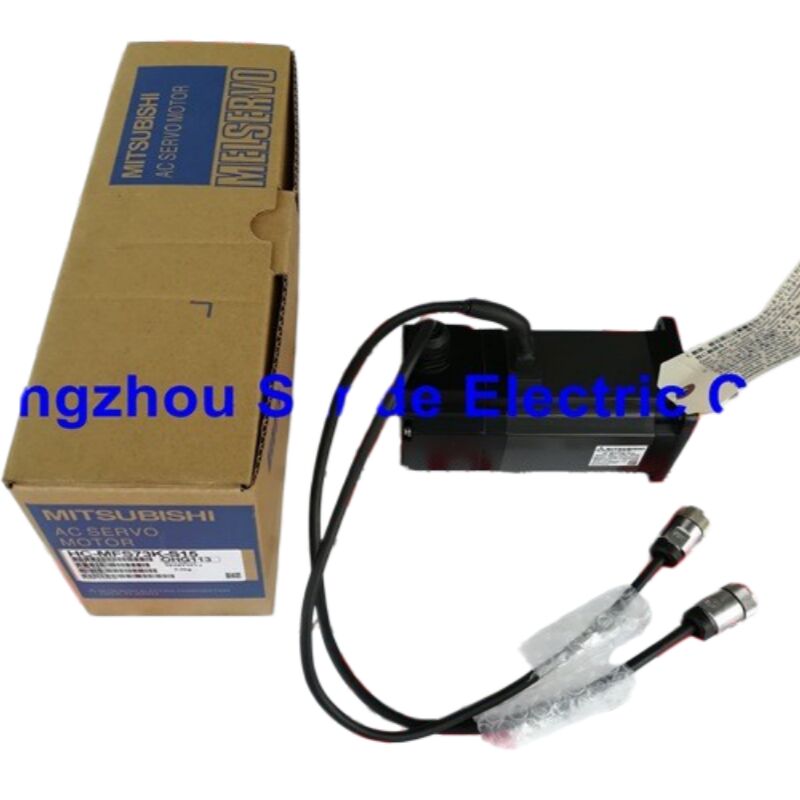
Mitsubishi HC-MFS73K-S15 AC Servo Motor — 750W, 3000 RPM, Ultra-Low Inertia
Brand: Mitsubishi Electric
Series: HC-MFS (MELSERVO)
Part Number: HC-MFS73K-S15
Condition: New in Box
Availability: In Stock — Fast Shipping
Built for Precision. Proven in Production.
When positioning accuracy and dynamic response matter — and in most serious automation applications, they do — the motor at the end of the servo loop carries more weight than people give it credit for. The Mitsubishi HC-MFS73K-S15 is an AC servo motor from Mitsubishi Electric's HC-MFS series: ultra-low inertia, compact body, and 750 watts of continuous output power that punches well above its physical size.
This is a motor that belongs on a machine tool, a pick-and-place system, a semiconductor handling line, or any precision automation application that demands tight, repeatable positioning without the mechanical complexity of a high-inertia drive train. It pairs directly with Mitsubishi's MR-J2S series servo amplifiers and integrates into the full MELSERVO ecosystem with no compatibility guesswork.
Core Specifications
| Parameter |
Value |
| Model |
HC-MFS73K-S15 |
| Series |
HC-MFS (Ultra-Low Inertia, Small Capacity) |
| Rated Output |
750W (0.75 kW) |
| Input Power |
3-Phase AC 117V |
| Rated Input Current |
5.2A |
| Rated Speed |
3,000 r/min |
| Maximum Speed |
4,500 r/min |
| Instantaneous Peak Speed |
5,175 r/min |
| Rated Current |
5.1A |
| Peak Current |
18.0A |
| Moment of Inertia |
0.6 × 10⁻⁴ kg·m² (3.28 oz·in²) |
| Electromagnetic Brake |
Installed |
| Shaft End |
Keyway (K suffix) with Special Shaft End (S15) |
| Voltage Class |
200V AC |
| Feedback |
Encoder |
| Compatible Amplifiers |
MR-J2S-70A / MR-J2S-70B / MR-J2S-70CL / MR-J2S-70CP |
Data sourced from Mitsubishi Electric HC-MFS Series product specifications.
What Sets the HC-MFS Series Apart
The HC-MFS line was engineered specifically around one design priority: minimize rotor inertia without sacrificing output torque. That decision has downstream consequences throughout the entire servo loop — and they're all positive.
Low-inertia rotors respond faster to velocity and position commands. Acceleration and deceleration happen in shorter windows, which means faster cycle times and tighter settling behavior on point-to-point moves. For applications running hundreds or thousands of positioning cycles per shift, that responsiveness compounds into real throughput gains.
The HC-MFS73K sits at the top of the HC-MFS small-capacity range at 750W — enough output for demanding single-axis applications while keeping the motor body compact enough to fit in space-constrained machine designs.
The K and S15 Suffixes — What They Mean for Your Installation
The K in HC-MFS73K indicates a keyway shaft end — the motor shaft includes a machined keyway slot for positive mechanical coupling to pulleys, gearboxes, or couplings. This is the preferred configuration when backlash-free torque transmission matters and the application calls for a keyed mechanical interface.
The S15 designation refers to a special shaft end specification within Mitsubishi Electric's catalog convention. This variant is intended for specific mounting and mechanical interface requirements. If you're replacing an existing HC-MFS73K-S15, the S15 suffix is part of the exact specification — confirm it matches your application before ordering.
The electromagnetic brake (indicated by the B characteristic in this model) is built into the motor housing and engages when power is removed — providing load-holding capability on vertical axes, clamping applications, or any installation where the axis must hold position without active motor power.
Compatible Servo Amplifiers
The HC-MFS73K-S15 is designed to operate with the following MR-J2S series servo amplifiers:
| Amplifier Model |
Type |
| MR-J2S-70A |
General-purpose AC servo amplifier |
| MR-J2S-70B |
SSCNET-compatible amplifier |
| MR-J2S-70CL |
Fully-closed loop amplifier |
| MR-J2S-70CP |
Fully-closed loop with SSCNET |
Connection is made through two interfaces: the encoder feedback cable connects to the CN2 port on the amplifier, and the power supply cable connects via three screw terminals labeled U, V, and W. Both cables should be specified to Mitsubishi Electric's cable compatibility guidelines for the MR-J2S series.
Where This Motor Works
The HC-MFS73K-S15 is at home in a wide range of precision motion applications:
CNC Machine Tools — Axis drives on milling, turning, and grinding centers where positioning repeatability and surface finish quality depend on tight velocity control and fast settling.
Pick-and-Place and SCARA Robots — Lightweight arm configurations benefit from the low rotor inertia, which keeps reflected inertia ratios favorable and allows more aggressive motion profiles.
Semiconductor and Electronics Manufacturing — Wafer handling, die bonding, and inspection systems running continuous high-cycle positioning in cleanroom environments.
Packaging Machinery — Form-fill-seal lines, labeling equipment, and case erectors where precise dwell positioning and fast acceleration between stations drive throughput.
Laser Cutting and Engraving Systems — XY gantry drives where path accuracy and velocity smoothness directly determine cut quality.
Ordering and Shipping
This unit ships new in original Mitsubishi Electric packaging. Fast dispatch is available for in-stock units — most orders process within one business day. International shipping via DHL, FedEx, and UPS with full tracking is available worldwide.
For bulk orders, scheduled delivery, or OEM procurement requirements, contact us directly for lead time and pricing confirmation.
FAQ
Q1: What servo amplifier do I need to run the HC-MFS73K-S15?
The HC-MFS73K-S15 is designed to work with Mitsubishi's MR-J2S-70 series amplifiers — specifically the MR-J2S-70A (general purpose), MR-J2S-70B (SSCNET), MR-J2S-70CL (fully closed-loop), and MR-J2S-70CP (fully closed-loop with SSCNET). The "70" rating in the amplifier model corresponds to the 750W output class of this motor. Using an amplifier outside this compatibility group is not recommended and may result in parameter configuration issues or hardware damage.
Q2: Does this motor include an electromagnetic brake, and how does it work?
Yes — the HC-MFS73K-S15 includes an integrated electromagnetic brake. This is a fail-safe, spring-applied brake that engages automatically when power to the brake coil is removed. It is designed for load holding on vertical axes or clamped positions — not for dynamic braking during motion. The brake should be released (coil energized) before the motor begins any movement command. Attempting to run the motor against an engaged brake will cause mechanical damage and void the warranty.
Q3: What does the S15 shaft specification mean, and is it interchangeable with a standard HC-MFS73K?
The S15 suffix identifies a special shaft end configuration in Mitsubishi Electric's product structure. While the base motor performance specifications remain consistent with the HC-MFS73K, the physical shaft dimensions or interface geometry may differ from the standard variant. If you are replacing an existing HC-MFS73K-S15 in a machine, the S15 specification must match exactly to ensure mechanical compatibility with your coupling, pulley, or gearbox. Do not substitute a standard HC-MFS73K without confirming shaft compatibility with your mechanical design.
Q4: Is the HC-MFS73K-S15 still in production, and are spare units available?
The HC-MFS73K-S15 is listed as a discontinued product by Mitsubishi Electric. However, new-in-box units remain available through authorized and specialist industrial automation suppliers serving the installed base of MR-J2S-based systems. If your machine still runs MR-J2S amplifiers and this motor is the specified part, sourcing a new spare now rather than waiting until a failure occurs is the practical approach — availability of discontinued Mitsubishi servo motors tends to tighten over time as stock is absorbed by maintenance demand.
Q5: How do I connect the encoder and power cables on the HC-MFS73K-S15?
The motor uses two connections. The encoder feedback cable connects to the CN2 port on the MR-J2S servo amplifier — use only Mitsubishi-specified encoder cables for this connection, as cable shielding and connector pinout are critical to signal integrity. The power connection is made through three screw terminals on the motor body, labeled U, V, and W, which correspond to the three-phase output terminals of the servo amplifier. Phasing must match the amplifier's U-V-W output sequence. Always refer to the MR-J2S servo amplifier installation manual and the HC-MFS series wiring diagram before making connections, and ensure all power is isolated before handling terminals.



 Your message must be between 20-3,000 characters!