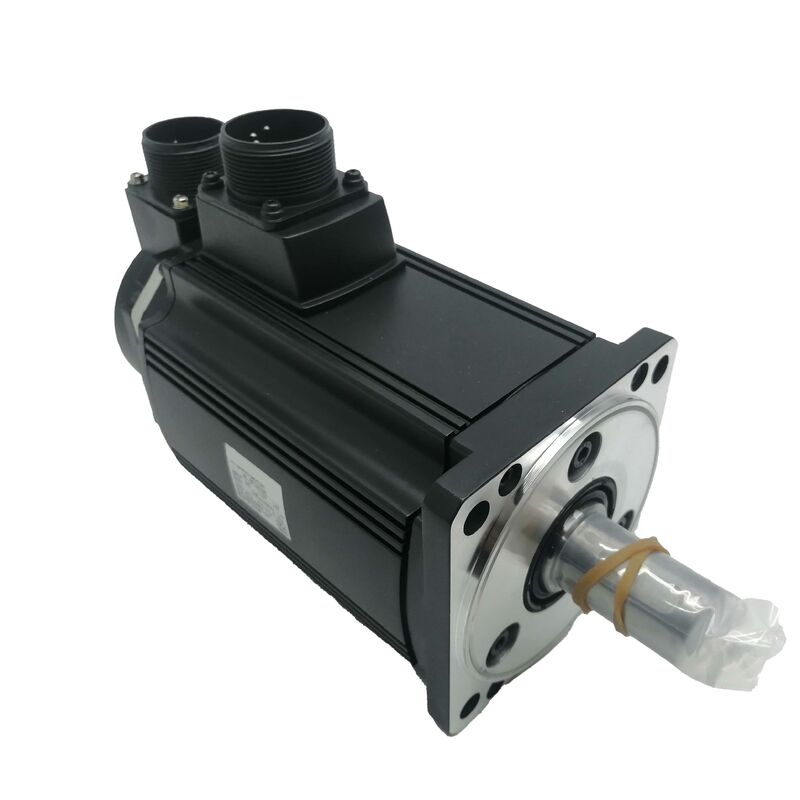
New Mitsubishi HC-RFS203 AC Servo Motor — 2 kW Ultra-Low Inertia, 3000 r/min, 17-Bit Encoder | Free Expedited Shipping
Brand: Mitsubishi Electric
Series: MELSERVO-J2-Super HC-RFS
Part Number: HC-RFS203 / HCRFS203
Condition: New | Free Expedited Shipping | In Stock
What Sets the HC-RFS Series Apart
Not every 2 kW servo motor is built for the same purpose. The Mitsubishi HC-RFS203 was developed specifically for applications where acceleration and deceleration cycles happen at high frequency — where the motor is starting, stopping, reversing, and repositioning dozens or hundreds of times per minute rather than running at sustained speed. This usage profile places very different demands on a motor than a conventional spindle or conveyor drive application does.
The defining engineering choice in the HC-RFS series is its ultra-low rotor inertia. A low-inertia rotor accelerates and decelerates faster for a given torque input, which means shorter positioning times, higher cycle rates, and reduced energy expended per move cycle. The trade-off is that low-inertia rotors are less tolerant of high reflected load inertia at the shaft — but in the applications this motor was designed for, that trade-off is the right one. High-frequency transfer machinery, pick-and-place mechanisms, indexing equipment, and fast-response positioning axes are where the HC-RFS203 performs at its best.
Technical Specifications
| Parameter |
Specification |
| Model |
HC-RFS203 |
| Series |
MELSERVO-J2-Super HC-RFS (Ultra-Low Inertia, Medium Capacity) |
| Rated Output Power |
2.0 kW |
| Rated Speed |
3,000 r/min |
| Power Supply |
3-phase 200V AC class |
| Encoder Type |
17-bit serial absolute / incremental |
| Encoder Resolution |
131,072 pulses/revolution |
| Shaft |
Standard straight shaft |
| Electromagnetic Brake |
Not included (standard model) |
| Protection Level |
IP65 |
| Cooling Method |
Totally enclosed, natural convection |
| Compatible Amplifier |
MR-J2S-200A / MR-J2S-200B / MR-J2S-200CP / MR-J2S-200CL |
| Status |
Discontinued OEM — available through specialist surplus supply |
Technical data cross-referenced from Mitsubishi Electric MELSERVO-J2-Super series documentation and verified specialist supplier records.
The 17-Bit Encoder — Precision That Holds at Low Speed
One of the most operationally significant features of the HC-RFS203 is its 17-bit serial absolute encoder, which provides 131,072 discrete position counts per motor shaft revolution.
To put that in perspective: at this resolution, each encoder count represents approximately 0.00275 degrees of shaft rotation. In a typical linear axis driven by a 10mm-pitch ballscrew with a 1:1 coupling ratio, that translates to a theoretical position feedback granularity of approximately 0.076 micrometers per count — a level of resolution that is not the limiting factor in any realistic mechanical system.
The practical significance is felt most at low speeds. Servo systems with low-resolution encoders produce choppy velocity feedback at slow feed rates because the position counts arrive at the controller infrequently and inconsistently. The speed control loop has limited data to work with and the result is visible velocity ripple — a problem that affects surface finish, process consistency, and positioning repeatability at low feed rates. The 17-bit encoder's fine count density provides the speed control loop with rich, regular position data even at very slow shaft speeds, which is what enables the smooth constant-velocity behaviour that precision applications require.
The encoder is also an absolute type, meaning it retains position reference through power cycling without requiring a homing return sequence after each power-on event.
Ultra-Low Inertia — Understanding the Specification and Its Implications
The HC-RFS designation signals ultra-low rotor inertia within the Mitsubishi MELSERVO-J2-Super motor family. Understanding what this means in practice — and where it matters — is essential for getting the most out of this motor in a system design.
What "low inertia" accomplishes. Rotor inertia is the resistance that the motor's rotating mass offers to changes in speed. A lower inertia rotor requires less torque to accelerate and decelerate at a given rate. For the servo amplifier driving the motor, this translates directly into faster response to velocity and position commands. The motor can follow the command profile more closely, which reduces following error and shortens the time required to reach and settle at a target position.
Where it applies. Applications that benefit most are those with short, repeated move cycles — indexing tables running multiple positions per second, packaging machines with fast pick-and-place cycles, printing equipment requiring precise registration at high line speeds, and semiconductor handling equipment where throughput depends on minimizing per-cycle move time.
What it requires from the load. Ultra-low inertia motors are most effective when the reflected load inertia at the motor shaft is kept within a reasonable multiple of the motor's own rotor inertia. Mitsubishi's MELSERVO-J2-Super documentation provides load-to-motor inertia ratio guidance for each motor model. When high load inertia is unavoidable, a gearbox can be used to reduce the reflected inertia at the motor shaft — a common approach when coupling an HC-RFS series motor to a heavier load mechanism.
HC-RFS in the J2-Super Family Context
The MELSERVO-J2-Super series established several distinct motor sub-families with different inertia characteristics, each optimized for a different class of application:
HC-KFS / HC-MFS — small-capacity, low-inertia motors in the 50W to 750W range, used in light-duty axes and small machines
HC-SFS — standard-inertia medium-capacity range covering applications where higher reflected loads are typical and smooth constant-velocity performance is prioritized
HC-RFS — ultra-low-inertia medium-capacity range (including the HC-RFS153, HC-RFS203, HC-RFS353, HC-RFS503) for high-frequency operation and demanding acceleration profiles
HC-LFS / HC-UFS — higher-capacity models for larger axis drives and specialty applications
The HC-RFS203 sits at the 2 kW level within the ultra-low-inertia group, paired with the MR-J2S-200A/B amplifier. Its siblings in the same series — HC-RFS153 (1.5 kW) and HC-RFS353 (3.5 kW) — cover adjacent power levels where the same ultra-low-inertia characteristic is needed at different output ratings.
Compatibility and Amplifier Pairing
The HC-RFS203 is designed for use with the Mitsubishi MELSERVO-J2-Super series amplifiers. The standard pairing for 200V class operation is the MR-J2S-200A (position, speed, and torque control, pulse train/analog interface) or the MR-J2S-200B (SSCNET compatible). The CP and CL variants of the same 200A platform support CC-Link and other communication interfaces within the same motor compatibility list.
Important note on migration: Mitsubishi has published a formal J2S renewal program that maps HC-RFS series motors to their successor HG-SR series equivalents for customers transitioning aging MELSERVO-J2-Super installations to current-generation MELSERVO-J4 hardware. The HC-RFS series and its compatible MR-J2S amplifiers are discontinued OEM products. Machines still running this platform are typically maintained through specialist surplus supply rather than new OEM procurement. The motor and amplifier combination continues to perform fully to specification when supplied as a tested surplus unit, and replacement with the original part number remains the most straightforward maintenance path for the installed base.
Condition and Availability
This listing covers new HC-RFS203 units. New-old-stock (NOS) Mitsubishi servo motors are available through specialist industrial automation distributors who maintain inventory sourced during the product's active production period. New units have never been installed in a machine and retain their original factory packaging, protective shaft cover, and connector blanks.
For applications where a new unit is essential — warranty requirements, critical new-build installations, or situations where the motor will be stored as a standby spare — new stock is the appropriate choice. Where cost is the primary consideration and the motor will be installed directly, fully tested surplus units offer comparable functional performance at lower cost.
Free expedited shipping is included on this listing. For international destinations, lead time and carrier options vary — contact us before ordering to confirm delivery arrangements for your region.
FAQ
Q1: The HC-RFS203 is described as "ultra-low inertia." What load-to-motor inertia ratio is acceptable for this motor?
Mitsubishi's MELSERVO-J2-Super documentation specifies a recommended load-to-motor inertia ratio of up to 30 times the motor's own rotor inertia for the HC-RFS series. Operating within this guideline ensures the servo amplifier's auto-tuning and gain adjustment functions can maintain stable closed-loop performance across the full speed and acceleration range. When the load inertia ratio exceeds 30 times, Mitsubishi advises contacting their technical support to evaluate whether the application can be accommodated with specific gain settings, mechanical modifications, or a different motor selection. In practice, if your application has high reflected load inertia at the motor shaft — for example, a heavy rotary table coupled directly — a reduction gearbox between the motor and load is a more effective solution than simply accepting a high inertia ratio.
Q2: Does the HC-RFS203 come with an absolute encoder, and does this mean no battery is needed at the amplifier?
The HC-RFS203 is equipped with a 17-bit serial absolute encoder as standard. The absolute encoder retains single-turn position information within the encoder itself. However, for multi-turn absolute position retention — which is what allows the controller to know the axis position across power-off events in machines with more than one revolution of travel per axis — the MR-J2S series amplifier requires an external battery (MR-BAT) connected at the amplifier's battery connector. The encoder's absolute property handles single-revolution position resolution; the amplifier battery handles the multi-turn revolution count through power-off intervals. If the MR-BAT battery is not installed or is depleted when power is removed, the absolute multi-turn position data is lost and a reference return will be required on the next power-on. The battery is a standard maintenance item on any MELSERVO-J2-Super installation using absolute-type motors.
Q3: What is the difference between the HC-RFS203 and the HC-SFS203, and can they be used interchangeably?
Both motors share the same 2 kW rated output and 3,000 r/min rated speed, and both are compatible with the MR-J2S-200A amplifier. The key difference is rotor inertia and the resulting performance characteristics. The HC-SFS203 is a standard-inertia motor suited to applications with moderate load inertia and requirements for smooth constant-velocity performance under load. The HC-RFS203 is the ultra-low-inertia variant engineered specifically for high-frequency acceleration and deceleration cycles. The two motors are electrically compatible with the same amplifier but mechanically have different flange dimensions and shaft configurations — they are not physically drop-in interchangeable without verifying the mounting dimensions against the machine's motor mounting interface. If you are replacing one with the other, confirm the frame dimensions, shaft diameter, and encoder cable compatibility before ordering, or consult the Mitsubishi J2S renewal documentation for verified replacement pairings.
Q4: What is the migration path if the MR-J2S-200A amplifier is also unavailable, and the whole servo axis needs to be replaced?
Mitsubishi Electric published a formal migration guide — the MELSERVO-J2S/J2M Renewal Guide — that covers the complete replacement path from HC-RFS series motors and MR-J2S amplifiers to current-generation equivalents. The primary upgrade path takes the MR-J2S-200A amplifier to the MR-J4-200A and maps the HC-RFS203 motor to the HG-SR series equivalent. This replacement involves using a Mitsubishi renewal kit that adapts the existing machine wiring harness to the new amplifier's connector pinout, avoiding the need to rewire the machine from scratch. The guide specifies the exact renewal kit part numbers, motor replacement pairings, and important notes regarding differences in torque characteristics and inertia ratios between the original and replacement components. For any machine where both the motor and amplifier need replacement simultaneously, using the renewal documentation and following the Mitsubishi-specified kit configuration is strongly recommended over ad-hoc component substitution.
Q5: This motor is listed as a new unit. How should it be stored if it is purchased as a spare and not installed immediately?
Mitsubishi Electric's servo motor storage recommendations should be followed for any new unit being held as a spare. The motor should be stored indoors in a clean, dry environment with ambient temperature maintained between −15°C and +70°C and humidity below 90% (non-condensing). Direct sunlight, vibration, and corrosive atmospheres should be avoided. The shaft should not be left exposed to moisture — keep the protective shaft cover in place until installation. For storage periods exceeding one year, it is advisable to rotate the shaft periodically to redistribute bearing grease and prevent static bearing indentation. The encoder assembly is a precision optical device; the motor should not be stored in environments with conductive dust, metallic swarf, or aggressive chemical vapors. When the motor is eventually installed after extended storage, inspect the encoder cable connector and power connector for any signs of corrosion or contamination before connecting to the amplifier.



 Your message must be between 20-3,000 characters!