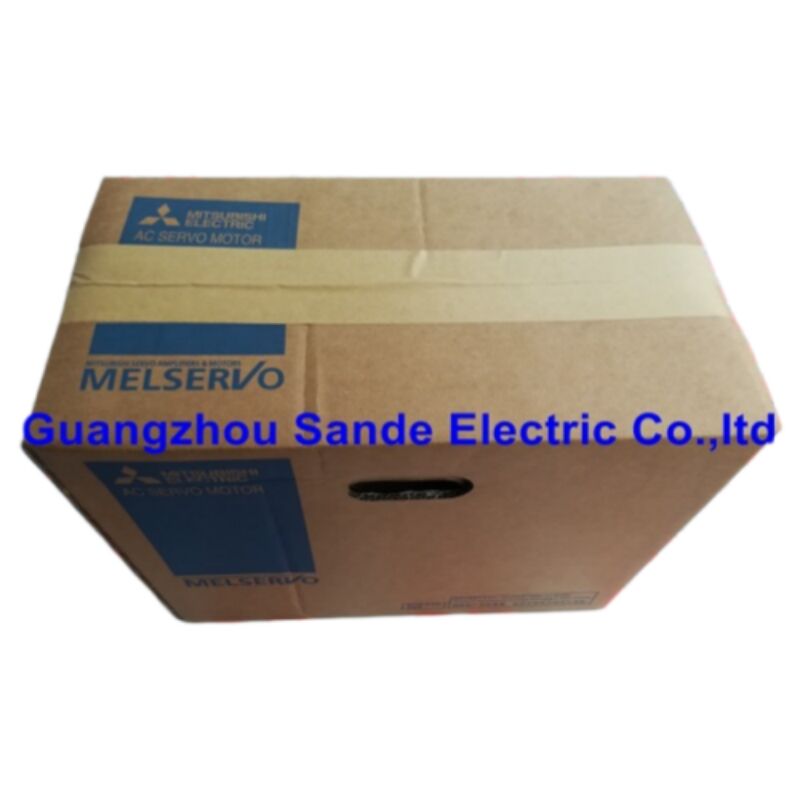
Mitsubishi HC-SF202B (HCSF202B) — MELSERVO J2 2kW AC Servo Motor with Electromagnetic Brake, Straight Shaft
Part Identification
Part Number: HC-SF202B (HCSF202B)
Series: Mitsubishi MELSERVO-J2 — HC-SF Series
Classification: Medium Inertia, Medium Capacity AC Brushless Servo Motor with Electromagnetic Brake
Voltage Class: 200V AC class
Overview
The HC-SF series sits at the foundation of Mitsubishi's MELSERVO J2 servo platform — a generation of machine-tool grade motors that defined how medium-inertia axis drives were applied across vertical machining centres, CNC lathes, and multi-axis transfer lines for well over a decade. The HC-SF202B is the 2kW brake variant in that family: the same medium-inertia rotor design that made the HC-SF series the standard choice for direct ball-screw coupling, now fitted with a factory-integrated spring-applied electromagnetic holding brake.
What separates the HC-SF202B from its non-brake counterpart (HC-SF202) is not a performance difference — the rated torque, speed, and encoder specifications are identical. The brake adds a fail-safe mechanism that keeps the motor shaft stationary when the drive is de-energised. That single addition changes where the motor can be deployed: vertical axes, inclined workpiece carriers, gravity-loaded tool changers, and any axis where an uncontrolled drop or creep during a power interruption would be hazardous or damaging. On a horizontal machining centre Z-axis, for instance, the electromagnetic brake is not optional — it is required by safe machine design.
The HC-SF series represents the MELSERVO-J2 generation (not J2S). Its encoder, connectors, and amplifier interface are matched to the MR-J2-A, MR-J2-B, and MR-J2-C amplifier families. Buyers migrating or maintaining existing J2-era installations will find the HC-SF202B is the correct replacement motor — not the later HC-SFS202B, which belongs to the J2S series and uses different connectors and a higher-resolution 17-bit encoder that is not backward compatible with MR-J2 amplifiers.
Technical Specifications
| Parameter |
Value |
| Part Number |
HC-SF202B |
| Series |
MELSERVO-J2 — HC-SF Series |
| Motor Type |
AC Brushless Rotary Servo Motor |
| Rated Output |
2,000W (2kW) |
| Rated Input Voltage |
3-phase AC 138V |
| Rated Input Current |
11A |
| Rated Torque |
9.55 Nm |
| Rated Speed |
2,000 rpm |
| Encoder Type |
Absolute encoder |
| Encoder Resolution |
16,384 ppr (14-bit) |
| Inertia Class |
Medium inertia / Medium capacity |
| Shaft Configuration |
Straight shaft, no keyway |
| Electromagnetic Brake |
Spring-applied, 24V DC electrically released |
| Connector Type |
Cannon (circular) connectors |
| Flange Mounting |
176 × 176mm |
| Protection Rating |
IP65 |
| Operating Temperature |
0°C to +40°C |
| Insulation Class |
Class F |
| Amplifier Generation |
MELSERVO-J2 (MR-J2 series) |
| Status |
Discontinued (new-old-stock available) |
The Electromagnetic Brake: How It Works and Why It Matters
The brake built into the HC-SF202B is a spring-applied, power-released design — meaning the brake engages automatically when power is removed and releases only when a 24V DC supply is applied to the brake coil. This is deliberate. In any application where a loss of power could cause the axis to move under gravity or residual momentum, a system that requires power to engage a brake is intrinsically unsafe. The HC-SF202B's brake operates on the opposite logic: no power means brake on.
During normal operation, the CNC or servo amplifier applies 24V DC to the brake coil as part of the servo-enable sequence. The brake releases, and the motor runs freely under servo control. When the axis is brought to a stop — either at end-of-cycle, during an E-stop, or following a power loss — the brake coil is de-energised and the spring clamp engages within milliseconds, holding the shaft in position.
Three points are critical for correct brake integration:
The brake is a holding device, not a dynamic braking mechanism. It is rated to hold the static shaft load once the motor has been brought to a stop by the amplifier's dynamic braking. Applying the electromagnetic brake to a rotating shaft at speed — as in a hard E-stop without first commanding a controlled deceleration — exceeds its design intent and degrades brake life rapidly. Machine builders should configure the E-stop sequence to allow a brief deceleration period (typically under 200ms at rated speed) before the brake is applied.
A surge absorber or free-wheeling diode is required across the brake coil. When the 24V DC supply is interrupted, the brake coil generates a voltage spike as its magnetic field collapses. Without a suppression circuit, this spike can damage the relay or transistor output driving the brake. Mitsubishi's instruction manual for the HC-SF series explicitly requires this suppression, and the brake circuit wiring diagram in the amplifier manual shows the correct placement.
For vertical axis applications, the brake holding torque should be checked against the axis's unbalanced torque. Mitsubishi's guidance for the J2 series recommends that unbalanced torque on a vertical axis be kept at or below 70% of the motor's rated torque. The electromagnetic brake must also have sufficient holding torque to retain the axis load under all static conditions including maximum workpiece weight. If the axis's holding requirement exceeds the brake's static rating, an additional mechanical axis brake or counterbalance must be provided.
Compatible MELSERVO-J2 Amplifiers
The HC-SF202B is designed for and compatible with the MR-J2 series servo amplifiers. The 200W class in this family covers the following variants:
| Amplifier |
Interface |
Notes |
| MR-J2-200A |
General-purpose (pulse/analog) |
Position, speed, torque control |
| MR-J2-200B |
SSCNET (Mitsubishi Motion bus) |
Requires Mitsubishi Motion Controller |
| MR-J2-200C |
Built-in positioning (point table) |
Standalone multi-point positioning |
All three are matched to the HC-SF202B's 2kW power rating and MR-J2 era encoder interface. The key distinction between variants is the command interface: the A variant accepts pulse-train and analog speed/torque commands from any compatible controller, while the B variant communicates over the Mitsubishi SSCNET high-speed serial bus with an A171SH, A172SH, A173UH, Q172, or Q173 Motion Controller. The C variant includes an internal point table that allows the motor to execute stored positioning sequences without requiring a motion controller.
The HC-SF series motors are not compatible with MR-J2S amplifiers (the later Super series). The J2S amplifier requires the 17-bit encoder interface used by the HC-SFS motors. Connecting an HC-SF202B to an MR-J2S amplifier will result in an encoder communication fault at initialisation.
HC-SF202B in Service: Applications and Axis Types
CNC vertical machining centre Z-axis. The Z-axis is the textbook application for a brake-equipped servo motor. The spindle head and quill assembly may weigh 50–200kg depending on machine size; without a powered axis or an engaged brake, gravity acts on that weight continuously. The HC-SF202B's fail-safe brake ensures the Z-axis stays exactly where it was commanded, even during a power interruption, a scheduled shutdown, or an E-stop triggered by a safety function.
Horizontal machining centre pallet rotary axis. Tombstone-style workholding on an HMC fourth axis carries considerable mass. When the axis is indexed and clamped at a station, the electromagnetic brake adds a secondary retention layer — particularly useful during aggressive heavy cuts where residual vibration from the cutting process might otherwise induce micro-movement on a servo-locked but unbraked axis.
Robot joint axes. Robot shoulder and elbow joints require the shaft to be positively held when power is removed, both for safety and to prevent the robot structure from sagging under its own weight. The HC-SF202B is proportioned for medium-load robot joints in the 2kW range.
Material handling gantry with vertical travel. Transfer gantries lifting workpieces or tooling vertically between process stations need a reliable hold when the gantry is stationary. The HC-SF202B provides that at motor level, complementing (not replacing) any machine-level clamping or mechanical hard-stop systems.
HC-SF Series Generation Context: J2 vs J2S
Understanding why the HC-SF202B remains in active demand despite being discontinued requires a brief look at Mitsubishi's servo generation history.
The MELSERVO-J2 series — which encompasses the HC-SF, HC-RF, HC-UF, HA-FF, and HC-MF motor families with the MR-J2-A/B/C amplifiers — was launched in the late 1990s and saw wide adoption through the early 2000s. Its successor, the MELSERVO-J2S (Super) series, introduced the HC-SFS/HC-RFS/HC-UFS families with higher-resolution 17-bit encoders, updated connectors, and improved amplifier performance. Mitsubishi eventually discontinued the J2 motor line as the J2S and then J3 and J4 series succeeded it.
The consequence is that thousands of machines running MR-J2 amplifiers remain in service worldwide — CNC machining centres, transfer lines, and special purpose machines with design lives measured in decades. When the original HC-SF202B motor wears out or fails, the options are: replace with a genuine new-old-stock HC-SF202B (maintaining full electrical compatibility), carry out an amplifier-and-motor migration to a current-generation J4 system (significant cost and re-commissioning work), or use a repaired/refurbished unit. For most maintenance teams managing a production facility, a genuine new-old-stock HC-SF202B is the most practical and cost-effective solution.
Variant Reference: HC-SF Series 2kW Models
| Part Number |
Shaft |
Brake |
Keyway |
| HC-SF202 |
Straight |
None |
None |
| HC-SF202B |
Straight |
EM brake |
None |
| HC-SF202K |
Straight |
None |
Keyway |
| HC-SF202BK |
Straight |
EM brake |
Keyway |
All four variants deliver the same 2kW / 9.55 Nm / 2,000 rpm electrical performance. The suffix "B" identifies the electromagnetic brake; "K" identifies the keyway shaft. The HC-SF202B (straight shaft, brake, no keyway) is the configuration for friction-coupling drive trains — the recommended approach for ball-screw axes where a keyed coupling would transmit shaft run-out as a periodic radial load.
Storage, Handling, and Commissioning Notes
Storage. New-old-stock units should be stored indoors, away from condensation, direct sunlight, and corrosive atmospheres. Rotate the motor shaft manually through several revolutions every three to six months during long-term storage to redistribute bearing grease. Units in storage for more than two years should have insulation resistance and encoder operation verified before installation.
Brake coil check before installation. Prior to fitting the motor to the machine, apply 24V DC to the brake coil terminals and confirm the shaft rotates freely. Remove power and confirm the shaft resists manual rotation. Both functions can be verified in under a minute with a multimeter and a 24V supply, and confirm the brake mechanism has not been damaged or seized during storage.
Cannon connector care. The HC-SF series uses circular Cannon-type connectors for both the power and encoder cables. These connectors require the bayonet ring to be fully seated and locked. A partially engaged connector will pass continuity checks but may lose contact under vibration — a common cause of intermittent encoder fault alarms. Inspect the connector lock ring condition before fitting cables.
After replacement. The absolute encoder retains position data backed by the battery in the MR-J2 amplifier. On first power-up after motor replacement, the controller will issue an absolute position lost or absolute encoder error alarm. This is expected: the new motor's encoder has no stored reference. Follow the machine's reference-return procedure as defined in the OEM's maintenance documentation to re-establish the absolute position reference, then clear the alarm.
FAQ
Q1: What is the difference between the HC-SF202B and the HC-SFS202B, and can one be used as a replacement for the other?
These are two separate servo motors from different Mitsubishi MELSERVO generations, and they are not interchangeable. The HC-SF202B belongs to the original MELSERVO-J2 series, uses a 14-bit (16,384 ppr) absolute encoder, and connects to MR-J2-A/B/C amplifiers via Cannon-type circular connectors. The HC-SFS202B belongs to the newer MELSERVO-J2S (Super) series, uses a 17-bit (131,072 ppr) absolute encoder, and also uses Cannon connectors — but the encoder communication protocol is different. Connecting an HC-SFS202B to an MR-J2 amplifier, or an HC-SF202B to an MR-J2S amplifier, will result in an encoder error at initialisation because the amplifier and motor encoder protocols do not match. The correct approach is always to replace like with like: HC-SF202B with HC-SF202B for existing J2 systems. Migration to the J2S or J4 platform requires changing both the motor and the amplifier.
Q2: Which MR-J2 amplifier models are compatible with the HC-SF202B, and does it matter which interface type (A, B, or C) is used?
The HC-SF202B is compatible with all three 200W MR-J2 amplifier interface variants: MR-J2-200A (general-purpose analog/pulse), MR-J2-200B (SSCNET bus), and MR-J2-200C (built-in positioning controller). The motor itself is electrically identical in all three pairings — it does not change based on which amplifier it is connected to. The choice of amplifier variant depends entirely on the machine's control architecture: the A variant is driven by pulse-train or analog commands from a CNC or PLC; the B variant is driven over the SSCNET high-speed bus from a Mitsubishi Motion Controller; and the C variant runs internal point-table positioning sequences autonomously. When replacing a failed HC-SF202B in an existing machine, the amplifier type is already determined by the machine's design — simply match the replacement motor to whatever amplifier variant is already installed.
Q3: How should the electromagnetic brake on the HC-SF202B be wired, and what circuit protection is needed?
The electromagnetic brake requires a separate 24V DC supply, independent from the encoder or control power. The brake releases when 24V DC is applied to the coil, and engages (clamps) when that supply is removed. In practice, the brake supply is switched by a relay output from the servo amplifier or safety circuit, which is wired to switch off the brake supply whenever the amplifier issues a servo-off command, an E-stop is triggered, or an alarm condition occurs. A surge absorber or free-wheeling diode must be connected across the brake coil terminals to suppress the voltage spike when the coil supply is interrupted — without it, the inductive spike from the coil can damage the switching relay or transistor over time. Mitsubishi's wiring diagrams for the MR-J2 series show the correct placement: the suppression component connects directly across the coil, as close to the motor connector as practical, not across the relay contact. The brake circuit wiring should also be kept physically separate from the encoder cable to avoid any possibility of inductive interference on the encoder signal wires.
Q4: After installing an HC-SF202B as a replacement, the servo amplifier is showing an absolute position error alarm. Is this expected, and what steps clear it?
Yes, an absolute position lost alarm after motor replacement is entirely expected and does not indicate a fault with the replacement motor or with the amplifier. The absolute encoder in the new motor has no stored home position reference — the reference was established and stored in the previous motor, and was lost when that motor was removed. To clear the alarm and restore normal operation, the axis needs to be re-homed: switch the machine to manual or jog mode; navigate the axis safely to the machine's reference or home position using the machine's manual return procedure; at the home position, execute the home-position set command through the CNC or controller interface to write the encoder's current count as the machine zero reference. Once the reference is stored, the alarm will clear, and the absolute position will be retained across all future power cycles without requiring repetition. The specific interface for the home-position set command varies by machine builder — consult the OEM maintenance manual for the precise procedure on the machine in question.
Q5: The HC-SF202B is listed as discontinued. How can a buyer verify that new-old-stock units are genuine Mitsubishi product and not counterfeits?
Discontinued status means Mitsubishi Electric has stopped new production — it does not mean that genuine new-old-stock inventory no longer exists. Verifying authenticity involves several straightforward checks. First, inspect the motor's nameplate: genuine Mitsubishi HC-SF series units are manufactured in Japan and carry a nameplate showing the rated input (3AC, voltage, current), rated output, rated speed, IP rating, insulation class, serial number, and the Mitsubishi Electric Japan mark. Second, confirm the model number on the nameplate matches the part number ordered — HC-SF202B, not HC-SFS202B or HC-SF202BK. Third, the Cannon connector housings and cable clamps on genuine units are moulded to Mitsubishi's specifications; poorly fitting or mismatched connector bodies can indicate a remanufactured or misrepresented unit. Fourth, request documentation of where the unit was sourced — reputable industrial surplus suppliers can trace inventory to its origin. Finally, for critical applications where verification is essential, basic pre-installation testing includes: insulation resistance check (motor phases to earth), continuity of the brake coil, and encoder power-on communication check with a compatible amplifier before the motor is fitted to the machine.



 Your message must be between 20-3,000 characters!