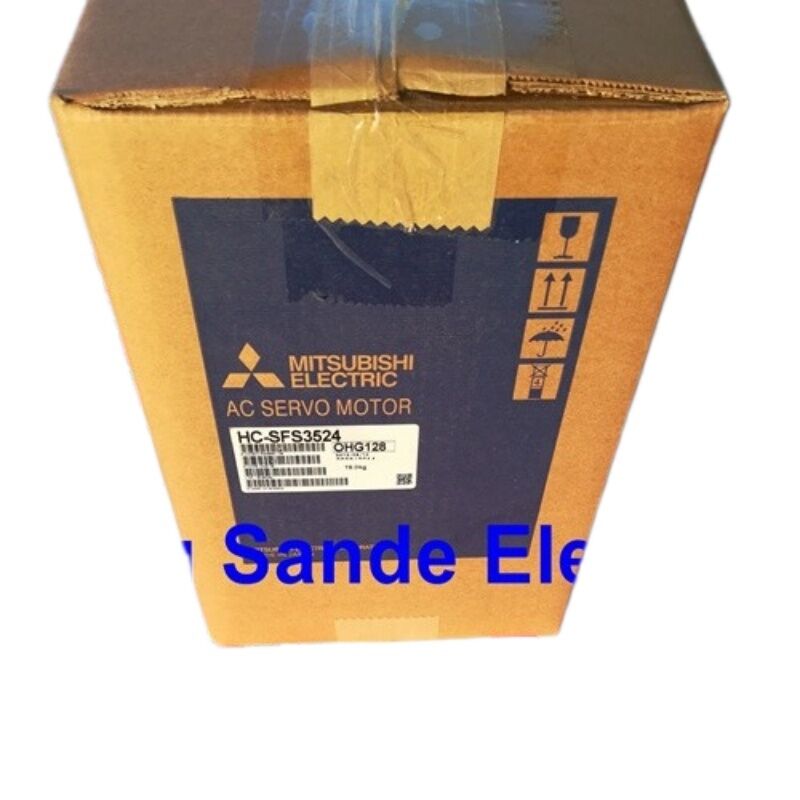
Mitsubishi HC-SFS3524 (HCSFS3524) — MELSERVO J2S 3.5kW AC Servo Motor, 400V Class, Straight Shaft, IP65
Part Identification
Part Number: HC-SFS3524 (HCSFS3524)
Series: Mitsubishi MELSERVO-J2S — HC-SFS Series
Classification: Medium Inertia, Medium Capacity AC Brushless Servo Motor
Voltage Class: 400V (distinguishing it from the HC-SFS352 200V equivalent)
A Different Class of Servo Motor
Most servo motors in industrial automation work in the sub-kilowatt range — compact units driving ball screws, positioning tables, and rotary indexes with relatively modest torque demands. The Mitsubishi HC-SFS3524 is not that motor. At 3.5kW continuous output and 16.7 Nm rated torque, this is a machine tool-grade servo motor built for the kind of axes that carry real loads: heavy milling spindle saddles, large rotary workholding tables, multi-pallet transfer systems, and press-brake forming axes where positioning accuracy and sustained torque output both matter.
The HC-SFS series occupies a specific and deliberate position in Mitsubishi's MELSERVO J2S lineup. Where the HC-KFS and HC-MFS series are optimised for ultra-low and low inertia applications with fast point-to-point cycling, the HC-SFS is a medium inertia design — one tuned for stability and smooth sustained torque delivery under variable load, rather than maximum acceleration response at minimal inertia. For applications where the load inertia ratio to motor inertia is naturally higher, the SFS series' rotor design produces better closed-loop stability and quieter operation than a low-inertia motor fighting a high-inertia load.
The "24" in the part number identifies this as the 400V supply class variant — the electrically equivalent counterpart to the HC-SFS352, which runs on 200V AC. Everything about the two motors is mechanically and magnetically identical; the rated torque, speed range, encoder, flange size, and protection rating are the same. The 400V version simply draws half the current (8.6A versus 17A rated) at double the supply voltage — a practical consideration for installations where 400V three-phase infrastructure is the standard, particularly in European and Asian industrial facilities.
Technical Specifications
| Parameter |
Value |
| Part Number |
HC-SFS3524 |
| Series |
MELSERVO J2S — HC-SFS Series |
| Motor Type |
AC Brushless Rotary Servo Motor |
| Rated Output |
3,500W (3.5kW) |
| Supply Voltage |
400V AC class (3-phase, 380V–480V) |
| Rated Current |
8.6A |
| Rated Torque |
16.7 Nm |
| Maximum (Instantaneous) Torque |
50.1 Nm |
| Rated Speed |
2,000 rpm |
| Maximum Speed |
2,500 rpm |
| Encoder Type |
17-bit absolute serial encoder |
| Encoder Resolution |
131,072 ppr (equivalent) |
| Motor Inertia Class |
Medium inertia / Medium capacity |
| Shaft Configuration |
Straight shaft, no keyway, no brake |
| Oil Seal |
Fitted |
| Flange Mounting |
176 × 176mm |
| Protection Rating |
IP65 |
| Operating Temperature |
0°C to +40°C |
| Storage Temperature |
−15°C to +70°C |
| Operating Humidity |
Max 80% RH (non-condensing) |
| Altitude |
Max 1,000m above sea level |
| Insulation Class |
Class F |
| Status |
Discontinued (genuine new-old-stock available) |
Torque-Speed Relationship: What the Numbers Mean in Practice
Rated torque of 16.7 Nm is what this motor delivers continuously — the sustained output it can maintain through a full production cycle without thermal overload. The maximum instantaneous torque of 50.1 Nm is the peak the motor can produce for short durations: acceleration bursts at axis start-up, deceleration into position, and brief overloads during cutting entry.
The ratio between those two figures — about 3:1 — is characteristic of the HC-SFS series design. It means that for any positioning move where the duty cycle is reasonable, the motor can accelerate at nearly three times its continuous rated torque, shortening the time from rest to feedrate and back to rest again. The practical result is rapid axis settling without requiring a lower inertia motor that would trade off running stability.
At 2,000 rpm rated speed, this motor is optimised for direct coupling to ball screws and gear drives rather than for high-speed spindle applications. A typical installation might couple the HC-SFS3524 directly to a 10mm or 20mm pitch ball screw: at 2,000 rpm, those produce linear travel rates of 20 m/min and 40 m/min respectively — squarely within the rapid traverse range of medium-format machine tools.
400V Class — Practical Implications
The choice between the HC-SFS3524 (400V) and HC-SFS352 (200V) is not a performance question — both deliver identical mechanical output. It is an infrastructure question.
Three-phase 400V supply is the standard grid voltage in the EU, much of Asia, and many modern industrial facilities in other regions. Running 3.5kW servo axes from a 400V supply rather than 200V means the supply current at full load is roughly halved, which allows the use of smaller cable cross-sections in the motor power harness and reduces resistive losses in long cable runs between the drive cabinet and the machine axis. In multi-axis machines where several HC-SFS3524 motors run simultaneously, the cumulative cable sizing benefit becomes meaningful.
The corresponding 400V servo amplifier — the MR-J2S-350A4 (general-purpose interface) or MR-J2S-350B4 (SSCNET bus interface) — draws from the same 400V three-phase supply, making the entire drive chain consistent with the facility's power infrastructure without requiring step-down transformers.
Compatible Servo Amplifiers
| Amplifier Model |
Interface |
Notes |
| MR-J2S-350A4 |
General-purpose pulse/analog |
Standard position/speed/torque control |
| MR-J2S-350B4 |
SSCNET high-speed serial |
Mitsubishi Motion Controller integration |
| MR-J2S-350CP4 |
Built-in positioning (point table) |
Program-free standalone positioning |
| MR-J2S-350CL4 |
Fully closed-loop |
External linear/rotary scale feedback |
All four amplifier variants are rated for 3.5kW at 400V class. The SSCNET-bus B4 variant is the standard choice for machines running a Mitsubishi Q-series or A-series Motion Controller, where all servo axes communicate over the high-speed fibre-optic SSCNET network rather than individual pulse-train cables. The A4 general-purpose variant accepts pulse train or analog speed/torque commands and suits stand-alone or non-Mitsubishi controller configurations.
Where This Motor Is Deployed
CNC machining centre main axes. The HC-SFS3524 sits in the torque and speed class appropriate for X/Y/Z axes on mid-range and large vertical machining centres — machines with table sizes from 400mm × 800mm upward, where axis drive inertia is non-trivial and continuous torque under cutting load matters as much as rapid traverse speed.
Horizontal machining centre pallet and rotary axes. Pallet indexing, tombstone-style fourth-axis drives, and large rotary table positioning axes require sustained torque and precise settling at indexed positions. The medium-inertia SFS design provides the load stability these axes need, and the 17-bit absolute encoder means there is no homing cycle required after each pallet transfer or shift start.
Press-brake and bending machine back-gauge drives. Back-gauge axes must position heavy backstops accurately against the forming stroke, then retract and reposition between bends. The combination of 16.7 Nm continuous torque and a robust 176mm flange provides the mechanical foundation for this kind of duty.
Industrial robot joints and gantry axes. High-payload robot wrist and shoulder joints, and gantry transfer systems moving heavy workpieces between process stations, fit well within the HC-SFS3524's torque envelope. The 400V supply class is standard in robot infrastructure.
Transfer machines and multi-station indexing lines. Transfer machines with shuttle or rotary indexing mechanisms use axes that must accelerate and decelerate heavy fixtures repeatedly throughout a production shift. The SFS series' thermal tolerance under sustained duty makes it a practical choice for this class of work.
The Absolute Encoder: No Homing, Every Start
The 17-bit absolute encoder built into the HC-SFS3524 retains position data across power cycles through battery backup in the MR-J2S-350A4/B4 amplifier. When the machine restarts — after a shift break, planned maintenance, or an unplanned power cut — every servo axis knows immediately where it is. The controller does not need to run reference-return sequences before the machine can resume automatic operation.
For a 3.5kW axis on a machining centre or transfer line, this is not a marginal convenience. A reference-return cycle on a large axis can take 30–90 seconds depending on axis travel and search speed. Multiply that across all axes of a multi-axis machine, and the time saved at each startup — or at each power restoration event during a shift — accumulates quickly over weeks and months of production.
The absolute position is maintained by a standard 3.6V lithium battery in the amplifier. Mitsubishi recommends replacing the battery on a roughly three-year cycle to prevent voltage drop below the retention threshold. The amplifier will issue a battery warning alarm before voltage reaches the critical point, providing advance notice for scheduled replacement.
HC-SFS35 Family: Variant Reference
| Part Number |
Supply Voltage |
Shaft |
Brake |
Key |
| HC-SFS352 |
200V class |
Straight |
None |
None |
| HC-SFS352K |
200V class |
Straight |
None |
Keyway |
| HC-SFS352B |
200V class |
Straight |
EM brake |
None |
| HC-SFS352BK |
200V class |
Straight |
EM brake |
Keyway |
| HC-SFS3524 |
400V class |
Straight |
None |
None |
| HC-SFS3524B |
400V class |
Straight |
EM brake |
None |
All variants share identical torque, speed, encoder, and flange specifications. The suffix structure follows a consistent pattern: "24" indicates 400V class; "B" indicates electromagnetic brake; "K" indicates keyway shaft.
Handling, Installation, and Storage
Coupling to the load. The HC-SFS3524 uses a straight shaft without keyway. Coupling to a ball screw or gear drive requires a friction-clamping style shaft coupling rather than a keyed arrangement. The run-out at the coupling interface should be verified before final tightening — Mitsubishi's installation guidance for the SFS series specifies that ball screw shaft run-out at the motor coupling should be kept to 0.01mm or less to prevent periodic radial loading on the motor's front bearing.
Mounting orientation. The motor can be mounted in any orientation. When the shaft-end is facing upward, Mitsubishi's instruction manual recommends providing a seal or barrier to prevent oil or cutting fluid from tracking down the shaft and past the oil seal into the bearing housing over time.
Cable routing. Route the motor power cable and encoder cable with a downward drip loop before reaching the connectors. This prevents fluid from being directed into the connector body by capillary action along the cable jacket. The IP65 rating depends on correct connector engagement, not the motor body alone.
Storage. New units held as maintenance spares should be stored indoors between −15°C and +70°C, away from condensation risk. The motor shaft should be rotated manually through several revolutions every three to six months during extended storage to maintain bearing grease distribution. Units stored for more than two years should have an encoder signal check before installation.
FAQ
Q1: What is the difference between the HC-SFS3524 and the HC-SFS352, and can they be used interchangeably in the same machine?
The HC-SFS3524 and HC-SFS352 are mechanically and magnetically identical motors — same 3.5kW output, same 16.7 Nm rated torque, same 2,000 rpm rated speed, same 17-bit encoder, same 176×176mm flange, same IP65 rating. The only substantive difference is supply voltage class: the HC-SFS352 operates on 200V AC class supply, while the HC-SFS3524 is rated for 400V AC class (380V–480V three-phase). They are not interchangeable without changing the servo amplifier to match the new supply voltage class. An HC-SFS3524 paired with a 200V-class MR-J2S-350A amplifier will not work — the amplifier must also be the 400V class variant (MR-J2S-350A4 or equivalent). On machines specifically wired for one voltage class, switching between the two motors requires verifying that the entire drive system — amplifier, power supply, and cabling — is consistent with the new motor's voltage rating.
Q2: Which Mitsubishi servo amplifiers are compatible with the HC-SFS3524, and does the SSCNET-bus variant require different motor setup parameters?
The HC-SFS3524 is compatible with all 400V class variants of the MR-J2S-350 amplifier family: the MR-J2S-350A4 (general-purpose analog/pulse interface), MR-J2S-350B4 (SSCNET), MR-J2S-350CP4 (built-in positioning), and MR-J2S-350CL4 (fully closed-loop). For the SSCNET-bus B4 variant, the motor is identified automatically by the amplifier through the encoder communication during initialisation when the correct motor type parameter (parameter No. 0) is confirmed. The servo gain settings, electronic gear ratios, and absolute position parameters are configured identically regardless of whether the drive interface is pulse-train (A4) or SSCNET (B4). The key commissioning step common to both is performing the servo parameter initialisation after initial connection, followed by verifying the absolute position counter once a reference home position has been established on the axis.
Q3: The HC-SFS3524 has a straight shaft with no keyway. What coupling arrangement should be used for a ball screw drive, and what happens if a rigid coupling is used?
Mitsubishi's own instruction manual for the HC-SFS series explicitly cautions against using a rigid coupling between the motor shaft and ball screw. A rigid coupling transmits any misalignment — axial, radial, or angular — directly as a periodic load on both the motor's front bearing and the ball screw's support bearing. Even a small amount of misalignment, invisible to the eye during installation, can significantly reduce bearing service life and introduce a periodic ripple on the encoder signal that shows up as velocity noise in the servo loop. The correct solution is a flexible coupling that accommodates small misalignment while transmitting torque without backlash. Jaw-type, disc-type, or bellows-type servo couplings are all commonly used. If a rigid coupling must be used for stiffness reasons in a specific application, Mitsubishi requires that the ball screw shaft run-out at the coupling interface be verified at 0.01mm or less before final assembly — a level of precision that requires proper dial indicator checking rather than visual inspection.
Q4: This motor is listed as discontinued. Is new-old-stock still genuine Mitsubishi Electric product, and what should buyers verify before purchasing?
Yes — new-old-stock units are genuine Mitsubishi Electric products manufactured in Japan to the original specification. "Discontinued" means Mitsubishi is no longer producing new units in the J2S series, not that existing inventory is in any way downgraded or counterfeit. The practical considerations when purchasing are straightforward: confirm that the unit comes in original Mitsubishi Electric packaging, verify the label shows the correct part number (HC-SFS3524, not a variant such as HC-SFS352 or HC-SFS3524B), and confirm with the supplier that the unit has been stored under appropriate conditions. For the most reliability-sensitive applications, buyers may also request that the supplier perform a basic function test — confirming encoder communication is active, insulation resistance is within specification, and there are no physical signs of storage damage — before shipment. Given that the HC-SFS3524 is a heavy-duty motor used on critical machine axes, this level of pre-delivery verification is a reasonable precaution.
Q5: After replacing the HC-SFS3524 motor on a machine axis, the servo drive displays an absolute position lost alarm. What is the correct procedure to restore normal operation?
An absolute position lost alarm after motor replacement is expected and normal — it does not indicate anything is wrong with the new motor or amplifier. The alarm occurs because the 17-bit encoder in the new motor has not yet established its reference position relative to the machine's mechanical zero point. The procedure to clear it and restore absolute position operation varies slightly between machine builders' implementations, but the general sequence is: first ensure the axis is physically clear to move safely; acknowledge the alarm and switch the control to manual (JOG) mode; move the axis to the machine's reference (home) point or zero mark, either by visual reference to a mechanical datum or by a controlled reference-return operation as defined by the machine builder; confirm the position at the controller; and then execute the absolute position setting command in the CNC or PLC to write the current encoder count as the machine zero reference. Once this reference is established, the alarm will clear and the absolute encoder will retain the position across all subsequent power cycles without requiring repetition. The specific parameter or screen for the position setting step is documented in the machine builder's maintenance manual for the axis.



 Your message must be between 20-3,000 characters!