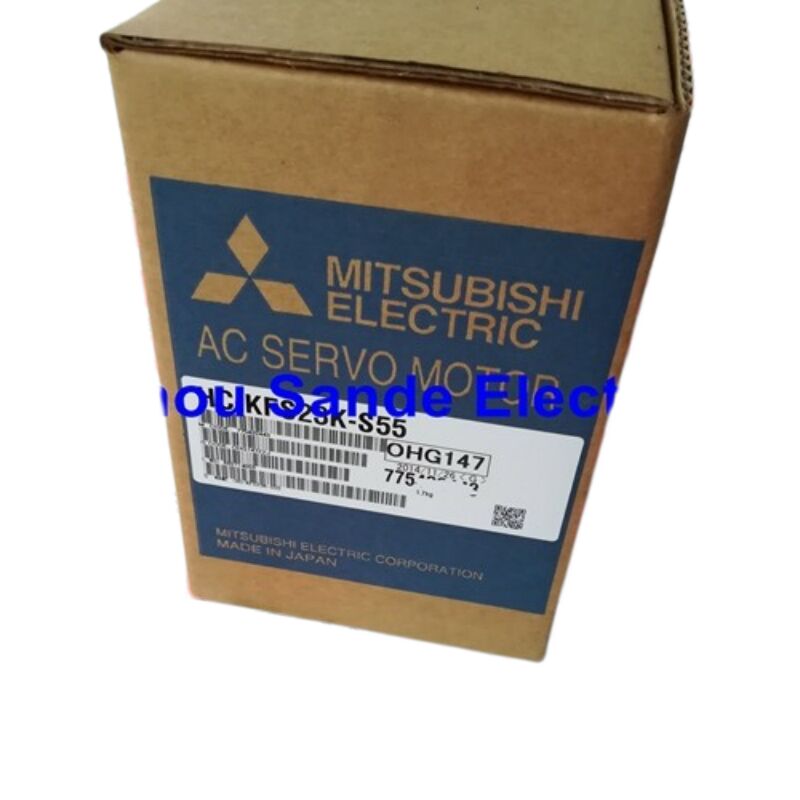
Mitsubishi HC-KFS23K-S55 — MELSERVO J2S Series 200 W AC Servo Motor, Keyed Shaft, Special Specification
Overview
The HC-KFS23K-S55 is a factory-ordered special specification variant of Mitsubishi Electric's HC-KFS23K servo motor — a 200 W, 3,000 r/min unit from the MELSERVO J2S series. Within the HC-KFS family, which spans from 50 W (HC-KFS053K) through 750 W (HC-KFS73K), the 200 W model occupies the second position in the range, sharing the same low-inertia design philosophy as its siblings while offering enough torque headroom for a wider class of mechanisms than the 50 W or 100 W entries below it.
The "-S55" extension identifies this as a special specification build ordered through Mitsubishi Electric's factory customisation programme. In Mitsubishi's MELSERVO motor documentation (SH030054/SH030056 series), the S-suffix codes in the specification symbol list denote motor variants produced to customer-specific requirements — covering combinations of oil seals, connector configurations, cable exit directions, shaft dimensions, and other factory-level modifications not available in the standard catalogue. The core electrical and mechanical characteristics of the HC-KFS23K remain unchanged; the S55 designation refers to a specific factory build option that should be confirmed against the machine builder's original bill of materials when sourcing a replacement.
This listing is offered as New, original Mitsubishi Electric manufacture.
Verified Specifications
| Parameter |
Value |
| Rated output |
200 W |
| Rated torque |
0.64 N·m (90.6 oz·in) |
| Maximum torque |
1.9 N·m |
| Rated speed |
3,000 r/min |
| Maximum speed (continuous) |
4,500 r/min |
| Permissible instantaneous speed |
5,175 r/min |
| Rated current |
1.1 A |
| Maximum current |
3.4 A |
| Supply voltage (from amplifier) |
200 V AC class, 118 V (3-phase output from amplifier) |
| Power facility capacity |
0.5 kVA |
| Power rate at continuous rated torque |
15.8 kW/s |
| Encoder type |
17-bit absolute/incremental serial (equivalent to 131,072 pulses/rev) |
| Rotor inertia |
2.60 × 10⁻⁵ kg·m² |
| Shaft |
Keyed straight shaft (open slot, key included) |
| Flange size |
60 × 60 mm |
| Electromagnetic brake |
None |
| IP rating |
IP55 (shaft-through portion and connector excluded) |
| Ambient operating temperature |
0 to +40°C |
| Motor weight (standard) |
Approx. 0.99 kg |
| Motor weight (with brake option) |
Approx. 1.6 kg |
The HC-KFS Series in Mitsubishi's Motion Portfolio
Mitsubishi released the HC-KFS series as part of the MELSERVO J2-Super (MR-J2S) platform — a generation that brought 17-bit absolute encoder feedback, real-time auto-tuning, and anti-microvibration control to a broad range of machine types. The "KFS" designation within Mitsubishi's naming convention identifies the low-inertia, small-capacity class: a family optimised for high-cycle-rate applications where rapid acceleration, short settling time, and compact physical dimensions matter more than high peak torque.
Where the SFS (medium inertia) and RFS (medium inertia, round flange) series serve heavier loads and larger inertia ratios, the KFS series was designed for mechanisms with a tight load-to-motor inertia ratio — belt drives, lightweight robotic arms, XY tables, labelling units, sewing machine drives, assembly pick-and-place, and similar tasks. The 60 × 60 mm flange of the HC-KFS23K fits naturally into compact machine frames, and the motor's power rate of 15.8 kW/s — a figure that represents the ratio of rated torque squared to rotor inertia — reflects genuinely responsive dynamics, not just nameplate output.
17-Bit Absolute Encoder: Position Without Reference Return
Every HC-KFS23K ships with an integrated 17-bit absolute encoder providing 131,072 counts per motor revolution. Unlike older incremental encoders, this device retains shaft position data continuously — across power cycles, emergency stops, and planned shutdowns. When the machine is powered on, the MELSERVO J2S amplifier reads the current shaft position immediately, without requiring a reference return (G28/zero return) to establish axis coordinates.
In practice, this eliminates the production delay that incremental-encoder machines impose at every startup and after any power failure. For multi-shift operations, the accumulated time saving across a year of production can be substantial. For vertical axes or any configuration where moving to a home position before operation is mechanically undesirable, the absolute encoder removes the constraint entirely.
The battery that maintains absolute position data during power-off periods is housed in the servo amplifier (MR-J2S series), not in the motor body. This means a motor change does not affect the battery or the stored absolute position data at the amplifier — a practical advantage during motor maintenance on machines with established coordinate systems.
Compatible Servo Amplifiers
The HC-KFS23K-S55 operates with MELSERVO MR-J2S-20 class amplifiers across all interface variants:
| Amplifier |
Interface Type |
| MR-J2S-20A |
General-purpose pulse/analogue interface |
| MR-J2S-20B |
SSCNET fibre-optic bus (for Mitsubishi motion controllers) |
| MR-J2S-20CP |
CC-Link interface |
| MR-J2S-20CL |
CC-Link with positioning function |
The MR-J2S-20A is the most common pairing for standalone machines with PLC-generated pulse commands. The MR-J2S-20B is used where the motor is one axis in a coordinated multi-axis motion system connected via Mitsubishi's SSCNET fibre-optic bus. Both share the same motor and encoder cable interfaces, and both support the full complement of MR-J2S functions: real-time auto-tuning, servo lock anti-microvibration, feed-forward gain, in-position output, and multi-mode gain switching.
Cable accessories for this motor class:
- Encoder cable: MR-JCCBL□M-L (2 m / 5 m / 10 m / 20 m / 30 m)
- Power cable: MR-PWCNS□-L (2 m / 5 m / 10 m / 20 m / 30 m)
- Encoder connector kit (field assembly): MR-J2CNM
IP55 Rating and Environmental Considerations
The HC-KFS23K-S55 carries an IP55 rating across the motor body — total protection against dust and protection against low-pressure water jets from any direction. The two areas explicitly excluded from this rating are the shaft-through opening and the cable connectors; in standard installation with correctly mated cable connectors, the connectors are dripproof. In environments with oil mist, cutting fluid, or splash exposure, Mitsubishi's documentation identifies this as a condition where the motor may not remain suitable in standard specification — the S-suffix special specification variants can address this, which is one reason the -S55 suffix exists in this family.
The motor mounts in any orientation. When installed horizontally, Mitsubishi recommends routing the power and encoder cables downward from the cable exit to prevent liquid migration along the cable into the connector. For vertical mounting or inclined installation, a cable trap (loop) in the routing provides the same protection.
HC-KFS23K Variant Matrix
The HC-KFS23K is available in four standard configurations. The S55 is a factory-specified variation built on the base HC-KFS23K:
| Model |
Shaft |
Brake |
Notes |
| HC-KFS23 |
Straight, no key |
None |
Standard variant |
| HC-KFS23K |
Straight, keyed |
None |
Key included |
| HC-KFS23B |
Straight, no key |
24V DC brake |
Brake motor |
| HC-KFS23BK |
Straight, keyed |
24V DC brake |
Brake + key |
| HC-KFS23K-S55 |
Straight, keyed |
None |
Factory special specification |
Compatibility note: The HC-KFS series has been succeeded by Mitsubishi Electric's HG-KR series (MELSERVO J4 platform). The HG-KR23K is the current-generation functional equivalent at 200 W / 3,000 r/min. These two series are not directly interchangeable — the encoder interface, cable connectors, amplifier generation (MR-J4 vs MR-J2S), and physical flange dimensions differ. HC-KFS23K-S55 units remain the correct replacement for machines built around MR-J2S amplifiers.
FAQ
Q1: What does the "-S55" suffix mean on the HC-KFS23K-S55, and how does it affect function?
In Mitsubishi Electric's MELSERVO motor catalogue documentation, the "-S" suffix codes following the base model number denote special specification variants produced to specific factory options. These modifications are documented in Mitsubishi's internal specification symbol list (Section 8 of the HC-KFS series instruction manual, SH030054 series) and can cover features including oil seals for shaft entry, alternative connector configurations, modified cable exit directions, or other build-level changes requested by machine builders ordering in volume. The core electrical performance — 200 W output, 0.64 N·m rated torque, 3,000 r/min, 17-bit absolute encoder, 1.1 A rated current — is identical to the standard HC-KFS23K. When sourcing an S55 to replace a failed unit, confirm the original motor's nameplate to ensure the physical build matches before installation.
Q2: Does the absolute encoder on this motor eliminate the need for a homing sequence at machine startup?
Yes, under normal operating conditions. The 17-bit absolute encoder retains the exact shaft position continuously, even when machine power is removed. When the MR-J2S amplifier is powered on, it reads the stored position immediately and the axis is available for commanded moves without a reference return cycle. The one exception is a battery alarm at the MR-J2S amplifier (alarm code A.E3 in the MR-J2S diagnostic display) — if the battery in the amplifier discharges fully before replacement, the absolute position data is lost and a single reference return is needed to re-establish the coordinate reference. Under normal maintenance intervals (battery replacement every 3–5 years), this situation is avoidable.
Q3: What is the maximum permissible load inertia ratio for this motor, and why does it matter?
Mitsubishi's MELSERVO J2S documentation specifies that if the load inertia moment exceeds the motor inertia moment by more than a defined ratio, the combination should be reviewed with Mitsubishi before commissioning. For the HC-KFS23K with a rotor inertia of 2.60 × 10⁻⁵ kg·m², the practical significance is this: as the load inertia ratio increases, the servo system requires lower gain settings to remain stable, which directly reduces bandwidth and settling speed. The low-inertia HC-KFS design is intentionally optimised for load-to-motor inertia ratios at the low end — typically below 10:1 to 30:1 depending on application demands. For applications with large, heavy-diameter rollers, large pulleys, or other high-inertia loads, the HC-SFS or HC-RFS medium-inertia series would normally be the more appropriate selection.
Q4: Can the HC-KFS23K-S55 be used on a vertical axis without a brake?
The HC-KFS23K-S55 does not have an electromagnetic brake. On a vertical axis, when the servo amplifier is in a ready state and the servo is energised, the motor holds its position actively through servo torque. The risk arises when the servo is de-energised — during an emergency stop, power loss, or alarm — at which point there is no mechanical holding force and gravity will move the load. For vertical axes where a drop would cause machine damage or a safety hazard, Mitsubishi's own guidance is clear: use either the HC-KFS23BK-S55 brake variant, or implement an external mechanical brake or counterweight system sufficient to hold the load. The spring-applied, 24 VDC electrically-released brake on the BK variants holds position without power, which is the correct configuration for vertical servo axes.
Q5: What are the compatible replacement motors when HC-KFS23K-S55 stock is exhausted?
The direct functional replacement within the current Mitsubishi product line is the HG-KR23K (MELSERVO J4 series), which shares the 200 W / 3,000 r/min specification and keyed shaft configuration. However, transitioning to HG-KR requires a matching MR-J4-20A or MR-J4-20B amplifier, new encoder cable (MR-J3ENCBL□M-A1-L type), new power cable, and a parameter review — the J4 amplifier does not accept J2S motors, and the J2S amplifier does not accept J4 motors. For machines where the investment in a full servo axis replacement is not justified, sourcing new-old-stock HC-KFS23K-S55 units through the industrial surplus and specialist automation parts market remains the fastest, lowest-cost path to restoring the original machine specification without any re-engineering work.



 Your message must be between 20-3,000 characters!