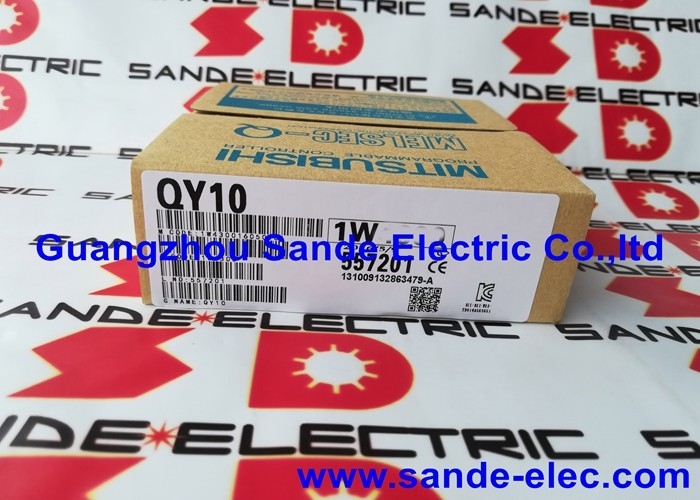
Mitsubishi QY10 Relay Output Module
Overview
The QY10 is a relay output module in the MELSEC-Q Series. Mitsubishi’s product pages identify it as a 16-point relay output module with 240 VAC / 24 VDC rated load voltage and screw terminals, and the product factsheet also lists it as occupying 16 PLC I/O points in the Q Series platform.
Additional module data shows a compact body with 27.4 mm width, 98 mm height, and 90 mm depth.
What makes the QY10 useful in real cabinets is the combination of relay isolation and compact modular Q-series integration.
In practical terms, that means it can switch mixed field loads while still fitting into a standard MELSEC-Q rack structure without forcing users toward external relay interface assemblies for every output channel.
For installed Q-series systems, that continuity is often more useful than changing to a different output style.
This is an engineering inference based on the published relay-output role and the Q Series modular context.
Technical Data
| Parameter |
Value |
| Part Number |
QY10 |
| Manufacturer |
Mitsubishi Electric |
| Product Family |
MELSEC-Q Series |
| Product Type |
Relay output module |
| Output Points |
16 |
| Occupied PLC I/O Points |
16 |
| Output Type |
Relay |
| Rated Load Voltage |
240 VAC / 24 VDC |
| Wiring Method |
Screw terminals |
| Internal Current Consumption |
0.43 A |
| Dimensions |
27.4 × 98 × 90 mm |
| Weight |
0.198 kg |
Application Value
The QY10 is well suited to MELSEC-Q control systems, machine panels, conveyors, utility cabinets, and general automation racks where 16 relay outputs are the right balance between output density and flexible field interfacing.
Mitsubishi’s Q-series product pages position it as a standard digital output module, which makes it a natural fit in cabinets that already depend on the Q platform for modular expansion and mixed I/O composition.
It is also practical in maintenance and spare-parts work.
When a machine has already been built around a Q-series rack and screw-terminal relay outputs, replacing the module with the same QY10 usually preserves the original wiring method, rack address structure, and output-side behavior more cleanly than changing to a different module family.
This is an engineering inference based on the module’s published Q-series position and screw-terminal arrangement.
Replacement and Selection Perspective
For replacement work, the QY10 should be matched by output type, terminal style, point count, and load class, not just by the fact that it is a “Q Series output module.”
The published data clearly identifies it as a relay-output module with 16 outputs, screw terminals, and 240 VAC / 24 VDC rated load voltage.
In practical installations, those details matter directly to field wiring and load compatibility.
FAQ
Q1: What kind of module is QY10?
It is a relay output module for the MELSEC-Q Series. In practical terms, it expands a Q-series PLC rack with 16 relay-switched outputs rather than analog channels or inputs.
Q2: What applications fit it best?
It fits Q-series machine control cabinets, utility panels, conveyors, and general industrial automation systems where a 16-point relay output card is already part of the design.
This follows directly from the published Q-series module role and output configuration.
Q3: Why are relay outputs still useful on a modular PLC system?
Because relay outputs provide electrical flexibility for mixed field loads and are often preferred in legacy or mixed-voltage machine wiring.
In replacement work, keeping the same relay output format usually helps preserve the original field interface behavior.
This is an engineering inference based on the module’s published relay-output class.
Q4: Why do screw terminals matter here?
Because terminal style affects cabinet wiring, replacement effort, and field-service convenience.
Matching the same screw-terminal format usually makes retrofit and maintenance work easier in existing panels.
This is an engineering inference based on the published screw-terminal specification for QY10.
Q5: What should be checked before ordering?
Check the installed part number, confirm that the application needs a relay output module, verify the 16-point requirement, and make sure the machine uses the same Q-series screw-terminal wiring style.
Those checks usually matter more than general family similarity.


 Your message must be between 20-3,000 characters!