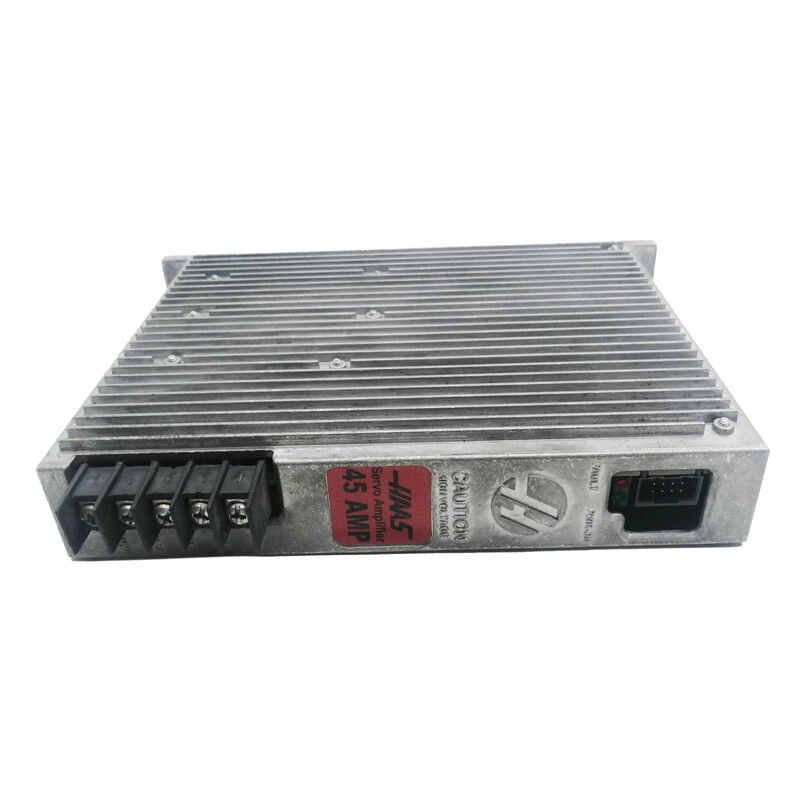
HAAS 32-3551J Servo Amplifier — 45A BL Smart Amp, Aftermarket Repair & Replacement
The Part That Keeps Your HAAS Axis Running
Every axis on a HAAS CNC machine depends on one thing working correctly behind the panel door: the servo amplifier. The 32-3551J — also cross-referenced as 93-32-3551J in updated HAAS part numbering — is the 45-amp BL Smart Amplifier assigned to medium-duty axes across a wide range of HAAS vertical machining centers, horizontal machining centers, and turning centers running the Next Generation Control (NGC).
When this amplifier fails, that axis stops. No jogging, no program execution, no production. Getting a tested replacement on the machine as fast as possible is the only priority — and that's exactly where aftermarket repair and customized replacement units become relevant.
Technical Specifications
| Parameter |
Detail |
| Part Number |
32-3551J / 93-32-3551J |
| Manufacturer |
HAAS Automation |
| Type |
BL Smart Servo Amplifier |
| Continuous Output Current |
45 A |
| DC Bus Input |
320–340 V DC (from HAAS Vector Drive or MMPS) |
| Motor Output |
Three-phase U/V/W to servo motor |
| Control Interface |
Digital communication with NGC control |
| Status Indicators |
Red LED (FAULT) / Green LED (POWER ON) |
| Over-Temperature Trigger |
195°F (90°C) |
| Max Ambient Operating Temp |
122°F (50°C) |
| Cooling |
Passive / cabinet fan assisted |
| Replaces |
32-3551J (original), superseded by 93-32-3551J |
How the 32-3551J Fits Into the HAAS Drive System
HAAS machines use a centralized power architecture. The Vector Drive — or on smaller machines, the Minimill Power Supply (MMPS) — rectifies the incoming AC line voltage and generates a shared 320–340 V DC bus that runs through the control cabinet. Each servo amplifier draws from that bus and converts the DC power into precisely controlled three-phase AC output for its assigned motor.
The 32-3551J sits in the amplifier rack, receives the 320 V DC on one side, and outputs variable-frequency, variable-amplitude current to the servo motor on the other. Communication with the NGC controller runs digitally, which is what makes these "Smart" amplifiers different from older analog designs — the amplifier doesn't just follow a voltage command, it actively reports its status, temperature, fault codes, and current draw back to the control. This digital feedback loop is what enables the detailed alarm diagnostics that HAAS NGC machines are known for.
When the amplifier develops a fault, the red LED on the face lights up and the CNC typically displays a specific servo amplifier alarm on the control screen, pointing directly to the affected axis. That's useful for diagnostics, but the underlying repair or replacement process still requires the machine to be fully de-energized and the 320 V DC bus confirmed discharged before any work begins.
Why Aftermarket Repair and Customized Replacement Makes Sense
The 93-32-3551J has been listed as discontinued by the manufacturer, meaning direct new procurement through HAAS Factory Outlets (HFOs) is no longer guaranteed for all regions and stock levels. That's a real problem when an amplifier fails on a production machine.
Aftermarket repair and quality-controlled replacement units fill this gap — and in many cases, they're the smarter financial choice even when OEM stock is available. Here's the practical picture:
Cost. A new OEM 45A HAAS servo amp, when available, typically trades in the $1,500–$1,750 range through aftermarket channels. Professional repair of a failed unit costs significantly less and returns the same electrical performance when done properly.
Speed. Specialty CNC component repair houses that maintain dedicated HAAS test equipment can often turn around a repaired unit faster than waiting on OEM lead times, particularly outside North America.
Customization. For shops running modified machine configurations, non-standard axis arrangements, or machines that have been re-controlled, aftermarket suppliers can source and configure replacement amplifiers to match the specific electrical and firmware requirements of the installation — something OEM channels rarely accommodate.
Preventive component replacement. Quality repair processes go beyond fixing the immediate fault. Capacitors, gate driver circuits, and other components with known aging characteristics are often proactively replaced during a professional repair, extending the effective service life of the rebuilt unit beyond what a simple fault-fix would achieve.
Common Failure Modes — What to Check Before Ordering
Not every axis alarm means the amplifier is bad. Before pulling the 32-3551J, a systematic check saves time and money.
Red FAULT LED, no movement on axis. This is the classic amplifier failure presentation, but mechanical blockage on the axis, a shorted servo motor winding, or a cable fault can produce identical symptoms. Disconnect the motor leads from the amplifier output and check motor winding resistance to ground — a low reading or dead short points to the motor, not the amp.
Axis runs rough or oscillates. In most cases, this is a control parameter issue or an encoder feedback problem rather than amplifier hardware failure. Verify the feedback cable and connector before condemning the amplifier.
Amplifier stays cold, no green LED. If the green POWER ON indicator doesn't light with 320 V DC present on the bus, the amplifier's internal power supply has likely failed. This is a hardware fault requiring repair or replacement.
Overtemperature fault. The amplifier's on-board temperature sensor triggers at 195°F (90°C). Before replacing the unit, confirm the cabinet cooling fan is running and receiving its correct 120 VAC supply. A failed cooling fan will cause thermal faults on otherwise healthy amplifiers.
DC bus collapses when one specific amplifier is connected. A shorted output stage in the amplifier will pull down the bus voltage the moment it's connected. Disconnecting amplifiers one at a time while monitoring bus voltage isolates the faulty unit.
Machine Compatibility
The 32-3551J / 93-32-3551J is used across a broad range of HAAS NGC-equipped machines, most commonly including:
- VF Series vertical machining centers (VF-1 through VF-12 and larger)
- VM Series vertical mills
- EC Series horizontal machining centers
- ST Series turning centers and lathes
- HL Series lathes
- UMC Series 5-axis universal machining centers
- Various rotary and indexer axis configurations using servo-driven tables
The 45A rating places this amplifier in the medium-axis class — typically X, Y, or Z axes on mid-size VMCs, or the primary turning axis on smaller lathes. Heavier axes use the 60A or 90A variants; lighter auxiliary axes use the 30A unit.
Safety Note Before Any Work
Working on servo amplifier circuits involves lethal DC voltages. Before touching any component in the HAAS control cabinet, power the machine fully off at the main breaker and wait a minimum of five minutes for the high-voltage DC bus to discharge. Confirm the HV indicator light on the Vector Drive or MMPS is fully extinguished before proceeding. Never rush this step.
Frequently Asked Questions
Q1: What is the difference between the 32-3551J and the 93-32-3551J?
These two part numbers refer to the same amplifier. The 93- prefix is HAAS's updated part numbering convention applied to the current catalog version of the component. The 93-32-3551J is the direct replacement for the original 32-3551J and is fully interchangeable with it in all HAAS NGC machines. When searching for a replacement, both numbers will return the same product. Some aftermarket suppliers list both numbers to capture searches using either format.
Q2: Will an aftermarket or repaired 32-3551J communicate correctly with the NGC control?
Yes, provided the unit has been properly tested and the firmware is compatible with the machine's control version. The digital communication protocol between the Smart Amplifier and the NGC control is hardware-level and not dependent on any licensing or authorization codes. A correctly repaired amplifier with functional communication circuitry will be recognized by the NGC control and behave identically to an OEM unit. Where firmware revisions are a concern — typically on machines with very recent software updates — a reputable supplier will be able to match the required version.
Q3: My machine shows an "Axis Drive Fault" alarm — how do I confirm the amplifier is actually the problem?
Start with the physical indicators on the amplifier face: a solid red FAULT LED with the green POWER ON light absent or dim strongly suggests amplifier hardware failure. Next, disconnect the motor cable from the amplifier and power the machine on — if the fault clears, the motor or cable is the issue. If the fault persists with the motor disconnected, and the DC bus voltage is confirmed normal (320–340 V DC), the amplifier itself is the most likely culprit. It's worth checking the amplifier's connector seating and any visible damage to the PCB before condemning the unit, as loose connectors cause a meaningful number of apparent amplifier faults.
Q4: Can the 32-3551J be used on axes that originally had a different amplifier rating?
No — amplifier ratings must match the axis configuration in the machine. The 45A unit is designed for axes where the servo motor and axis load demand falls within that current envelope. Installing a lower-rated amplifier on a high-demand axis will result in repeated overcurrent faults and premature amplifier failure. Installing a higher-rated amplifier is generally harmless electrically, but may produce parameter-related faults if the NGC control is configured to expect a specific amplifier type on that axis. Always match the replacement rating to the original.
Q5: What does a "customized" aftermarket replacement mean in practice?
For most standard HAAS NGC machines, a direct replacement unit requires no customization — it ships ready to install. Customization becomes relevant in specific situations: machines that have been retro-fitted with different servo motors requiring a different current profile; multi-axis retrofit projects where the original control has been replaced; machines operating in non-standard voltage environments; or installations where a customer requires pre-configured parameters loaded into the amplifier before shipping to minimize on-site commissioning time. If your application is standard, a tested stock replacement is all you need. If you're running a modified machine, discuss your specific configuration with the supplier before ordering.



 Your message must be between 20-3,000 characters!