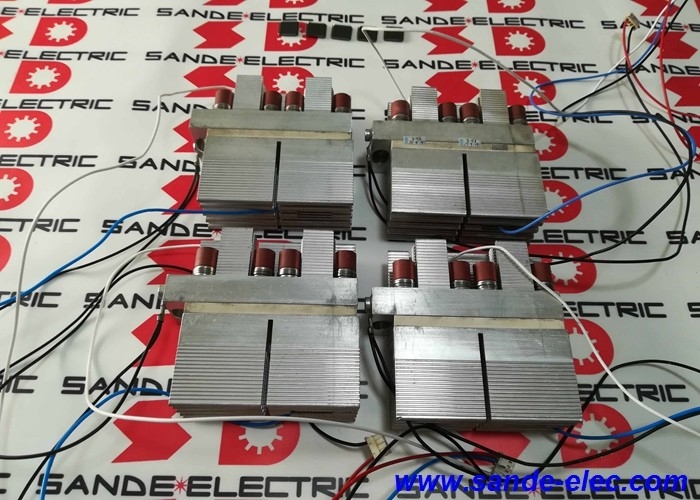
SKKQ560/14E | Semikron SEMISTART Anti-Parallel Thyristor AC Switch — 1400V / 560A / Amplifying Gate / Pressure Contact / C11 / Screw / Soft Starters
Anti-Parallel Thyristors — How an AC Switch Works
A single thyristor conducts current in one direction only — it turns on when triggered and turns off when current naturally reverses. For AC power control, current alternates direction every half-cycle. Controlling both half-cycles requires two thyristors: one for positive half-cycles, one for negative. Connecting them in anti-parallel (cathode of one to anode of the other) creates an AC switch — a bidirectional controllable switch that conducts in both directions on demand.
The SKKQ560/14E packages both thyristors in a single compact module body. Two thyristors, two gate connections, one housing. In a three-phase soft starter, three SKKQ modules (one per phase) replace six separate thyristors that would otherwise require individual mounting, heat sinking, and gate wiring. The module format reduces component count, wiring complexity, and assembly time in the power section.
Key Specifications
| Parameter |
Value |
| VDRM / VRRM |
1400V |
| ITRMS (560/14E) |
560A |
| Gate Type |
Amplifying gate |
| Technology |
Pressure contact |
| Package |
C11 |
| Mounting |
Screw |
| Series |
SEMISTART |
| Weight |
approx. 531g |
Soft Starter Application — Three Modules, Three Phases
In a standard three-phase motor soft starter, one SKKQ module is wired in series with each phase of the motor supply. All three modules together form the power switching section:
- Phase L1: One SKKQ module controls current to motor terminal U
- Phase L2: One SKKQ module controls current to motor terminal V
- Phase L3: One SKKQ module controls current to motor terminal W
By varying the firing angle of the thyristors (how late in each half-cycle they are triggered), the soft starter adjusts the effective RMS voltage applied to the motor. At startup, firing angle is large (late triggering = low RMS) and the motor receives reduced voltage. As the motor accelerates, firing angle decreases progressively until the thyristors fire at zero angle (full voltage) and the motor runs at line voltage.
Three SKKQ560/14E modules cover motor starting ratings that depend on the motor rated current and the duty cycle — 560A RMS capacity supports substantial motor sizes at reduced duty.
FAQ
Q1: What is the difference between the SKKQ and SKKT/SKKE thyristor modules from Semikron?
The SKKQ designation indicates an anti-parallel pair — two thyristors opposing each other for bidirectional (AC) switching. The SKKT designation typically indicates a thyristor-thyristor or thyristor-diode pair in series or parallel configuration for DC converter applications. SKKE indicates a thyristor-diode pair. Choose SKKQ for AC switch applications (soft starters, AC power controllers); choose SKKT or SKKE for rectifier or DC converter applications.
Q2: What heatsink is required for the SKKQ560/14E in a soft starter application?
The C11 package requires a flat-surface heatsink with the appropriate screw mounting pattern. The required thermal resistance of the heatsink (Rth,ha in °C/W) depends on the motor's duty cycle, the ambient temperature inside the enclosure, and the thyristor's power loss at the specific operating current and firing angle profile. Use Semikron's thermal design tools or the device datasheet's power loss graphs to calculate the minimum heatsink specification for the target application.
Q3: How many SKKQ560/14E modules are needed for a three-phase soft starter?
Three modules — one per phase. Each module handles both the positive and negative half-cycles of its phase current via its anti-parallel thyristor pair. For three-phase motor soft starting with the standard in-line phase connection, three SKKQ modules and their associated gate driver circuits constitute the complete power section.
Q4: What is the significance of the 1400V (14E) voltage rating in a standard mains supply application?
Standard industrial mains in Europe and Asia is 400V AC line-to-line (690V in some applications). A rule of thumb for thyristor voltage selection is to derate the repetitive peak voltage rating to approximately 50% of the device rated VDRM. For the SKKQ560/14E at 1400V, this gives a derated working voltage of approximately 700V — covering 400V mains comfortably, with margin for supply transients and commutation spikes. The 1400V rating provides adequate safety margin for 480V (North American) and 600V applications as well.
Q5: Can the SKKQ560/14E be used in AC power controller (AC voltage regulator) applications beyond soft starting?
Yes. Anti-parallel thyristor modules in the SEMISTART series are not limited to motor soft starters. AC power control — resistive heating element regulation, transformer tap changing, electrolytic process control, reactive power compensation — also uses anti-parallel thyristor pairs with firing angle control. The same module that provides soft starting for a motor can be used as a phase-angle controller for a resistive load at the same voltage and current ratings.


 Your message must be between 20-3,000 characters!