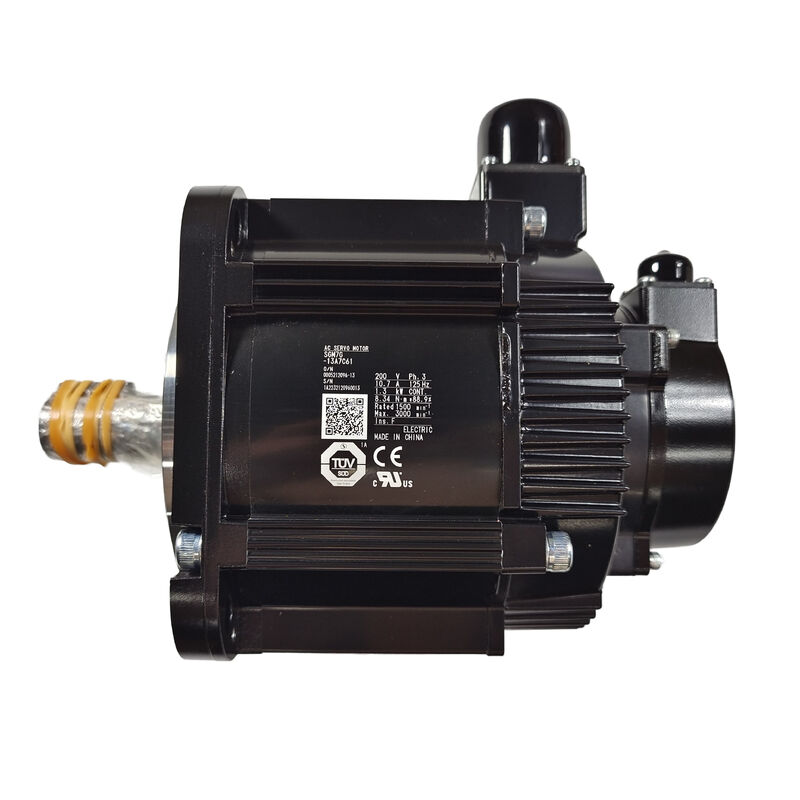
Yaskawa SGM7G-13A7C61 | Sigma-7 Medium-Inertia 1.3kW Servo Motor — 1500RPM / AC200V / 24-Bit Absolute / Keyway Shaft / Design A
SGM7G — Medium Inertia, Large Torque in the Sigma-7 Family
The Sigma-7 servo system covers several motor families for different application profiles. The SGM7G occupies the medium-inertia, large-torque position — a motor designed for loads that require higher torque density than the smaller SGM7A frame provides, particularly at lower rated speeds such as 1500 r/min.
The 1500 r/min rating distinguishes the SGM7G from the SGM7A and SGM7J families that run at 3000 r/min standard speeds. For loads where the drive shaft operates at lower speeds — direct-coupled machine table drives, ball screws with large pitch, large rotary axis applications — the SGM7G delivers rated torque at a speed that keeps the mechanical transmission simple. A 3000 r/min motor on the same load would require a 2:1 reduction ratio; the SGM7G may connect directly or with minimal reduction.
Key Specifications
| Parameter |
Value |
| Rated Output |
1.3 kW |
| Rated Speed |
1500 r/min |
| Power Supply |
AC200V |
| Encoder |
24-bit absolute (serial) |
| Design |
Sequence A |
| Shaft |
Straight with keyway + screw |
| Speed Reducer |
None |
24-Bit Absolute Encoder — Position Without Homing
The SGM7G-13A7C61 carries a 24-bit serial absolute encoder. The absolute encoder stores the shaft position in non-volatile memory — the drive knows the exact position from the moment power is applied, without running a homing sequence. For machines where homing takes significant time (large axis travel, slow reference switch approach) or where homing is mechanically impractical (vertical axes, rotary tables without a clear home position), the absolute encoder eliminates the start-up homing cycle entirely.
The 24-bit resolution provides approximately 16.7 million counts per revolution. At 1500 r/min, the angular resolution is approximately 0.000021° per count — far beyond the positioning requirement of most mechanical systems. The practical benefit is the absence of quantisation error in position control at any mechanically relevant resolution target.
Application Scenarios
Machine tool rotary axis: A CNC machine with a large rotary table uses the SGM7G-13A7C61 as the table drive motor. The 1500 r/min rated speed matches a direct drive configuration or simple reduction to the table. The absolute encoder allows the control to know table position on power-up without a homing routine.
Injection moulding machine axis: A plastics machine clamp or ejector axis uses the SGM7G at 1.3kW. The medium-inertia characteristics provide smooth deceleration with the larger mechanical load inertia typical of these machines.
Industrial robot auxiliary axis: A servo-driven conveyor or workpiece positioning system uses the SGM7G-13A7C61 where a compact 1.3kW torque output at 1500 r/min matches the mechanical gearing to the load speed requirement.
FAQ
Q1: Is the SGM7G-13A7C61 compatible with the Sigma-7 SGDV or SGDH series servo drives?
The SGM7G motor series is designed for the Sigma-7 (Σ-7) SGDV servo drive family. The SGDH is an older Sigma-V series drive and is not compatible with the SGM7G motor's 24-bit serial absolute encoder interface. Use the SGDV servo drive specified for the SGM7G series at the correct power rating to ensure proper motor-drive matching.
Q2: What does "Design Sequence A" in the part number indicate?
Design Sequence A identifies the motor's internal design revision. It is used for manufacturing and compatibility tracking purposes within Yaskawa's product lifecycle. In practice, it indicates this is the initial released design of the SGM7G-13 in this specification combination. There is no functional difference to the end user compared to later design sequences unless a specific revision is required by a machine tool builder's certification.
Q3: Can the SGM7G-13A7C61 be used without a battery for the absolute encoder?
No. The SGM7G series uses a battery-type absolute encoder — the battery maintains the stored position count during power-off periods. Without a charged battery connected to the servo drive (the battery mounts in the encoder feedback cable's battery case), position data is lost on power-off. Before first power-on, and periodically thereafter, verify the encoder battery condition. A low battery alarm from the servo drive indicates the battery requires replacement.
Q4: What is the keyway dimension for the SGM7G-13 shaft?
The keyway dimensions follow JIS B 1301 standard for the shaft diameter of the SGM7G-13 motor. The exact shaft diameter and keyway width are specified in the SGM7G series technical datasheet (Yaskawa document KAEP-S800001-41). Confirm the shaft dimensions from the official datasheet before designing the mechanical coupling interface.
Q5: Can the SGM7G-13A7C61 be used in an overhanging load (cantilever) installation?
The SGM7G-13A7C61 does not specify a flange or foot type in the listed configuration — the mechanical mounting and radial load limits are defined by the motor frame's bearing specification in the SGM7G technical manual. Overhung radial loads (from pulleys, gears, sprockets directly on the shaft) must not exceed the motor's specified radial load limit at the installation point distance from the bearing. Consult the SGM7G series datasheet for the permitted overhung load values at the applicable load position.



 Your message must be between 20-3,000 characters!