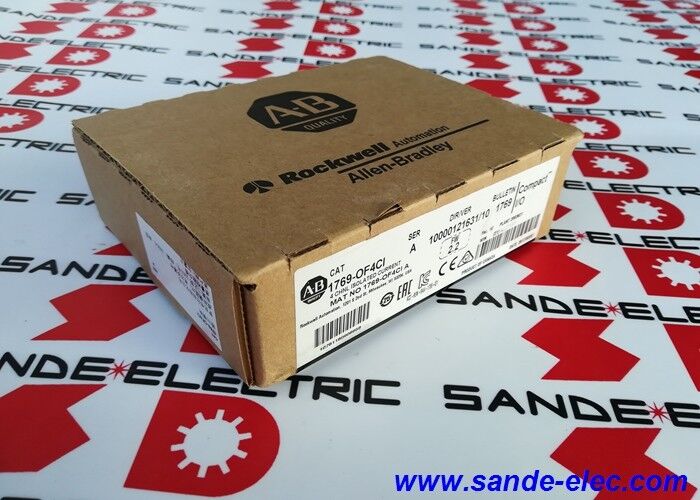
1769-OF4CI | Compact I/O 4-Channel Isolated Analog Current Output — 4–20mA / 110ms / No Field Cal / EGU / PID / MicroLogix 1500 & CompactLogix
Four Individually Isolated Outputs — Why It Matters
Standard analogue output modules share a common reference across all output channels. When all four loads connect to the same common, a common-mode voltage difference between load circuits shows up across the output — it can create ground loop currents that appear as signal errors at the actuators.
The 1769-OF4CI addresses this with individual channel isolation. Each of the four channels is galvanically isolated from every other channel. A ground potential difference between the four field devices connected to this module does not corrupt any channel's output. For installations where field devices — control valves, variable frequency drives, positioners — have different ground references across the machine or process, individually isolated outputs eliminate the hardware workaround of external signal isolators.
Key Specifications
| Parameter |
Value |
| Output Channels |
4 × differential, individually isolated |
| Output Ranges |
0–20mA / 4–20mA |
| Full-Scale Ranges |
0–21mA / 3.2–21mA |
| Conversion Rate |
110ms |
| Field Calibration |
Not required |
| Compatible |
MicroLogix 1500 / CompactLogix |
| Data Formats |
Raw, EGU, PID, % Full Range |
| Power Supply Distance |
8 |
| Wire |
Copper-90 AWG |
| Weight |
0.26 kg |
Four Data Format Options — Output What the Programme Needs
Most analogue output modules accept a raw integer from the programme and convert it to a current. The 1769-OF4CI adds three higher-level format options that let the programmer choose the most natural way to express the output setpoint:
Raw/Proportional: A 16-bit integer maps directly to the output span. Standard for programmes that calculate current outputs as integer values.
Engineering Units (EGU): The programme sends the value in engineering units — bar, °C, m³/h, or any custom unit. The module scales from EGU to current using the configured min/max mapping. The programme does not need a scaling calculation.
Scaled for PID: The output connects directly to the PID instruction's CV (control variable) output. The module accepts the PID's output in percent (0–100%) and converts it to the current range — the PID instruction's output directly drives the analogue output without additional scaling logic.
Percent of Full Range: The programme sends a percentage (0–100%) and the module converts it to the configured current range. Useful for interfaces where percentage of output capacity is the natural expression.
Application Scenarios
Multi-zone flow control: Four control valves on four independent process branches, each referenced to a different ground potential. The 1769-OF4CI provides one isolated output per valve — no inter-channel interference regardless of the potential differences between valve actuator bodies.
PID temperature loops: Four furnace zone temperature PID loops in one CompactLogix programme output through a single 1769-OF4CI. The Scaled-for-PID format allows each PID instruction's CV output to directly drive one module channel without intermediate scaling logic.
Mixed VFD speed references: Four variable frequency drives receiving analogue 4–20mA speed references from one module. The drives may share a common AC supply but have different signal ground references — individual isolation handles the difference.
FAQ
Q1: Can 1769-OF4CI channels mix 0-20mA and 4-20mA signals on the same module?
Yes. Each channel is individually configurable for either 0–20mA or 4–20mA output range. Channel 0 can be set to 4–20mA for a control valve while channel 1 is configured for 0–20mA for a different actuator type. The range setting is made in the module's I/O configuration within the programming software.
Q2: What is the significance of the Power Supply Distance Rating of 8?
Compact I/O modules draw power from the controller's local power bus. The Power Supply Distance Rating of 8 indicates how far the 1769-OF4CI can be positioned from the power supply module in the Compact I/O bank. A higher rating means greater current draw from the bus — the position limit ensures the bus voltage at the module's slot remains within specification. Plan the module slot position within the Compact I/O rack accordingly.
Q3: Is the 1769-OF4CI backward compatible with Series A and Series B controllers?
The module itself comes in Series A and Series B designations. Both series of the 1769-OF4CI are functionally compatible with the listed controllers (MicroLogix 1500 and CompactLogix). The series designation reflects hardware revision; the module's programming interface and data format configuration are the same between series.
Q4: What copper wire gauge should be used with the 1769-OF4CI?
The module specifies Copper-90 AWG wire — standard copper conductor rated at 90°C insulation temperature class. AWG size selection depends on cable run length and the acceptable voltage drop over the 4–20mA loop. For typical instrument-to-panel runs of up to 300 metres, AWG 18 to AWG 22 solid or stranded copper conductor is commonly used. Use shielded twisted-pair cable for analogue signal wiring to minimise EMC interference.
Q5: What is the 1769-RD replacement door used for?
The 1769-RD is the replacement door cover for the 1769-OF4CI's front access cover. The front door covers the module's wiring terminals when closed and protects against accidental contact or contamination. If the door is damaged or broken, the 1769-RD provides a direct replacement that restores the module's mechanical protection without replacing the full module.



 Your message must be between 20-3,000 characters!