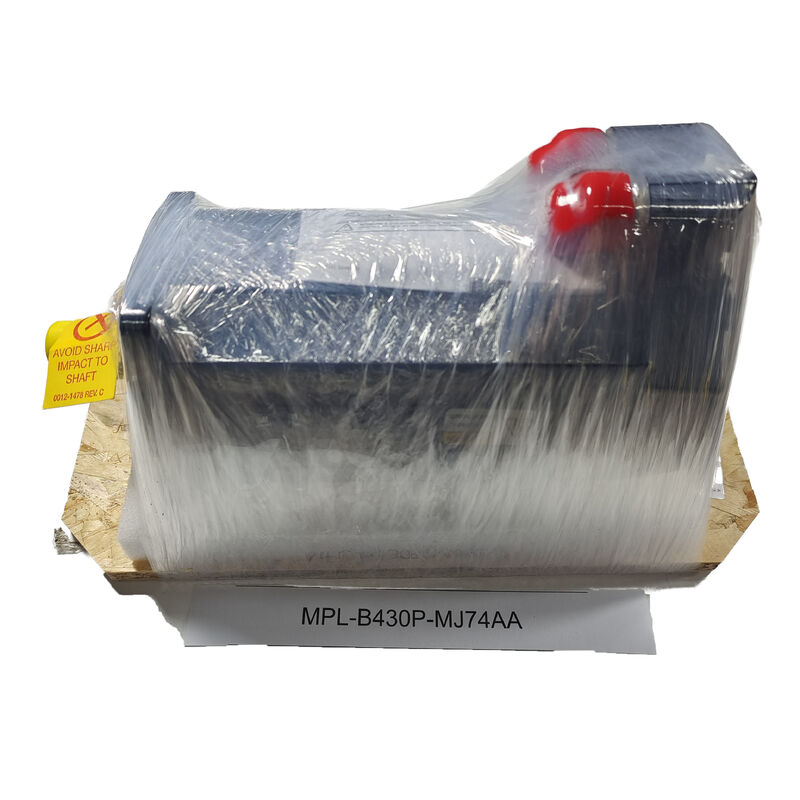
Allen-Bradley MPL-B320P-SJ72A | Kinetix MP-Series Low-Inertia Brushless Servo Motor — 1.5kW, 3.05Nm, 5000RPM, 400V, 1024 Sin/Cos Hiperface Encoder, SpeedTEC DIN
Overview
The Allen-Bradley MPL-B320P-SJ72A is a Kinetix MP-Series low-inertia brushless AC servo motor in the 400V class, delivering 1.5 kW with 3.05 Nm continuous stall torque and 5,000 RPM rated speed. The defining characteristic that sets it apart from the later revision in this same physical family is the feedback device: a 1024 sin/cos absolute single-turn encoder operating on the Hiperface protocol.
Hiperface — the serial/analog hybrid encoder interface developed by Stegmann — combines two communication channels in one cable: an analog track that outputs the 1024 sine/cosine cycles per revolution of raw position signal, and a digital RS-485 serial channel that carries absolute position data, motor identification, and diagnostic information.
The drive processes both channels simultaneously, using the analog sin/cos cycles for high-resolution interpolation during motion and the digital serial channel to read absolute position at startup. What leaves the encoder as 1024 cycles arrives at the drive interpolated to a much finer angular resolution — the practical position accuracy exceeds what the cycle count alone implies.
This encoder and protocol combination was the precision feedback standard for the Kinetix 6000 and 7000 drive platforms when the MPL-B320P-SJ72A was specified into production machines.
Many installations still running these drive generations require this exact feedback interface — a newer high-resolution digital encoder variant will not communicate on the Hiperface channel that the drive's feedback circuit is designed around.
Key Specifications
| Parameter |
Value |
| Rated Output |
1.5 kW |
| Continuous Stall Torque |
3.05 Nm (27 lb·in) |
| Peak Stall Torque |
7.91 Nm (70 lb·in) |
| Peak-to-Continuous Torque Ratio |
2.6 : 1 |
| Continuous Stall Current |
4.5 A |
| Peak Stall Current |
14.0 A |
| Rated Speed |
5,000 RPM |
| Rotor Inertia |
0.000078 kg·m² |
| Voltage Class |
400V (B Series) |
| Frame Size |
100 mm (3.94 in.) |
| Magnet Stack Length |
50.8 mm (2.0 in.) |
| Encoder Type |
1024 Sin/Cos Single-Turn Absolute |
| Encoder Protocol |
Hiperface (Stegmann) |
| Connector |
SpeedTEC DIN, Right-Angle, 180° Rotatable |
| Shaft |
Keyed, No Brake |
| IP (without shaft seal) |
IP53 / IP51 / IP50 (orientation-dependent) |
| IP (with shaft seal) |
IP66 |
| Insulation Class |
H (180°C) |
| Operating Temperature |
0°C to +40°C |
| Compatible Drives |
Kinetix 6000, 6200/6500, 7000, Ultra3000 |
The Hiperface Encoder — How 1024 Sin/Cos Becomes Fine Position Data
The 1024 sin/cos encoder in the MPL-B320P-SJ72A generates one complete sine wave and one complete cosine wave for each 1/1024th of a motor revolution. In raw terms, 1024 cycles per revolution means the analog tracks complete a full 360° electrical cycle every 0.352° of shaft rotation.
But 1024 cycles/revolution is the starting point, not the final resolution the drive operates with.
The Kinetix drive's feedback processing circuit samples the instantaneous amplitude of both the sine and cosine channels at high speed and computes the angular position within each cycle using an arctangent calculation — a process called interpolation.
Interpolation ratios of 256:1 or higher are common in precision servo drives, turning each 1/1024 mechanical cycle into 256 or more interpolated positions.
The effective resolution at the drive input therefore runs into the tens of thousands of counts per revolution, a figure determined by the drive's interpolation hardware rather than by the encoder's cycle count alone.
The second channel — the Hiperface digital RS-485 link — carries the absolute position register. At power-up, the drive reads this register to know the exact shaft position within the current revolution without any movement.
The drive then tracks position from that reference using the fine-resolution interpolated sin/cos data.
The result is a feedback system that combines the absolute startup certainty of a digital position register with the high-resolution, high-bandwidth velocity feedback of an analog sin/cos track — two tasks, one cable, one encoder connector.
Single-Turn Absolute — What It Provides and What It Does Not
Single-turn absolute means the encoder knows the angular position within one complete shaft revolution from power-up. The moment the Kinetix drive initialises, it reads a position value between 0 and 359.999...° from the Hiperface serial channel with no shaft movement required.
What this does not provide is knowledge of how many complete revolutions have accumulated since the encoder was last initialised.
After a power interruption, if the axis has moved by one or more complete turns — through coasting, manual movement, or mechanical creep — the drive will read a correct within-turn angular position but cannot determine the absolute multi-turn position without a homing traversal.
In practice this means: after every power cycle on a linear axis with more than one motor revolution of travel, a reference return is required to re-establish the absolute multi-turn position.
For rotary axes with less than one revolution of total travel, or for applications where within-turn absolute position is sufficient, the single-turn encoder eliminates homing entirely. The multi-turn Hiperface variant — the MJ-suffix series in the same motor family — extends absolute retention across multiple revolutions for applications where eliminating the homing requirement across full axis travel is an operating requirement.
3.05 Nm Continuous, 7.91 Nm Peak — The Same Performance Platform
The torque specifications of the MPL-B320P-SJ72A are identical to the later SJ72AA revision: 3.05 Nm continuous stall, 7.91 Nm peak, 4.5A continuous and 14.0A peak stall current. The encoder revision does not alter the motor's electromagnetic design, rare-earth magnet rotor, or winding characteristics — only the feedback device and its communication interface changed between revisions.
At 5,000 RPM rated speed and 1.5 kW output, the 400V B-class winding is the appropriate voltage class for European and global 400–480V three-phase industrial supplies.
The rare-earth permanent magnet rotor that produces 3.05 Nm continuous in a 100 mm, 50.8 mm stack housing keeps the rotor inertia at 0.000078 kg·m² — low enough that the motor's own mass contributes minimally to the total system inertia seen by the drive, allowing the available 7.91 Nm peak to accelerate predominantly the load rather than the motor itself.
Class H insulation at 180°C provides the thermal margin that continuous industrial duty demands.
Correct mounting — the motor's heat path is through its flange face into the machine structure — requires adequate thermal contact between the motor mounting face and the machine. Mounting on thermally isolating materials or with excessive interface gap reduces the motor's effective continuous torque rating below the nameplate value.
SpeedTEC DIN Connector and Keyed Shaft
The SpeedTEC DIN circular right-angle connector in the 180° rotatable configuration is the same mechanical interface used throughout the MPL series at this connector code.
A single-action quarter-turn locking collar fully engages the connector in the time it takes to rotate it from unlocked to locked — reliable, repeatable, and verified by the tactile and audible confirmation of full engagement.
The 180° rotation of the right-angle head allows cable exit direction to be set before locking, orienting the cable toward the routing path without cable strain at the motor.
The keyed shaft extension provides positive rotational engagement between motor and coupling.
At 3.05 Nm continuous stall and 7.91 Nm peak, the key prevents any rotational slip between shaft and hub regardless of clamping force condition — particularly important for applications with frequent acceleration reversals where the cyclic torque loading repeatedly stresses the shaft-coupling interface in alternating directions.
The key is provided with the motor; the coupling hub must be machined with a matching keyway to the correct tolerance for the motor shaft diameter.
No shaft seal is factory-installed. Without a seal, the IP rating varies with mounting orientation as noted above.
For installations where the shaft gap will be exposed to process fluids, coolant, or significant contamination, the appropriate shaft seal kit — ordered separately with reference to the MPL shaft seal catalog — provides IP66 rated shaft protection when correctly installed before the coupling is fitted.
Kinetix Drive Compatibility and Hiperface Protocol Specifics
The MPL-B320P-SJ72A and its Hiperface encoder interface are natively compatible with the Kinetix 6000, Kinetix 6200/6500, Kinetix 7000, and Ultra3000 drive families — the Rockwell Automation drive platforms designed to process Hiperface protocol feedback on their motor feedback interface cards.
The Hiperface protocol operates over a specific cable and connector pinout on the drive's motor feedback terminal.
The drive's feedback module must support Hiperface — not all Kinetix drive modules do, and the drive's axis module must be configured for sin/cos feedback type and the Hiperface serial communication parameters.
For systems where the existing drive is already configured for Hiperface with another MPL motor, the MPL-B320P-SJ72A is a drop-in replacement on the feedback side, assuming the motor power and brake wiring also matches.
One practical consideration when replacing the SJ72A with the later SJ72AA: the SJ72AA uses a different encoder interface — a purely digital high-resolution feedback protocol compatible with Kinetix 5500 and 5700 — not Hiperface.
The SJ72AA is not a direct encoder-compatible replacement for the SJ72A on a Kinetix 6000 or Ultra3000 drive without also changing the drive's feedback module or the drive itself.
FAQ
Q1: What is the difference between the MPL-B320P-SJ72A and the MPL-B320P-SJ72AA?
Both motors are physically and electrically identical — same frame, same stack length, same torque, current, speed, connector, shaft, and IP ratings. The single difference is the encoder. The SJ72A carries a 1024 sin/cos absolute single-turn encoder using Hiperface protocol, compatible with Kinetix 6000, 7000, and Ultra3000 drives.
The SJ72AA carries a newer high-resolution digital encoder using a different feedback protocol, compatible with Kinetix 5500 and 5700 in addition to 6000 and 7000. When replacing the SJ72A on an existing machine, the replacement motor's encoder must match the installed drive's feedback protocol — the SJ72AA cannot replace the SJ72A on a Kinetix 6000 or Ultra3000 drive without drive-side changes.
Q2: How does the drive achieve high position resolution from 1024 sin/cos cycles?
The drive samples the instantaneous voltage levels on the sine and cosine output channels at a high rate and computes the fractional angle within each cycle via arctangent interpolation.
A 256:1 interpolation ratio turns each 1/1024 mechanical cycle into 256 interpolated position counts, giving an effective feedback resolution of approximately 262,144 counts per revolution at the drive — comparable to a 18-bit digital encoder.
The actual interpolated resolution depends on the drive's feedback processing hardware. The key point: the 1024 cycle count is not the operating resolution; it is the raw material that the drive's interpolation electronics convert into a much finer position signal.
Q3: Does the single-turn encoder on the SJ72A require homing after a power cycle?
For linear axes or rotary axes with more than one motor revolution of total travel: yes, a homing traverse is typically required after power loss to re-establish multi-turn absolute position.
The Hiperface serial channel provides absolute angular position within one revolution at power-up — but cannot account for full turns that may have occurred during power loss.
For applications where the axis cannot move during power loss and the within-turn position at power-up is known to be valid, the drive may accept the encoder's position directly without homing.
The multi-turn variant (MJ suffix) extends absolute retention across multiple revolutions, eliminating this requirement for most axis configurations.
Q4: What happens if the SpeedTEC connector is not fully locked?
A partially engaged SpeedTEC connector makes electrical contact but the Hiperface sin/cos and serial signals will be susceptible to vibration-induced intermittent contact.
The failure mode presents as sporadic encoder fault codes at the drive — position error alarms, feedback loss alarms, or erratic velocity behaviour — rather than as a persistent fault that immediately identifies the cause.
The connector's locking collar must be rotated to the fully locked position until the engagement confirmation is felt. On motors that are removed and reinstalled during maintenance, re-verifying connector engagement before powering the drive is the correct procedure, and it takes approximately two seconds.
Q5: What are the critical installation checks specific to the MPL-B320P-SJ72A?
Confirm the Kinetix drive module supports Hiperface protocol before connecting — use the drive's axis configuration in Studio 5000 to verify the feedback type is set to Hiperface/sin-cos, not incremental or digital high-resolution.
Verify the motor feedback cable is rated for Hiperface (the cable must carry both the analog sin/cos pairs and the RS-485 differential pair with correct shielding — a standard encoder cable that omits the RS-485 pair will prevent absolute position readout even if the analog tracks connect correctly).
Engage the SpeedTEC connector fully before powering the drive.
Confirm the keyed shaft and coupling hub keyway are matched and the hub retention fastener is torqued to specification. After initial power-up, verify the drive reads a stable absolute position before executing any motion command.



 Your message must be between 20-3,000 characters!