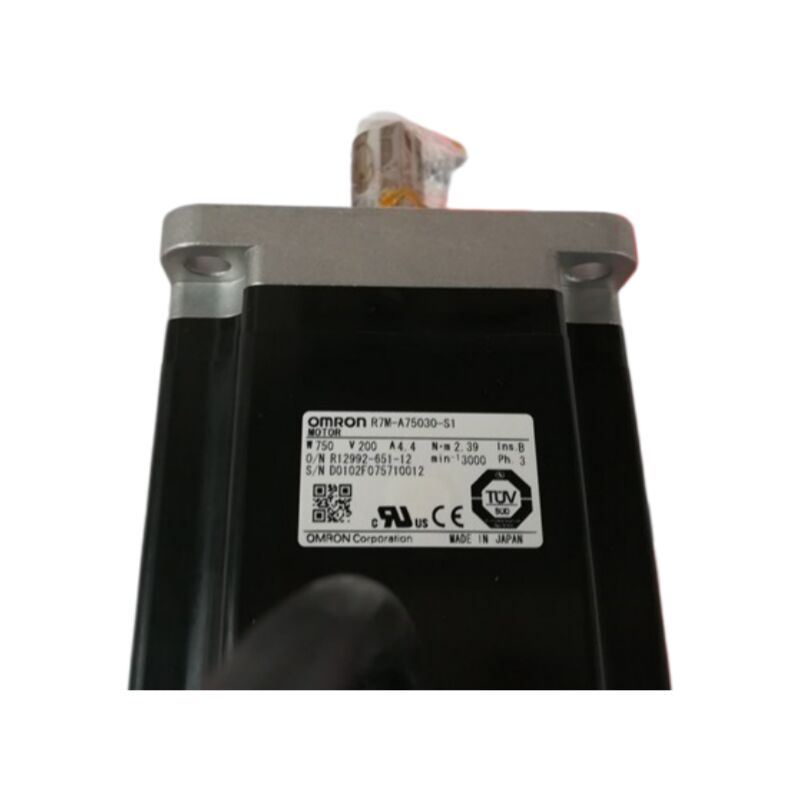
Omron R7M-A75030-S1 SmartStep AC Servo Motor
Product Overview
The R7M-A75030-S1 is an Omron SmartStep AC servo motor commonly listed as a cylinder-type motor with 750 W, 3000 rpm, and 2.39 Nm rated torque.
Distributor listings also identify it as an obsolete part number and show incremental encoder context for this model family, while Omron’s official G-Series motor pages describe the SmartStep/G-Series motor platform as a compact servo solution designed for simple motion applications with servo-level advantages over stepper-style approaches.
That gives the model a clear commercial role.
It sits in the part of the servo market where users want straightforward motion control, stable speed, and repeatable positioning without moving immediately to a larger or more complex motion platform.
In real automation systems, motors like this are attractive when the application needs more controlled motion than a conventional motor can offer, but the machine still benefits from a compact, serviceable servo format.
This interpretation is consistent with Omron’s SmartStep/G-Series positioning and the model’s published 750 W / 3000 rpm / 2.39 Nm class.
Technical Data
| Parameter |
Value |
| Part Number |
R7M-A75030-S1 |
| Manufacturer |
Omron |
| Product Type |
AC Servo Motor |
| Product Family Context |
SmartStep / G-Series |
| Motor Style |
Cylinder type |
| Phase |
3-phase |
| Rated Voltage |
230 VAC |
| Rated Current |
4 A |
| Rated Power |
750 W |
| Rated Speed |
3000 rpm |
| Rated Torque |
2.39 Nm |
| Encoder Context |
Incremental |
| Connector Note |
Non-IP67 connectors |
| Product Status |
Obsolete / installed-base spare |
Application Value
In practice, the R7M-A75030-S1 is well suited to packaging equipment, indexing systems, conveyors, feed axes, compact transfer mechanisms, and general machine modules where the designer wants reliable servo motion without jumping into a much larger motor class.
The 3000 rpm speed and 750 W power place it in a useful middle range for many compact industrial axes, while the cylinder-type construction fits the kind of space-conscious machine design often seen in packaging and assembly equipment.
These application examples are engineering inferences based on the model’s published data and Omron’s SmartStep/G-Series family positioning.
Its replacement value is also easy to understand.
Buyers looking for this motor are usually supporting an existing Omron motion system rather than building a new design from zero. In that context, exact family continuity is often more valuable than generic equivalence.
Keeping the original motor family can reduce mechanical adaptation, preserve the expected encoder behavior, and shorten the path back to production after a failure. This is an engineering inference based on the model’s installed-base sales context and Omron’s family documentation.
Replacement and Selection Perspective
A motor like this should be treated as part of a servo system rather than as a stand-alone AC motor defined only by watts and speed.
Omron’s G-Series materials describe the family in terms of servo functionality, encoder context, and application simplicity, which is why buyers should verify the installed model code, drive compatibility, encoder expectation, shaft arrangement, and any brake or seal options before ordering.
Omron’s manuals for G-Series motors explicitly organize the family by such option patterns.
FAQ
Q1: What kind of motor is R7M-A75030-S1?
It is an Omron SmartStep AC servo motor in the 750 W / 3000 rpm class, positioned for controlled machine motion rather than generic motor duty.
Q2: What gives this motor practical value in automation equipment?
Its value comes from combining a moderate power class with stable servo behavior in a compact format.
That makes it useful for many machine axes that need more precision and predictability than a simple motor solution can provide.
This is an engineering inference based on the motor’s published class and Omron’s SmartStep positioning.
Q3: What types of applications fit this motor best?
It fits packaging systems, indexing units, conveyors, feeder axes, and compact automation modules where 3000-rpm servo performance is appropriate.
These application examples are inferred from the model’s power/speed class and family positioning.
Q4: Why is exact family matching important here?
Because servo motors work inside a specific drive and feedback architecture.
Matching the original Omron family helps preserve encoder expectations, installation fit, and machine behavior after replacement.
This is an engineering inference supported by Omron’s G-Series family documentation.
Q5: What should be checked before ordering this motor?
Verify the installed model code, voltage class, encoder expectation, shaft and connector style, and the existing Omron servo drive arrangement.
Those checks usually prevent the most common replacement errors.



 Your message must be between 20-3,000 characters!