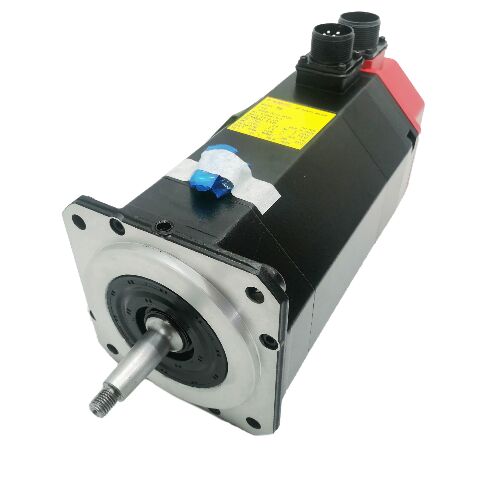
FANUC A06B-0345-B231 | S-Series Model 5RF AC Servo Motor — 6 Nm / 3000 rpm / Taper Shaft / Brake / 2000P + Resolver
S-Series 5RF — Dual Feedback from FANUC's Earliest AC Servo Generation
The A06B-0345-B231 is a FANUC S-series AC servo motor — model 5RF — from FANUC's original generation of AC servo motor products. The S-series predates the Alpha generation and represents the motor technology that powered the first generation of FANUC AC servo-controlled CNC machine tools.
At 6 Nm stall torque and 3,000 rpm, the 5RF sits in the mid-range of the S-series motor family. Its 117V / 3-phase / 8-pole electrical specification reflects the drive system architecture of the era — the operating voltage and frequency are generated by the period-correct S-series servo amplifier, not drawn directly from mains supply.
The dual feedback system — 2000P ABS encoder combined with a resolver — is the defining technical feature of this variant. The resolver provides continuous, sine/cosine-based angular position output that does not depend on pulse counting. The 2000P absolute encoder provides the digital position register the CNC uses for coordinate control. Both operate simultaneously: the resolver provides the fine angular reference for the servo's current and velocity control loops, while the 2000P encoder provides the axis position count that the CNC maintains and displays.
Key Specifications
| Parameter |
Value |
| Motor Model |
5RF (5F/3000) |
| Stall Torque |
6 Nm |
| Max Speed |
3,000 rpm |
| Rated Current |
10 A |
| Motor Voltage |
117V, 3-phase, 8-pole |
| Shaft |
Taper + spring brake |
| Feedback |
2000P ABS encoder + Resolver |
| Status |
Discontinued |
Taper Shaft with Brake
The taper shaft draws the coupling hub axially onto the motor shaft with a drawbolt, providing a zero-slip mechanical joint. For a motor of the 5RF class driving primary CNC axes under sustained cutting loads, the positive taper engagement maintains coupling integrity over the machine's operational life without the fretting risk that keyed-shaft interfaces can develop under heavy cyclic reversals.
The spring-applied brake holds the shaft mechanically whenever brake voltage is removed. For vertical axes and gravity-loaded mechanisms on the machine tools this motor served, the spring-applied brake is the fail-safe holding mechanism that prevents load movement at servo-off, E-stop, and power loss.
Legacy Parts Situation
The S-series was FANUC's AC servo generation from the early 1980s. FANUC ceased production many years ago. A facility operating S-series motors is managing assets at the end of their originally planned service life. Replacement stock comes from decommissioned machine salvage and managed surplus. On S-series motors still running in production, having a tested spare unit on hand is a meaningful risk management step — the window for aftermarket supply continues to narrow as the installed base ages.
FAQ
Q1: What is the purpose of the resolver on this motor alongside the 2000P encoder?
The resolver provides continuous analog angular position output — a sine/cosine signal that does not depend on pulse counting or battery backup. It supports the servo amplifier's velocity and current control loops with high-resolution continuous feedback. The 2000P absolute encoder provides the digital position register for the CNC. Operating together, the resolver covers the high-speed real-time control loop while the encoder maintains the machine coordinate position.
Q2: What servo amplifiers are compatible with the A06B-0345-B231?
The S-series motor requires the period-compatible S-series servo amplifier — not Alpha, Alpha i, or Beta series drives. The encoder interface, resolver connections, and motor voltage parameters of the S-series drive system are specific to the S-series motor generation. Confirm the installed amplifier's compatibility with the 5RF motor type before ordering a replacement motor.
Q3: How is the taper shaft hub removed correctly on an S-series motor?
Use a drawbolt extractor engaging the tapped hole at the shaft end — apply controlled axial force to break the taper engagement. Never hammer, strike, or pry the shaft. Impact loads transmit through the shaft to the resolver and encoder assembly and to the motor bearings. If the taper is tight, apply penetrating fluid at the joint and use steady extractor force.
Q4: The machine produces correct spindle positioning but resolver-related alarms appear under load. What should be checked?
Check the resolver cable routing and connector condition — resolver signal cables are susceptible to noise pickup from motor power cables if run in parallel without adequate separation or shielding. Verify the cable shielding is grounded at the amplifier end only. Check the resolver connector pins for corrosion. If signal quality is confirmed good at the motor end but degraded at the amplifier, the cable is the suspect.
Q5: Is the A06B-0345-B231 still sourced in the aftermarket?
Yes, through specialist legacy FANUC motor dealers and salvage from decommissioned machines. Given the motor's age and discontinued status, inspect any used unit thoroughly: brake operation at the correct voltage, resolver signal quality under rotation, taper shaft condition, and winding insulation resistance. A bench test with the correct S-series amplifier before committing to production installation is strongly recommended.


 Your message must be between 20-3,000 characters!