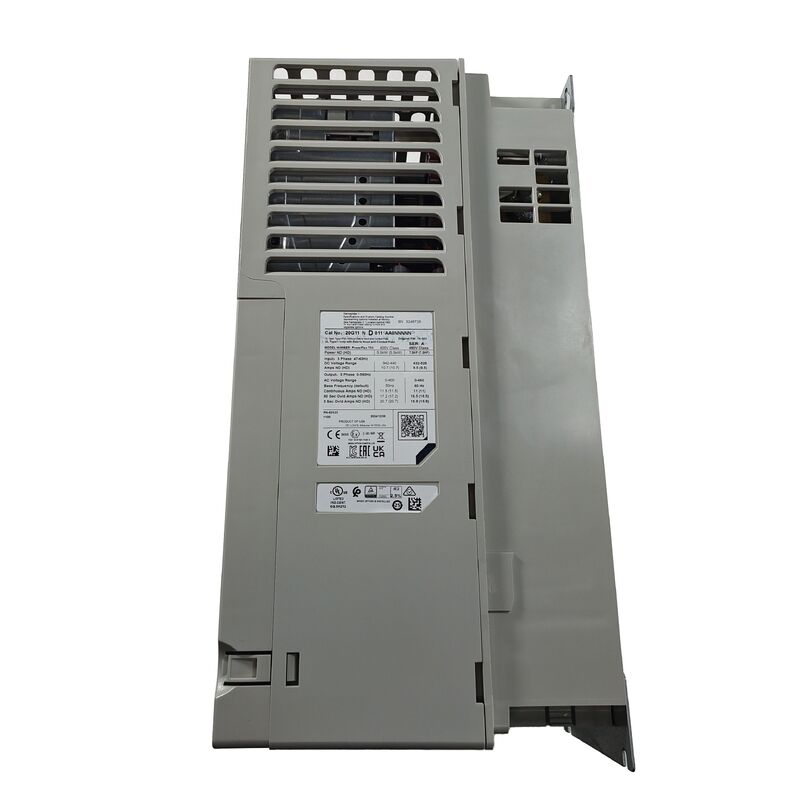
20G11ND011AA0NNNNN | AC Variable Frequency Drive — 480V / 11A / 10HP / Open Type / IP20 / Forced Air Cooled
480V / 10HP AC Drive — Open-Type Configuration with Integrated Dynamic Braking
The 20G11ND011AA0NNNNN is a 480V three-phase AC variable frequency drive rated for 11A continuous output current and 10HP motor power class — designed for industrial motor speed control applications using a three-phase induction motor matched to this current and power rating. The open-type enclosure configuration is intended for installation inside an enclosing cabinet that provides the ultimate environmental protection — the drive itself, at IP20, protects against finger contact and larger solid object ingress but is not rated for direct dust or moisture exposure outside a cabinet.
The integrated DB (dynamic braking) transistor is a significant included feature: this provides the switching element required to dissipate regenerative energy from a decelerating motor load through an external braking resistor — essential for applications where the motor must decelerate quickly or where overhauling loads (such as descending hoists or unwinding reels) would otherwise return energy into the drive's DC bus.
Key Specifications
| Parameter |
Value |
| Voltage |
480V AC, 3-phase |
| Output Current |
11A |
| Power Rating |
10HP |
| Input Frequency |
50/60Hz |
| Enclosure |
Open type |
| IP Rating |
IP20 |
| Cooling |
Forced air |
| Operating Temp. |
0°C to 40°C |
| Storage Temp. |
−40°C to +70°C |
| Humidity |
5–95% non-condensing |
| Weight |
10.00 lbs (4.54 kg) |
Open Type Enclosure — Cabinet-Mounted Installation
The "open type" designation defines how this drive is installed and protected in a real machine or panel:
Cabinet installation required: An open-type drive lacks the sealed outer housing of a fully enclosed (NEMA/UL Type 1 or higher) drive — it is designed to be mounted inside an electrical cabinet that provides the complete environmental enclosure, with the cabinet door and seals providing the actual ingress protection appropriate to the installation environment.
IP20 rating: Within the cabinet, the drive itself carries an IP20 rating — protecting against solid objects larger than 12mm (finger-safe) but providing no protection against dust accumulation or any moisture ingress. The surrounding cabinet must provide whatever additional environmental protection the installation location requires.
Cost and footprint advantage: Open-type drives are typically more compact and cost-effective than fully enclosed variants of the same power rating — appropriate when the drive panel or machine control cabinet already provides the necessary environmental protection class for the installation location.
Applications
General industrial motor speed control: Pumps, fans, conveyors, and general material handling equipment using three-phase induction motors at the 10HP power class requiring variable speed operation.
Applications requiring rapid deceleration: Machine axes, indexing equipment, and process equipment where motor deceleration time is a critical part of the cycle time, benefiting from the dynamic braking capability.
Overhauling load applications: Hoists, elevators, unwind/rewind stations, and other applications where the load can drive the motor faster than the commanded speed — requiring the dynamic braking function to manage the resulting regenerative energy.
Panel-mounted OEM machine control: Machine builder control cabinets where the open-type drive is integrated into a custom enclosure design alongside other control components.
FAQ
Q1: What determines whether the CM jumper should be installed or removed for a specific installation?
The CM jumper configuration depends on the facility's electrical distribution system grounding type. Grounded (TN-S, TN-C-S, or TT) systems typically use the jumper installed configuration as shipped. Ungrounded or high-resistance grounded (IT) distribution systems generally require the jumper removed to prevent the EMC filter's ground-referenced capacitors from creating excessive leakage current or causing nuisance ground fault trips. Consult the drive's installation manual and confirm the facility's distribution system type with the site's electrical engineer before commissioning.
Q2: Is a separate braking resistor required, or does the drive include one internally?
The drive includes the DB transistor — the switching element that controls current to a braking resistor — but the resistor itself is a separate external component that must be sized and selected for the specific application's braking duty cycle and energy dissipation requirement. Confirm the appropriate braking resistor specification (resistance value and power rating) from the drive's technical manual based on the connected motor's inertia and the required deceleration profile.
Q3: Can this drive be installed in an unventilated cabinet given its forced-air cooling design?
No — a forced-air cooled drive requires adequate airflow through the cabinet to remove the heat generated during operation. The cabinet must include either ventilation openings with filtered intake/exhaust or a cabinet cooling fan/air conditioning system sized for the drive's heat dissipation at full load. Installing a forced-air cooled drive in a sealed, unventilated enclosure will cause the drive to overheat and fault under load, or operate with reduced reliability over time.
Q4: What is the significance of the 0°C to 40°C operating temperature range for installation planning?
The 0°C to 40°C range defines the ambient air temperature directly at the drive's location — not the general room temperature, but the actual air temperature surrounding the drive enclosure, which can be elevated in poorly ventilated cabinets or cabinets containing multiple heat-generating components. For installations where ambient cabinet temperature may exceed 40°C — due to dense component packing, inadequate cabinet ventilation, or hot industrial environments — additional cabinet cooling or a derated current rating should be planned to keep the drive within its rated operating range.


 Your message must be between 20-3,000 characters!