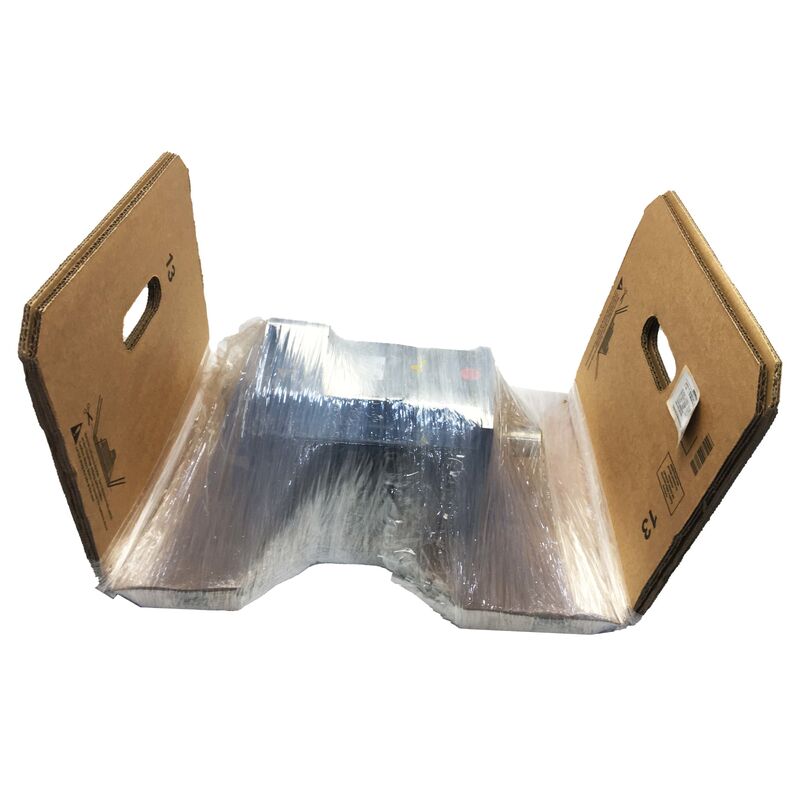
Siemens 1FK7083-5AF71-1DG5 | SIMOTICS S 1FK7 Compact Synchronous Servomotor — 3.3kW, 16Nm, 3000RPM, 7.4A, 80mm Shaft Height, Plain Shaft, Holding Brake, IP65/IP67
Overview
The Siemens 1FK7083-5AF71-1DG5 is a SIMOTICS S 1FK7 Compact synchronous permanent-magnet servomotor delivering 3.3 kW at 16 Nm rated torque and 3,000 RPM, with a holding brake on a plain 80 mm shaft height, rated at 7.4A continuous and built around a rare-earth rotor that achieves an exceptionally high torque density for a naturally cooled 155 × 155 mm flange motor.
IP65 across the motor body and IP67 at the drive-end (DE) flange — the mechanical interface that sees the most fluid exposure in real machine tool installations — complete the environmental specification.
The 1FK7 Compact designation within the SIMOTICS S family means the motor has been designed around maximum power-to-volume efficiency: more torque per kilogram, more kilowatts per litre of motor volume, relative to conventional wound-field motors of the same frame size.
Rare-earth magnets — the same neodymium-iron-boron alloy class used throughout the high-performance servo motor sector — are what makes this density possible.
The magnets produce the rotor flux that creates torque when the stator's three-phase current reacts with it, and because rare-earth magnets produce substantially higher flux per unit volume than ferrite, the motor's active length can be kept short while meeting the 16 Nm torque specification.
Natural air cooling — no external fan, no forced ventilation, no cooling water — means the motor dissipates its thermal load by convection and radiation from its housing surface and the machine flange it mounts on.
Adequate thermal contact between the motor's mounting face and the machine structure is therefore not cosmetic; it is part of the motor's thermal management system, and isolating the motor from its mounting surface with gaskets or thermally resistant fasteners reduces the achievable continuous torque rating below the 3.3 kW nameplate value.
Key Specifications
| Parameter |
Value |
| Rated Output |
3.3 kW |
| Rated / Stall Torque |
16 Nm |
| Rated Speed |
3,000 RPM |
| Rated Current |
7.4 A |
| Phase |
3-Phase |
| Shaft Height |
80 mm |
| Shaft Type |
Plain (No Keyway) |
| Holding Brake |
Yes |
| Flange Mounting |
155 × 155 mm, IM B5 (IM V1, IM V3) |
| IP Rating |
IP65 body / IP67 DE flange |
| Cooling |
Natural air |
| Magnets |
Rare-earth |
| DC Link Voltage |
600V class |
| Compatible Drive |
SINAMICS S120 / S210 |
16 Nm in a Naturally Cooled 155 mm Flange Motor
Sixteen Newton-metres at 3,000 RPM and 3.3 kW from a motor that requires no forced cooling and mounts on a 155 × 155 mm flange is the achievement that the 1FK7 Compact's rare-earth rotor makes possible.
For comparison, a conventional induction motor achieving the same power output at the same speed would require either a larger frame to manage the greater heat generation of its resistive rotor losses, or an external cooling fan that adds volume, weight, and a maintenance item.
The synchronous permanent-magnet design eliminates rotor copper losses entirely — there is no current flowing in the rotor at all, no resistive heating in the rotor bars, and no slip-dependent efficiency loss.
All the electrical losses are in the stator winding, where they can be conducted to the motor housing and dissipated by the housing's surface area and the machine flange's thermal mass.
This fundamental difference in loss distribution is why a 3.3 kW synchronous servomotor at this frame size can operate without forced cooling, while an induction motor of similar frame and power rating would generate more heat than natural convection could remove.
The 16 Nm stall torque is the figure against which the axis load must be sized. Peak torque — available during acceleration phases at the drive's maximum current output — will be higher, typically 2.5 to 3 times the rated value depending on the drive configuration and thermal constraints.
The RMS torque across the full duty cycle must stay within 16 Nm for the motor to operate continuously within its thermal limits; brief excursions to peak torque during acceleration are permitted within the drive's thermal model.
Holding Brake — Fail-Safe Axis Security
The holding brake integrated into the 1FK7083-5AF71-1DG5 is the spring-applied type used throughout SIMOTICS S: a spring-loaded friction disc that is held off the shaft by electromagnetic force when the brake supply voltage is applied, and engages instantly when that voltage is removed.
The brake does not participate in dynamic stopping — it is not designed to decelerate the motor from speed — but provides mechanical holding once the servo has brought the axis to rest.
On vertical axes and inclined axes in machine tool and handling applications, the brake prevents the load from moving during servo disable events: E-stop, power interruption, programmed pause between operations, or control system restart.
Without a brake on a vertical axis, every servo disable event allows the axis to drift under gravity until servo torque is restored — a condition that can cause tool or workpiece collisions on restart if the axis has moved from its last commanded position.
The brake supply voltage should be confirmed from the machine's wiring documentation before installation — SIMOTICS S brakes in this class typically use 24V DC, but the specific voltage for this motor should be verified.
The SINAMICS drive controls the brake release and engagement as part of its axis enable/disable sequence, ensuring the brake engages before servo torque is removed, and releases only after the servo is enabled and ready.
Plain Shaft, 80 mm Shaft Height
The plain shaft on the 1FK7083-5AF71-1DG5 has no keyway machined into it.
The 80 mm shaft height refers to the distance from the motor's mounting flange face to the shaft centreline — the dimensional parameter that determines whether this motor is geometrically compatible with a given machine's motor mounting cavity and coupling alignment.
A plain shaft transmits torque through friction with the coupling hub bore. At 16 Nm rated and peak torques potentially reaching 40 Nm or above, the coupling design and installation torque must be specified against the motor's peak output. Hub bore tolerance (ISO fit), surface finish, and the clamping mechanism's specified tightening torque collectively determine the achievable friction torque at the interface.
For applications with frequent direction reversals under full torque — typical in servo-controlled machine tool axes — the coupling specification should include a safety margin above the peak torque to account for fatigue and micro-slip effects over the machine's service life.
The IM B5 mounting configuration positions the motor with the shaft horizontal and the flange face vertical, which is the standard orientation for direct coupling to a ball screw or gearbox input on a CNC machine axis.
The motor can also be mounted in IM V1 (shaft upward) and IM V3 (shaft downward) orientations — both of which are covered by the IP67 DE flange rating, as the flange joint is the most fluid-vulnerable interface and is sealed to the higher IP67 standard regardless of mounting direction.
IP65 Body / IP67 DE Flange — Targeted Environmental Protection
The split IP rating on the 1FK7083-5AF71-1DG5 reflects the different fluid exposure risks at different parts of the motor.
The body — the cylindrical housing covering the stator and winding — is rated IP65: complete dust exclusion and protection against water jets from any direction. This covers the ambient environment of most CNC machine tool installations, including coolant mist, cleaning jets, and humidity.
The drive-end (DE) flange — the mechanical face that interfaces with the machine structure, through which the shaft exits — carries the more demanding IP67 rating: temporary immersion protection in addition to jet resistance.
The DE flange is the interface most likely to be flooded by coolant accumulation or direct cleaning fluid, and the shaft oil seal at this face is the one component whose failure allows fluid ingress into the bearing cavity. Sealing this interface to IP67 provides the additional protection margin appropriate for its exposure position.
What IP65/67 does not cover is continuous chemical attack from cutting fluid additives: high-sulfur content oils, synthetic cutting fluids, and alkaline cleaning agents can degrade seal lip materials and housing coatings over time regardless of the IP rating.
Siemens specifies that the motor surface should be protected from solvents, and that cable routing should include a drip loop to prevent fluid tracking into the motor along the cable jacket.
SINAMICS Integration and Drive Compatibility
The 1FK7083-5AF71-1DG5 operates within the SINAMICS S120 and S210 drive systems.
The SINAMICS-1FK7 combination is one of the tightest motor-drive integrations in the servo market: the motor's electrical parameters — stator resistance, inductance, back-EMF constant, encoder interface — are stored in Siemens' motor database within the SINAMICS commissioning software, so the drive self-configures the current regulator, speed controller initial gains, and thermal protection model automatically when the motor type is selected.
The 600V DC link voltage class means this motor is designed for the 400V three-phase AC supply that is the European and global industrial standard, converting through the SINAMICS infeed to the 600V DC bus.
North American 480V supply also feeds the same nominal DC bus.
The motor's 7.4A rated current determines the minimum drive module current rating required: the selected drive axis module must have a continuous output current rating at or above 7.4A, with a peak current capability sufficient for the application's maximum acceleration torque demand.
FAQ
Q1: Does the 1FK7083-5AF71-1DG5 require a specific SINAMICS drive, or is it compatible across the S120 range?
The 1FK7083-5AF71-1DG5 is compatible with SINAMICS S120 drive modules and the S210 single-axis servo drive. The motor data is stored in the SINAMICS motor database, so commissioning is parameter-selection rather than manual data entry.
The specific drive module must be rated for at least 7.4A continuous output and the required peak current for the application's acceleration demands.
S120 axis modules in the 9A and higher current class cover the continuous rating; peak current requirements depend on the acceleration profile. Consult the SINAMICS configuration tool or Siemens drive sizing software to confirm module selection.
Q2: The brake supply voltage — what is the correct value, and where does it come from?
SIMOTICS S 1FK7 holding brakes in this class are typically supplied at 24V DC, controlled by the SINAMICS drive's brake control output as part of the servo enable/disable sequence.
The brake releases (24V applied) when the servo is enabled and ready; it engages (24V removed) before the servo output is disabled.
Always verify the specific brake voltage from the motor's nameplate or the motor data sheet for this exact article number — do not assume based on series alone. Applying the wrong voltage either fails to release the brake (motor runs against continuous brake drag) or fails to hold (spring force insufficient).
Q3: What is the significance of IP67 at the DE flange versus IP65 on the motor body?
The drive-end flange is the mechanical interface between motor and machine, through which the shaft exits and coolant exposure is highest.
IP67 at this interface adds temporary immersion protection above the jet-water IP65 of the motor body — specifically, it covers the sealed flange joint and shaft oil seal against the coolant flooding and accumulation typical in machine tool environments where the motor is mounted near the working zone.
The motor body IP65 covers the general ambient environment (mist, spray, cleaning jets); the DE flange IP67 covers the most fluid-exposed structural interface.
Q4: Can the plain shaft be replaced with a keyed shaft if the machine requires a keyway?
This would require a mechanical modification to the shaft — either machining a keyway into the existing plain shaft or replacing the shaft assembly. Both require factory-qualified service, as the motor's bearings, shaft preload, and front endshield geometry are part of a precision assembly.
If the machine's coupling design requires a keyed shaft, the correct approach is to specify the keyed shaft variant at the time of ordering: the 1FK7083-5AF71-1 suffix series includes variants with keyway (typically "B" or "H" shaft end designations) that can be ordered directly.
Retrofitting a keyway to a plain shaft in the field risks bearing damage and encoder misalignment if done without the correct tooling and shaft support.
Q5: What are the critical installation checks for the 1FK7083-5AF71-1DG5?
Verify the coupling hub bore fits the plain shaft to the correct tolerance and that the hub clamping torque meets the specification for the application's peak torque.
Confirm the mounting flange contact is thermally adequate — the motor's continuous rating assumes heat flows through the flange into the machine structure, so mounting on insulating materials or with poor surface contact reduces the achievable continuous torque.
Test the holding brake before mechanical coupling by cycling the brake supply voltage and confirming clean release and engagement.
After drive commissioning, verify the motor auto-identification is accepted correctly by the SINAMICS system and that the drive's motor data matches the motor's nameplate before executing the first motion command.


 Your message must be between 20-3,000 characters!