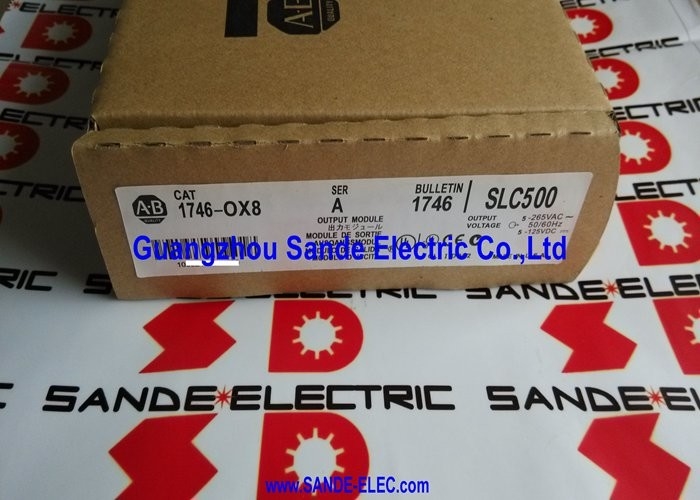
Allen-Bradley 1746-OX8 | SLC 500 8-Point Individually Isolated Relay Output Module — 5–265V AC / 5–125V DC / 3A / 30A Make
Individual Isolation on All Eight Contacts — No Shared Commons
The 1746-OX8 is the individually isolated relay output module in Allen-Bradley's SLC 500 digital I/O family. Every one of the eight relay contacts is fully isolated from every other — there are no shared common terminals, no grouping constraints, and no current summation requirement across contacts. Each contact switches an entirely independent load circuit at its own voltage, from a different power source if required.
This architecture is the defining characteristic of the 1746-OX8 and the reason it exists alongside the standard grouped-common relay output modules in the SLC 500 family. Where a panel has eight field loads operating at different voltages — 24V DC for solenoids, 120V AC for contactors, 12V DC for signal lamps — the 1746-OX8 handles all eight from one module without any shared reference or common current path between them.
The relay contacts are rated for high-current switching: 30A make and break at 120V AC. This is not a continuous rating — the contacts handle the inrush and break current that real loads (motor starters, magnetic contactors, transformer primaries) impose at switching transitions, without contact welding or arc damage. Continuous current is 3A at 120V AC per contact, limited to 1440VA across the entire module.
Key Specifications
| Parameter | Value |
|---|
| Points | 8, individually isolated |
| AC Range | 5–265V AC, 47–63 Hz |
| DC Range | 5–125V DC |
| Continuous (120VAC) | 3A per contact |
| Continuous (240VAC) | 1.5A per contact |
| Make @ 120V AC | 30A |
| Break @ 240V AC | 3A |
| Signal Delay (ON/OFF) | 10ms / 10ms |
| Isolation | 1,500V AC (I/O to logic) |
| Module VA Limit | 1,440VA |
| Backplane | 85mA @ 5VDC / 90mA @ 24VDC |
| Heat Dissipation | 8.60W (all on) / 2.59W (all off) |
| Hazardous Location | Class 1, Division 2 |
| Noise Immunity | NEMA ICS 2-230 |
| Operating Temperature | 0–60°C |
When Individual Isolation Matters Over Grouped Commons
Standard SLC 500 relay output modules group outputs into commons — 4 or 8 outputs per common terminal. This works well when all loads in a group share the same supply voltage and return path. When loads differ in voltage, polarity, or power source, grouped commons force either multiple separate field supplies wired to different group commons or the use of interposing relays.
The 1746-OX8 eliminates both workarounds. Eight separate isolated contacts handle eight independent loads regardless of their electrical relationship. The penalty is higher heat dissipation (0.825W per energised contact) compared to grouped modules. Size the backplane and cabinet cooling accordingly.
FAQ
Q1: Why use the 1746-OX8 instead of a standard SLC 500 relay module with grouped commons?
When field loads operate at different voltages or from different power sources — or when the loads must be electrically isolated from each other for safety or fault containment reasons — individual isolation eliminates the shared common path. Standard grouped-common modules require all contacts in a group to share the same supply voltage at the common terminal. The 1746-OX8 has no such constraint.
Q2: What does 1,440VA total module limit mean in practice?
The continuous module power dissipation must stay below 1,440VA. Divide 1,440VA by the field supply voltage to find the maximum simultaneous current across all eight contacts. At 120V AC, that is 12A total — four contacts at 3A each. Exceeding the module VA limit causes thermal damage even when individual contacts remain within their 3A rating.
Q3: The signal delay is listed as 10ms. How does this compare to transistor outputs?
The 10ms ON/OFF delay is inherent to mechanical relay contact closure and release — electromechanical response time. Transistor outputs switch in under 1ms. For applications requiring sub-millisecond output response (high-speed machine cycles, encoder-triggered outputs), transistor output modules are the correct choice. For standard machine control (conveyor start, valve actuation, pilot lamp switching), 10ms is acceptable.
Q4: What is the minimum load current the 1746-OX8 can reliably switch?
Minimum load current is 10mA at 5V DC. Below this threshold, the relay contact surface may not maintain a clean low-resistance closure — dry switching of microload signals (under 1mA) is not reliable on this module. For low-level signal switching, use solid-state output modules or purpose-designed microcurrent relay modules.
Q5: Can the 1746-OX8 be installed or removed with the SLC 500 chassis powered on?
No. Rockwell Automation requires removing or inserting 1746 I/O modules only when the chassis is de-energised. Inserting or removing with power applied can produce arcing at the backplane connector, potentially damaging the module, the chassis, or adjacent modules.


 Your message must be between 20-3,000 characters!