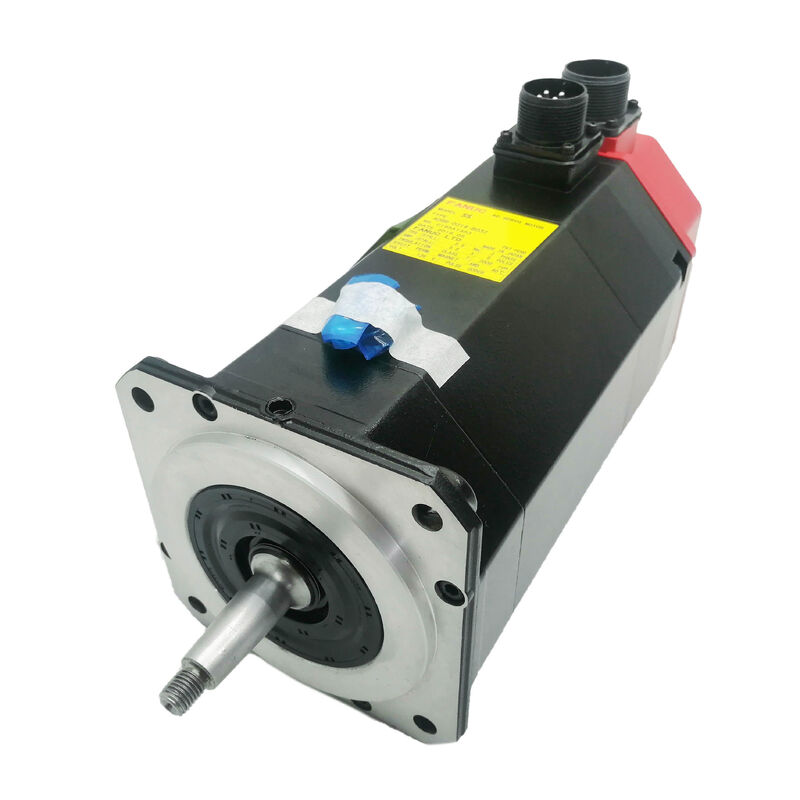
Fanuc A06B-0315-B033 | S Series Model 10S AC Servo Motor — 12Nm, 2000RPM, 7.6A, 150V, 3000P Encoder, No Brake, IP65 / IP67 Options
Overview
The Fanuc A06B-0315-B033 is a Model 10S AC servo motor from the Fanuc S series — the generation of Fanuc servo motors recognised by their distinctive red encoder cap — carrying 12 Nm stall torque at 2,000 RPM on a three-phase 150V, 7.6A input. No brake, straight shaft (with or without keyway depending on the specific build), and available in standard IP65 or waterproof IP67 sealing — the flexibility in shaft and sealing configuration is a characteristic of how the A06B-0315-B033 has circulated through the machine tool repair and exchange market over its service life, with different builds reflecting different original machine specifications.
At 12 Nm and 2,000 RPM, the Model 10S occupies the middle ground of the S series range.
Twelve Newton-metres of stall torque is substantial — enough to drive the primary feed axes of medium-class CNC lathes, machining centres, and multi-axis machines that were the Model 10S's original application territory when the S series was produced.
These machines are still running in workshops worldwide, and that sustained installed base is why the A06B-0315-B033 remains actively traded in the exchange and refurbishment market decades after the S series' production ended.
The 3000P pulsecoder — available in both incremental (3000P INC) and absolute (3000 ABS, encoder A860-0320-T113) variants on this motor — provides the position and velocity feedback to the Fanuc Series 0, 6, 10, 11, or 15 CNC controller.
When the encoder is the absolute variant and the CNC's battery is maintained, the motor retains position data through power interruptions; with the incremental encoder, a reference return is required at each startup.
Key Specifications
| Parameter |
Value |
| Stall Torque |
12 Nm |
| Maximum Speed |
2,000 RPM |
| Motor Voltage |
150 VAC |
| Rated Current |
7.6 A |
| Phase |
3-Phase |
| Poles |
8 |
| Shaft Diameter |
35 mm |
| Flange Centering Diameter |
114 mm |
| Brake |
None |
| Encoder |
3000P (INC or ABS) |
| IP Rating |
IP65 standard / IP67 waterproof option |
| Series |
Fanuc S Series (Red Cap) |
| Compatible CNC |
Series 0, 6, 10, 11, 15 |
12 Nm at 2,000 RPM — The Model 10S in the S Series Context
The Fanuc S series named its motors by torque class: the "10" in Model 10S nominally identifies the 10 kg·cm (approximately 10 Nm) nominal class, with the actual stall torque on the nameplate specified as 12 Nm.
Stepping through the S series makes the progression clear: the Model 5S produces approximately 5–6 Nm, the Model 10S produces 12 Nm, the Model 20S and above scale upward in torque for heavier axis duties.
The "S" designation distinguishes this range from the same-generation Model series (like the M series for milling centres) within the broader Fanuc motor catalogue of this era.
At 2,000 RPM rated maximum speed, the Model 10S delivers its full 12 Nm throughout the entire speed range from zero to 2,000 RPM.
On a ball screw axis with a 10mm pitch at 1:1 coupling, 2,000 RPM produces 20 m/min rapid traverse — the standard for the class of medium-capacity machine tool the Model 10S was designed to serve.
On machines with 6 or 8mm pitch screws, the traverse rates adjust proportionally, typically settling between 12 and 16 m/min for the most common feed screw configurations in this machine class.
The 7.6A rated current at 150V three-phase reflects the motor's electrical operating point.
At 8 poles, the S series motor produces smooth torque ripple characteristics that contribute to the surface finish quality the machine tool manufacturers of that era required — an 8-pole winding produces four torque pulses per electrical cycle rather than the two produced by a 4-pole winding, which smooths the force output at the shaft and reduces the vibration signature at low speeds.
The S Series Generation — Red Cap Identity and Application History
The red encoder cap is the unmistakable visual signature of the S series and the broader Fanuc DC and early AC servo motor generation that it represents.
This colour coding was consistent across production: red cap identifies the S series generation connector at the encoder (pulsecoder) junction at the motor rear, distinguishing it from the later Alpha series (different connector design) and from Fanuc DC servo motors (which used different connector styles for their tachogenerator feedback).
The S series was designed for and fitted on a generation of CNC machine tools that were built for longevity.
Mazak machining centres, Okuma lathes, Mori Seiki turning centres, Doosan mills, and dozens of other manufacturers fitted S series motors on machines that are still producing parts.
The 12 Nm Model 10S was the workhorse torque class — used wherever the axis load fell in the moderate-to-heavy range that neither the lighter 5S nor the heavier 20S matched as closely.
Across that installed base, the A06B-0315-B033 represents one of the more commonly encountered S series motor specifications in the exchange and maintenance market.
Because the S series is long discontinued by Fanuc, every A06B-0315-B033 in the market today is either surplus stock removed from an obsolete system, or a motor that has been refurbished through replacement of bearings, seals, encoder assembly, and — where necessary — winding repair.
The quality of that refurbishment varies significantly between suppliers; understanding what "refurbished" means in practice for a specific unit, and what testing was performed, is part of the due diligence for sourcing a replacement A06B-0315-B033.
Shaft and Sealing Configurations — The B033's Known Variations
The A06B-0315-B033 appears in the market in several documented configurations, a consequence of both the original Fanuc ordering system (which allowed multiple suffix and modification options) and the way motors have been repaired, re-shafted, and re-sealed over their service histories.
The shaft is 35 mm diameter, 114 mm flange centering. Most examples are straight plain shaft without keyway, which is the default configuration for this motor. Some examples carry a keyway cut into the shaft — either original from Fanuc's B033 #7008 ordering modification, or added during shaft repair or replacement.
The presence or absence of a keyway is visible on inspection and determines the coupling design required: a plain shaft uses friction-clamped coupling hubs; a keyed shaft uses hub-and-key assemblies with the positive rotational interlock that a keyway provides.
The IP65 standard sealing covers the motor body against dust ingress and water jets.
The IP67 waterproof option — which Fanuc offered on the S series as a factory modification for machine tool environments with high coolant exposure — extends protection to temporary immersion.
On refurbished motors, the sealing condition depends on whether the seals were replaced during the refurbishment process; requesting confirmation of seal replacement and oil seal condition at the shaft exit is a reasonable question when sourcing a used A06B-0315-B033 for an installation in a high-coolant environment.
3000P Encoder — Incremental and Absolute Variants
The 3000 pulses-per-revolution pulsecoder is the feedback device generation fitted to the A06B-0315-B033.
At 2,000 RPM, this encoder outputs approximately 100,000 pulses per second — the pulse rate the Fanuc series 0/6/10/11/15 controller processes to determine both position and velocity in the servo control loop.
The B033 part number is associated with the 3000P encoder in both incremental (INC) and absolute (ABS) forms on different documented examples.
The absolute variant (A860-0320-T113) retains position through power loss when the CNC's battery is maintained, eliminating the reference return at startup. The incremental variant requires homing after each power cycle.
On machines where the encoder variant is critical to the machine's startup sequence and operational requirements, confirming the encoder type — from the motor's label or the machine's maintenance documentation — before ordering is essential.
The 3000P pulsecoder is a physically separate component that mounts on the motor's rear pulsecoder interface.
This makes the encoder individually serviceable: a motor with a failed encoder but healthy windings and bearings can be restored by fitting a replacement 3000P pulsecoder assembly, which is typically less costly than replacing the entire motor.
Conversely, a motor offered for sale without an encoder fitted requires sourcing the correct pulsecoder assembly separately before the motor can be installed and operated.
FAQ
Q1: What is the difference between A06B-0315-B033 and A06B-0315-B032?
Both are Model 10S motors with identical stall torque (12 Nm), speed (2,000 RPM), voltage (150V), current (7.6A), and straight shaft configuration.
The encoder differs: the B032 carries a 2500P absolute encoder; the B033 carries a 3000P encoder (incremental or absolute).
The servo amplifier parameter settings that configure the encoder type and resolution must match the encoder fitted — substituting a B033 on a machine that previously had a B032 requires confirming the amplifier accepts the 3000P encoder type, or parameter adjustment if the amplifier supports both.
Q2: Does the A06B-0315-B033 have a brake?
No. The A06B-0315-B033 has no electromagnetic brake.
The "B0" prefix in Fanuc's S series naming convention indicates no brake; the brake-equipped variant would carry a "B2" or similar prefix. For axes that require mechanical holding when the servo is off — vertical axes, inclined axes — the brake-equipped Model 10S variant must be specified.
Installing a brake-free motor on an axis that requires holding creates a risk of uncontrolled axis drift during servo disable events.
Q3: How do I confirm whether my A06B-0315-B033 has an incremental or absolute encoder?
Read the encoder assembly label on the pulsecoder at the motor rear. The absolute encoder assembly carries the Fanuc part number A860-0320-T113 (3000 ABS); incremental variants carry different A860 series numbers such as A860-0615-T113 (3000 INC).
The motor's machine documentation or the CNC parameter file will also record the encoder type.
If the label is damaged or missing, the encoder type can be determined by testing whether the CNC reads a valid absolute position at power-up without any axis movement — if it does, the absolute encoder is fitted and functioning with a battery in the CNC.
Q4: Can the A06B-0315-B033 be upgraded to IP67 waterproof sealing?
Yes. Motor repair and rebuild services for S series motors routinely include IP67 sealing upgrades, replacing the standard shaft oil seal with a higher-specification seal assembly and applying the additional body sealing required to achieve the IP67 rating.
General Servo and other specialist repair companies explicitly offer winding encapsulation and waterproofing upgrades for S series motors.
If the motor is being refurbished before returning to service in a high-coolant environment, requesting IP67 sealing as part of the rebuild specification is worthwhile.
Confirm the repair shop's method for achieving IP67 and whether they pressure-test the assembly before shipping.
Q5: What are the most important checks when evaluating a used A06B-0315-B033?
Rotate the shaft by hand to assess bearing smoothness — the 35 mm shaft and 114 mm flange indicate a substantial motor with correspondingly larger bearings, and bearing roughness is audible and tactile before it becomes structurally significant.
Verify the 3000P pulsecoder is present and inspect its connector pins and locking mechanism. Measure three-phase winding resistance for phase balance and check insulation resistance to earth; 7.6A at 150V three-phase generates meaningful heating under load, and winding condition directly determines service life.
If possible, confirm whether the encoder is incremental or absolute before installation, as this affects the machine's startup sequence configuration.
A run-up on a compatible Fanuc amplifier to 2,000 RPM with current monitored and encoder feedback verified is the definitive check before committing the motor to production.


 Your message must be between 20-3,000 characters!