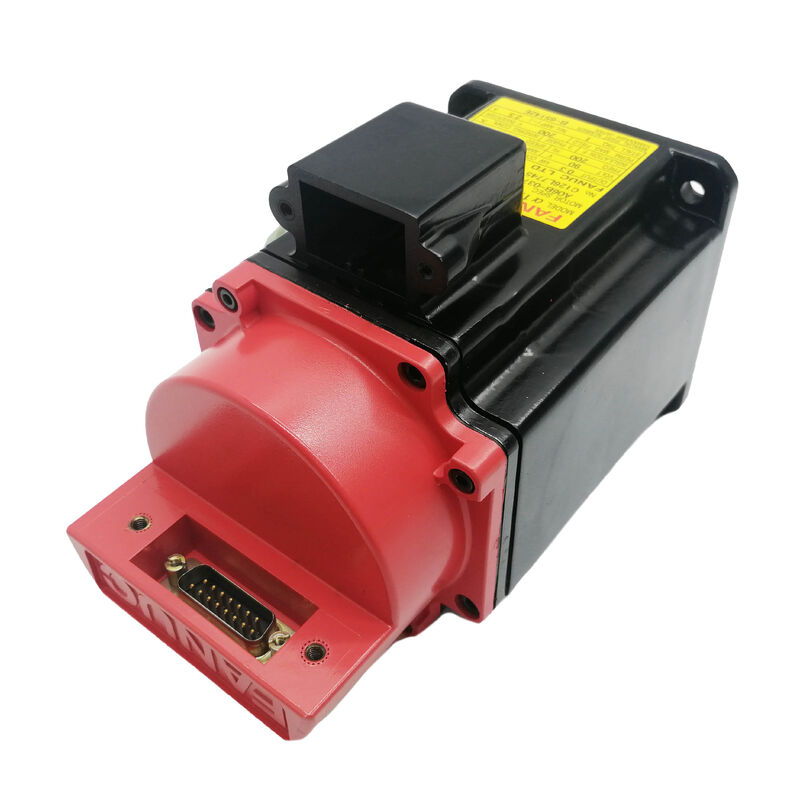
Fanuc A06B-0371-B177 | Alpha Series AC Servo Motor α1/3000 — 0.3kW, 1Nm, 3000RPM, Taper Shaft, 90V Brake, I64 Encoder, IP67
Part Number: A06B-0371-B177 (also A06B0371B177)
Series: Fanuc Alpha (α) Series AC Servo Motor
Model: α1 / 3000
Configuration: Taper Shaft with Keyway, 90V DC Spring-Applied Brake, I64 Absolute Encoder, IP67
Rated Output: 0.3 kW
Stall Torque: 1 Nm
Maximum Speed: 3,000 RPM
Motor Voltage: 90 VAC
Rated Current: 2.5 A
Rated Frequency: 200 Hz
Phase: 3-Phase
Associated Encoder: A860-0365-T001 (I64 Pulse Encoder)
Compatible CNC: Series 0, 15, 16, 18, 20, 21
Condition: New / Refurbished / Surplus
Overview
The Fanuc A06B-0371-B177 is a compact Alpha series AC servo motor — model α1/3000 — rated at 0.3 kW with 1 Nm stall torque and 3,000 RPM maximum speed.
Operating at 90V three-phase, 200 Hz, and 2.5A on a taper shaft with keyway, the B177 variant carries a 90V DC spring-applied brake and the I64 absolute encoder.
It fits the lightest end of the original Fanuc Alpha series feed motor range: small axis applications on compact CNC machine tools where 1 Nm stall torque is sufficient for the axis load, and where the motor's compact size, taper shaft interface, and full IP67 environmental protection make it the appropriate choice.
The IP67 rating — one step above the IP65 standard on most Alpha series motors — marks this as a motor selected for the wettest, most fluid-exposed positions in the machine. IP67 provides both the jet-water resistance of IP65 and protection against temporary immersion, which is why this rating appears on motors fitted close to coolant delivery zones or in machine axes where the motor body may be submerged during cleaning or flooding conditions.
The "red cap" connector cover — the visual signature of the original Fanuc Alpha generation — identifies this motor's generation at a glance on the shop floor, distinguishing it from the later Alpha i series motors whose connector design differs.
This generation context matters for spare parts sourcing, amplifier selection, and encoder battery maintenance: the A06B-0371-B177 is designed for the Alpha series amplifier platform, not the Alpha i (αiS) generation, and its absolute encoder requires a battery at the CNC for position retention across power cycles.
Key Specifications
| Parameter |
Value |
| Rated Output |
0.3 kW |
| Stall Torque |
1 Nm |
| Maximum Speed |
3,000 RPM |
| Motor Voltage |
90 VAC |
| Rated Current |
2.5 A |
| Rated Frequency |
200 Hz |
| Phase |
3-Phase |
| Shaft Type |
Taper with Keyway |
| Brake |
90V DC Spring-Applied |
| Encoder |
I64 Absolute Pulsecoder |
| Associated Encoder P/N |
A860-0365-T001 |
| Ingress Protection |
IP67 |
| Series |
Fanuc Alpha — A06B-0371 |
| Compatible CNC |
Series 0, 15, 16, 18, 20, 21 |
α1/3000 — The Lightest Alpha Feed Motor
At 1 Nm stall torque and 0.3 kW, the α1/3000 is the entry point of the Fanuc Alpha series compact feed motor range. Understanding where this motor sits in the Alpha lineup is straightforward: the number preceding the slash in the model designation is the stall torque in Newton-metres.
The α1/3000 produces 1 Nm. The α2/3000 (A06B-0373 series) produces 2 Nm. The α3/3000 and α6/3000 step progressively upward, each doubling the available torque for heavier axis loads.
The α1/3000 was specified on the smallest axes of small to medium CNC machine tools: sub-spindle positioning on turning centres, rotary table axes on compact machining centres with light tooling, fourth-axis rotary indexers on small vertical machining centres, and feed axes on compact engraving and precision drilling machines where the table mass is low and the cutting forces are modest.
The 3,000 RPM maximum speed provides 30 m/min rapid traverse at a 10mm pitch ball screw with 1:1 coupling — the standard rapid traverse for this class of machine axis.
The 90V motor voltage at 200 Hz and 2.5A is the electrical signature of the α1/3000 at rated speed.
These parameters appear on the motor nameplate and are the values that the Alpha series servo amplifier's current control loop is designed around for this motor type.
Setting the correct motor type parameter in the CNC servo parameter table ensures the amplifier applies the correct current control to match these nameplate values.
Taper Shaft with Keyway — Precision Coupling at Small Diameter
The taper shaft on the A06B-0371-B177 provides the self-centering interference fit that characterises taper shaft servo motors across the Alpha series.
The taper geometry draws the coupling hub concentrically onto the shaft as the retention fastener is tightened, producing precise radial alignment between motor shaft and driven component without the angular positioning constraint of a straight keyway fit.
The keyway adds positive rotational engagement to the taper's interference fit.
At 1 Nm stall torque — modest by servo motor standards — the keyway is not strictly necessary for torque transmission at rated load.
At the peak current transients the Alpha amplifier can deliver during rapid acceleration phases, however, the instantaneous torque can reach three to four times the stall value.
The key prevents any rotational slip at the shaft-hub interface during these transients, regardless of the interference fit's friction condition.
Taper shaft removal requires a proper puller. The interference fit developed when the hub is drawn onto the taper can generate substantial extraction force, particularly on a motor that has been in service for an extended period.
A puller that bears against the shaft end face and pulls on the hub flange is the correct tool — improvised removal by hammering or prying risks shaft damage, encoder damage from shock transmitted through the motor body, and hub damage that prevents correct refit on a replacement motor.
IP67 — Full Immersion Protection on the Smallest Alpha Motor
The IP67 rating on the A06B-0371-B177 provides complete dust exclusion and temporary immersion protection — one level above the IP65 standard that most Alpha series motors carry as their base specification.
On a 0.3 kW motor this additional protection level reflects the specific installation environments where the α1/3000 was deployed: small axis positions inside CNC machine tool enclosures where the motor body may be directly in the coolant spray zone, or on machines that are cleaned by flooding the machining area with coolant.
IP67's immersion protection means the motor can withstand temporary submersion at a defined depth and duration without water ingress.
In practice on a machine tool, this translates to surviving the occasional coolant flooding event, the high-pressure wash-down cycle, and the sustained coolant mist exposure of continuous production machining without compromising the winding insulation or encoder electronics.
The oil seal at the shaft exit works in conjunction with the IP67 body sealing. The shaft gap — the annular space between rotating shaft and motor front endshield — is the mechanical pathway that body sealing alone cannot close.
The Fanuc Alpha motor instruction manual notes this specifically: the shaft oil seal prevents entry through the shaft gap during rotation, but prolonged static immersion with the shaft stationary can allow lubricant or fluid ingress past the seal lip.
In installation, the encoder cable connector must be fully engaged with the connector locking mechanism properly seated — IP67 connector performance depends on complete engagement, and a partially seated connector is the most common fluid ingress pathway in field service.
90V DC Brake — Alpha Series Standard
The spring-applied brake on the A06B-0371-B177 uses the 90V DC standard that runs across the entire original Fanuc Alpha series. When 90V DC is applied, the coil overcomes the spring force and releases the shaft. When 90V DC is removed — for any reason — the spring re-engages and holds the shaft mechanically.
At 1 Nm stall torque, the brake's holding requirement is modest compared to the larger Alpha series motors. But the application context — small rotary axis, fourth-axis indexer, compact turning centre sub-spindle — typically involves gravity loading at some axis positions: a tilted fourth axis that has an unbalanced tool head, a turning centre sub-spindle that must not drift when the servo is off. For these applications, the 90V DC brake on the α1/3000 provides the same fail-safe mechanical holding as on the larger motors, scaled to the physical size and torque class of this compact motor.
The 90V DC supply comes from the machine's control cabinet — confirmed by voltage measurement at the brake cable terminals before connecting any replacement motor.
The Alpha series 90V DC brake is not interchangeable with the 24V DC brake used on Beta iS motors.
The error of connecting a 24V supply to a 90V brake coil leaves the spring incompletely overcome, the brake partially engaged, and the motor running against continuous drag — damage that is progressive and initially silent before manifesting as elevated current, overheating, and eventually bearing failure.
I64 Encoder (A860-0365-T001) — Absolute with Battery Backup
The I64 encoder associated with the A06B-0371-B177 is the A860-0365-T001 pulsecoder, providing 64,000 pulses per revolution.
The I64 is the encoder fitted to the smaller Alpha series motors in the A06B-0371 and A06B-0373 frames, designed specifically for the compact physical envelope of the α1/3000 and α2/3000 motors.
Like all Alpha series encoders, the I64 can operate in absolute mode when a battery pack is installed at the CNC. With the battery installed, the encoder retains the shaft's absolute position through power interruptions — the CNC reads the correct axis position directly at power-up without a reference return traverse.
Without the battery, the encoder operates in incremental mode and requires homing at each startup cycle.
The encoder assembly at the motor rear is the component most sensitive to mechanical shock and connector handling.
The A860-0365-T001 encoder is physically a separate component that ships with the motor and mates to the motor's rear pulsecoder interface. When evaluating a used A06B-0371-B177, confirming that the encoder assembly is present, undamaged, and correctly mated to the motor body is as important as verifying the motor's electrical condition.
A missing or damaged encoder assembly requires sourcing the A860-0365-T001 separately to restore the motor to full operational condition.
FAQ
Q1: What is the difference between the A06B-0371-B177 and the A06B-0371-B077?
Both are α1/3000 Alpha series motors with identical output, torque, speed, voltage, current, and IP67 sealing. The single difference is the brake: the B177 has a 90V DC spring-applied holding brake; the B077 does not. Both use the taper shaft with keyway.
The B177 is specified for axes where mechanical holding is needed when the servo is de-energised — vertical or inclined load positions, and axes where servo power removal must not result in unintended movement. The B077 is the correct choice for horizontal or counterbalanced axes where holding is not required.
Q2: Why is this motor rated at IP67 rather than the standard IP65?
IP67 includes all IP65 protections — complete dust exclusion and jet-water resistance — plus adds temporary immersion protection.
The IP67 rating on the A06B-0371-B177 reflects its deployment in particularly fluid-exposed positions: inside CNC machine enclosures close to coolant delivery, on machines cleaned by flooding, or in tight axis positions where the motor body sits in the direct coolant spray path.
IP65 is adequate for most machine tool positions; IP67 is specified for the most demanding fluid exposure situations. The IP67 encoder connector must be fully engaged with the locking mechanism seated to maintain IP67 performance at the connector junction.
Q3: What servo amplifier is compatible with the A06B-0371-B177?
The α1/3000 at 2.5A rated current is compatible with the Fanuc Alpha series servo amplifier modules — the small-capacity SVM modules in the A06B-6079 (Type A) or A06B-6096 (FSSB) series. The SVM1-12S or SVM2 modules in the appropriate current class for the α1/3000 are the relevant amplifier options.
The interface type — Type A versus FSSB — depends on the machine's CNC generation. Type A serves Series 0, 15, 16, 18, 20, and 21; FSSB serves the Alpha i generation controls. Confirm the interface type before sourcing either the motor or its amplifier.
Q4: Does the I64 encoder require a battery, and what happens if the battery is not installed?
Without a battery at the CNC, the I64 operates in incremental mode: position is tracked from a reference point established by a homing traverse at startup, and position data is lost at every power cycle.
A reference return is required after every power interruption, including E-stops and programmed power-off. With a battery installed at the CNC, the encoder retains absolute shaft position through power loss — no homing at startup, and position continuity is maintained through any power interruption.
The battery covers up to four Alpha series axes on one battery pack. Battery condition should be checked at scheduled maintenance intervals; a discharged battery means absolute position is lost at the next power interruption.
Q5: What are the key checks when evaluating a used A06B-0371-B177?
Test the 90V DC brake first — apply 90V and confirm the shaft rotates freely with no drag; remove 90V and confirm the shaft is firmly locked. Inspect the taper shaft surface for fretting from previous hub installations and confirm the keyway walls are undamaged.
Rotate the shaft by hand to check bearing smoothness.
Verify the A860-0365-T001 encoder assembly is present and correctly mated to the motor rear interface, and inspect the encoder connector for undamaged pins and a functioning locking mechanism. Measure winding resistance across all three phases for balance and check insulation resistance to earth.
A bench run-up on a compatible Alpha series amplifier to 3,000 RPM with brake function verified and encoder feedback confirmed is the correct final check before the motor returns to production use.


 Your message must be between 20-3,000 characters!