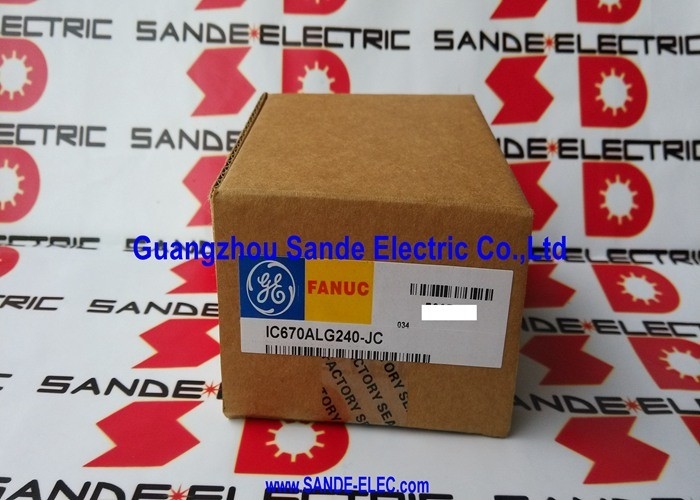
IC670ALG240-JC | GE Fanuc Field Control 16-Channel Analog Current Input Module — 4–20mA / 16-Bit / ±0.1% / 10ms / 250Ω / 24VDC / Open-Wire Alarm / Rev JC
16 Channels in One Group — High Density at Low Cost per Point
The IC670ALG240-JC places all 16 analogue current inputs in a single grouped configuration. All 16 channels share one common. This is appropriate when all connected transmitters share the same earth reference — typical of most 4–20mA loop installations where field instruments are earthed at a common panel.
Sixteen inputs in one module means one module slot, one terminal block, one power connection. Sixteen separate analogue modules would occupy 16 slots. For installations where measurement density matters — tank farm level monitoring, multi-zone temperature measurement, multi-stream flow metering — the grouped 16-channel architecture reduces hardware footprint and wiring complexity at the cost of channel-to-channel isolation.
Key Specifications
| Parameter |
Value |
| Input Channels |
16 (single-ended, grouped) |
| Input Range |
0–20mA / 4–20mA (0–25mA rated) |
| Impedance |
250Ω |
| Resolution |
16-bit |
| Accuracy |
±0.1% full scale |
| Update Rate |
10ms |
| Power |
24VDC / 8W |
| Filter |
50Hz or 60Hz |
| Operating Temp |
−40°C to +70°C |
| Storage Temp |
−40°C to +85°C |
| Humidity |
5–95% RH non-condensing |
2-Wire and 3-Wire Transmitter Support
The IC670ALG240-JC supports both 2-wire and 3-wire current transmitters:
2-wire transmitters (loop-powered): The module supplies loop power, the transmitter modulates current from 4mA to 20mA in response to its process variable. Most field transmitters (pressure, temperature, level, flow) are 2-wire.
3-wire transmitters (separately powered): The transmitter has its own separate power connection; the current output connects between the signal terminal and common. The IC670ALG240-JC accepts either type without hardware reconfiguration.
For 4–20mA signals, the 250Ω input impedance produces 1V to 5V across the input terminals — within the normal operating range of the internal ADC. At 0mA (open wire condition), the input drops to 0V — distinguishable from the valid 4mA minimum, enabling open-wire detection.
Open-Wire Alarm — Automatic Fault Detection for 4–20mA Loops
In 4–20mA loop measurement, a broken cable or failed transmitter drops loop current to zero. Zero current is distinguishable from the 4mA live-zero minimum — a current below 4mA cannot represent a valid process signal. The IC670ALG240-JC monitors each channel in 4–20mA mode and triggers an open-wire alarm when current falls below the valid range. The alarm is automatically reported to the host processor as a diagnostic command, without requiring a scan programme change.
Over-range and under-range alarms follow the same principle — configurable threshold levels trigger diagnostic reports when process values exceed normal operating limits.
Terminal Block Mounting — Module Replacement Without Rewiring
The IC670ALG240-JC mounts on a terminal block that carries the field wiring. The module plugs into the terminal block; the terminal block stays fixed on the mounting surface with all field wires connected.
When a module requires replacement, the module is pulled from the terminal block without disconnecting any field cables. A replacement module — calibrated and configured — drops into the same terminal block. The 16 analogue loops reconnect instantly. No rewiring, no continuity testing, no risk of cross-wiring during maintenance. In a process environment running 24/7, this is the difference between a 15-minute module swap and a 4-hour rewire-and-test job.
Application Scenarios
Tank farm inventory: 16 level transmitters on a storage tank field — one per tank across a 16-tank battery. All 4–20mA signals connect to one IC670ALG240-JC. The module's 10ms update rate provides near-real-time level data for inventory calculation.
Multi-zone temperature monitoring: 16 thermocouple transmitters (4–20mA output type) for furnace zone temperature measurement. The 16-bit resolution provides fine temperature resolution across the measurement range — relevant for furnaces where zone-to-zone setpoint matching is important.
Process variable acquisition for DCS: Field instruments (flow, pressure, temperature, level) in a process plant provide 4–20mA signals. The IC670ALG240-JC aggregates 16 channels to the Genius Field Control bus for transmission to the host DCS.
FAQ
Q1: What Bus Interface Unit (BIU) is required for the IC670ALG240-JC?
The IC670ALG240-JC installs on a Genius Field Control bus and communicates through a Bus Interface Unit (BIU). The compatible BIU depends on the bus type: the IC670GBI102 is the standard Genius Bus Interface Unit for the Field Control series. The module is configured via the BIU using a hand-held programmer or from the host processor's application.
Q2: What is the difference between 12-bit and 16-bit specifications quoted for this module?
Multiple sources reference different resolutions. The verified figure for the IC670ALG240 is 16-bit, providing 65,536 discrete count levels across the 0–25mA input span. The 12-bit figure appears in some older catalogues and may reflect earlier hardware revisions. The JC revision carries 16-bit ADC resolution.
Q3: How is scaling configured on the IC670ALG240-JC?
Three pre-defined scaling ranges cover the standard 4–20mA and 0–20mA transmitter input standards. A user-configured custom scaling option allows the module to report values in engineering units (e.g. 0–100% for a flow transmitter, 0–1000°C for a temperature transmitter) directly to the host programme without conversion in the ladder logic. Scaling configuration is performed via the BIU programming interface.
Q4: Does the -JC suffix affect compatibility with existing Field Control systems?
The JC suffix identifies the hardware revision. All revisions of the IC670ALG240 are functionally compatible with the Genius Field Control system and use the same terminal block. A JC revision drops into the same terminal block as an earlier revision without wiring or configuration changes.
Q5: What happens to the channel reading during an open-wire condition?
When a channel detects an open-wire condition (current below the 4mA threshold in 4–20mA mode), the module reports the alarm to the host and continues monitoring the channel. The channel's converted value is held at the last valid reading or set to a configurable default — the host programme reads the alarm flag and handles the channel's value according to the programmed fault response strategy.


 Your message must be between 20-3,000 characters!