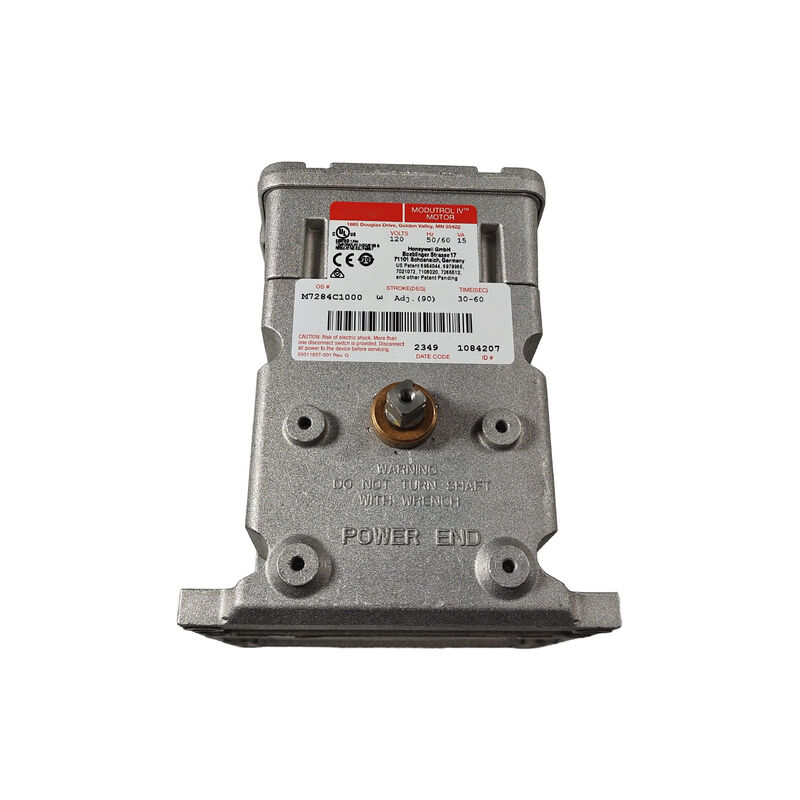
Honeywell M7284C1000 Modutrol IV Motor
Product Overview
The M7284C1000 is a Honeywell Modutrol IV motor used to position dampers and valves from a 4–20 mA control signal.
Product data for the M7284 family shows it as a 120 VAC, 50/60 Hz actuator motor in the 150 lb-in torque class, while published selling pages for this exact model also describe adjustable 90° to 160° stroke and 30 to 60 second nominal timing.
What makes this model valuable is the way it bridges electronic control signals and real mechanical movement in HVAC and process-control hardware. A motor in this class is not chosen simply because it turns a shaft.
It is chosen because it can position a damper or valve smoothly, repeatedly, and predictably across a useful working stroke. In practical building-control and industrial air-flow systems, that kind of repeatable positioning matters more than raw speed.
This use perspective follows directly from the Modutrol IV family’s stated role in valve and damper positioning.
Application Value
The M7284C1000 is well suited to HVAC dampers, combustion-air controls, process valves, and mechanical plant automation where a 4–20 mA command signal is already part of the control strategy.
Honeywell’s Modutrol IV literature frames the family around proportional positioning of dampers and valves, which naturally makes this model relevant for boiler rooms, air-handling systems, burner control assemblies, and similar automation environments where controlled angular travel is required.
Several installation details also add practical value in the field.
Published data for the family and this model include foot mounting, quick-connect terminals, NEMA 3 weather protection, and a dual-ended square shaft in the M7284 range. Those are not small details in real service work.
They affect how easily the motor can be mounted, wired, linked to the driven mechanism, and protected in mechanical rooms or outdoor-adjacent equipment spaces.
Replacement and Selection Perspective
For maintenance and retrofit work, the M7284C1000 is best treated as a control actuator motor, not just as a motor with matching voltage.
The signal type, torque class, stroke range, rotation behavior, mounting format, and shaft style all matter.
In practical terms, a correct replacement keeps the damper or valve linkage behavior consistent and reduces the chance of control instability after startup.
That recommendation is grounded in the published Modutrol IV product data for the M7284 family.
Technical Data
| Parameter |
Value |
| Part Number |
M7284C1000 |
| Manufacturer |
Honeywell |
| Product Type |
Modulating actuator motor |
| Product Family |
Modutrol IV |
| Power Supply |
120 VAC, 50/60 Hz |
| Control Signal |
4–20 mA |
| Torque |
150 lb-in |
| Stroke |
Adjustable 90° to 160° |
| Timing |
30 sec (90°), 60 sec (160°) nominal |
| Mounting |
Foot-mounted |
| Shaft Style |
Dual-ended square shaft |
| Protection |
NEMA 3 weather protection |
| Input Impedance |
100 ohms |
FAQ
Q1: What kind of product is M7284C1000?
It is a Modutrol IV actuator motor used to position dampers and valves from a 4–20 mA control signal.
Q2: What gives this model its practical value in control systems?
Its value comes from combining proportional electronic input with a well-defined mechanical stroke and torque class.
That makes it useful where a controller needs repeatable damper or valve positioning instead of simple on/off actuation.
Q3: What types of applications fit this motor best?
It fits HVAC dampers, boiler-room controls, air-handling equipment, and process-valve positioning where 4–20 mA control is used.
These application examples follow directly from the Modutrol IV family’s damper-and-valve role.
Q4: Why do torque and stroke matter so much here?
Because actuator motors are selected by the mechanical work they must perform, not just by supply voltage.
The linkage load, required travel angle, and response time all influence whether the actuator will control the device correctly.
This is an engineering interpretation supported by the published M7284 family data.
Q5: What should be checked before ordering M7284C1000?
Check the installed part number, signal type, torque requirement, stroke range, shaft style, and mounting arrangement.
On actuator replacements, those points usually matter more than appearance alone.



 Your message must be between 20-3,000 characters!