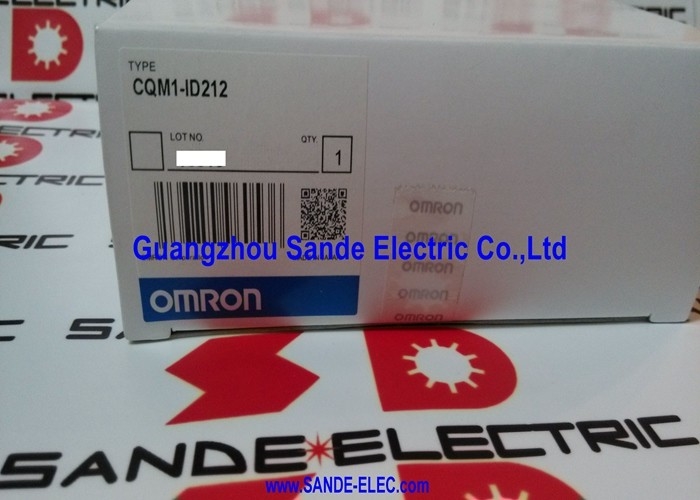
CQM1-ID212 | Omron CQM1 16-Point 24VDC DC Input Module — NPN/PNP / 6mA / Shared Common / Terminal Block / 8ms Response
16 Inputs in One Module — Compact I/O Expansion for the CQM1
The CQM1-ID212 is a direct-plug I/O expansion module for the CQM1 and CQM1H programmable controller systems. It connects via the side bus connectors — no separate wiring between the module and the CPU. Field devices wire directly to the module's terminal block.
16 input points per module handle the standard sensor and switch signals found in machine control applications: limit switches, photoelectric sensors, proximity switches, manual pushbuttons, and safety interlock contacts. At the CQM1's maximum configuration, each ID212 contributes 16 input points to the system's total I/O count.
Key Specifications
| Parameter |
Value |
| Input Points |
16 |
| Input Voltage |
24V DC (20.4–26.4V) |
| Input Current |
6mA typical |
| Input Impedance |
3.3kΩ |
| ON Threshold |
14.4V DC min |
| OFF Threshold |
5V DC max |
| Response Time |
8ms (programmable 0–32ms) |
| Logic |
NPN and PNP (no polarity select) |
| Common |
Shared (16 points, 1 circuit) |
| Connector |
Terminal block |
| Backplane Current |
85mA max |
| Weight |
180g max |
Configurable Response Time — Noise Immunity vs. Speed
The 8ms default response time applies to both ON-to-OFF and OFF-to-ON transitions. This is set in the CQM1 PLC Setup. The configurable range is 0 to 32ms in 1ms steps.
Longer response time (e.g., 16ms): Filters electrical noise from sources such as contactors, solenoids, or long cable runs. Spurious transitions shorter than the set time are ignored — the input only registers a state change if the signal remains stable for the full filter period. Useful in noisy electrical environments.
Shorter response time (e.g., 0–2ms): Required for fast signal sources — high-speed sensors, position switches on fast-moving machines, or control signals that change state quickly and must be detected promptly. At 0ms, no digital filter is applied — the raw input signal is read.
The selection is per-module via the PLC Setup, not per-point — all 16 inputs on the CQM1-ID212 share the same response time setting.
Application Scenarios
Machine tool sensor input: A CNC machining centre adds a CQM1-ID212 to the CQM1 system to handle tool presence sensors, limit switches on axis guards, and coolant system feedback signals. The module's 16 inputs cover the machine's full sensor complement in one module slot.
Conveyor control: A packaging conveyor uses CQM1-ID212 for photoelectric sensors detecting product presence at each station. The configurable response time is set to 8ms to filter contact bounce on the sensors' output signals while still detecting product gaps at normal line speeds.
Mixed-sensor panel: A machine panel uses both NPN proximity switches (for ferrous metal detection) and PNP-output safety door contacts. The CQM1-ID212 handles both in the same module — no need for separate input modules or polarity converters.
FAQ
Q1: Can all 16 inputs of the CQM1-ID212 be active simultaneously?
Yes. The CQM1-ID212 supports 100% simultaneous ON — all 16 inputs can be in the active (ON) state at the same time at 24VDC without exceeding the module's power ratings. The backplane current of 85mA accommodates fully loaded input conditions.
Q2: What CQM1 CPUs are compatible with the CQM1-ID212?
The CQM1-ID212 is compatible with the CQM1 and CQM1H CPU series. For the CQM1H, CPU unit models CQM1H-CPU21, CPU51, and CPU61 accept I/O expansion modules including the ID212. Maximum I/O expansion depends on the CPU model — for example, the CQM1H-CPU61 supports up to 11 I/O expansion units. Check the specific CPU's datasheet for the maximum I/O unit count and total point capacity.
Q3: How is the CQM1-ID212 physically connected to the CQM1 CPU unit?
The module connects via the CQM1's bus connector on the left side of the module — the same connector used for all CQM1 I/O expansion units. Modules slide together and lock. No ribbon cable or external I/O bus wiring is needed. A right end cover (CQM1H-TER01) attaches to the last module in the row. The modular side-connect architecture allows modules to be added or removed without disturbing the wiring on adjacent modules.
Q4: Is the response time setting shared across all 16 input points on the CQM1-ID212?
Yes. The response time is set per-module in the PLC Setup, not per individual point. All 16 inputs on a single CQM1-ID212 share the same filter setting. If different points in the same system require different response times, place sensors that need faster response on a separate ID212 module and configure each module's response time independently.
Q5: What is the minimum input signal duration the CQM1-ID212 can reliably detect?
At the minimum response time setting of 0ms (no digital filter), the module can detect input signals as short as approximately 0.1ms (100 microseconds) when triggered as an interrupt input on compatible CQM1H CPUs. Under standard cyclic scanning, the minimum detectable signal duration is approximately equal to one PLC scan cycle — typically 1 to 10ms depending on the programme length. Very short pulses shorter than one scan cycle may be missed under standard cyclic I/O refresh.


 Your message must be between 20-3,000 characters!