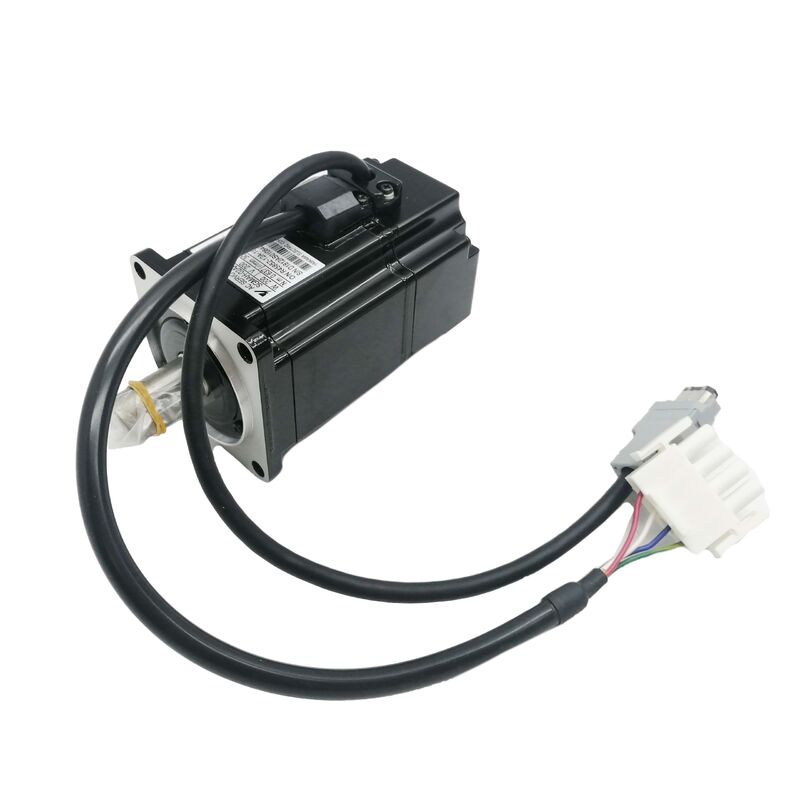
Yaskawa SGMAH-02AAA61D Sigma-II AC Servo Motor
Product Overview
The SGMAH-02AAA61D belongs to Yaskawa’s Sigma-II SGMAH servo-motor family.
Yaskawa describes the SGMAH series as a legacy low-inertia servomotor line designed for extremely fast accelerations and short settling times, with rated-speed coverage in the 3000 rpm to 5000 rpm range and frame offerings that include NEMA 23 and NEMA 34 flanges.
Yaskawa’s CAD listings for the SGMAH line also identify SGMAH-02 as the 200 W frame class, which places this model at the lower-power end of the Sigma-II family.
Commercial listings for SGMAH-02AAA61D describe it as an AC servo motor in the 200 W class with 230 V, 2.1 A, 0.637 Nm, a 13-bit incremental encoder, and a Hypertac connector.
I am treating those as market-side details tied to this exact order code, while using Yaskawa’s own family documentation for the broader positioning of the SGMAH series.
Application Value
The practical appeal of this motor comes from its low-inertia Sigma-II character. Motors in the SGMAH family are intended for applications where the axis must accelerate quickly, settle fast, and behave cleanly under repeated short-cycle motion.
That makes this model a strong fit for pick-and-place units, indexing tables, compact feed axes, small transfer systems, and light automation modules where responsiveness matters more than moving a large load with a heavy rotor.
These application examples are engineering inferences based on Yaskawa’s description of the SGMAH line as a low-inertia family for fast acceleration and short settling time.
There is also a clear maintenance value here.
Yaskawa identifies the SGMAH family as a legacy product no longer promoted in the Americas, which tells a buyer that this motor is most relevant in installed-base support, retrofit projects, repair work, and spare-parts planning.
In those situations, keeping the correct Sigma-II motor family often matters more than chasing a broad cross-family substitute, because the original machine behavior and system compatibility are usually built around that specific motion platform.
Replacement and Selection Perspective
For replacement work, the SGMAH-02AAA61D should be treated as a servo-system component, not as a generic AC motor with the right power number.
Buyers should verify the installed model code, motor family, encoder expectation, connector style, and surrounding Yaskawa drive configuration before purchase.
That recommendation is consistent with the way Yaskawa documents Sigma-II as a motion platform and with the exact-order commercial details published for this model.
Technical Data
| Parameter |
Value |
| Part Number |
SGMAH-02AAA61D |
| Manufacturer |
Yaskawa |
| Product Type |
AC Servo Motor |
| Series |
Sigma-II SGMAH |
| Family Position |
Low inertia, legacy servo motor |
| Power Class |
200 W |
| Voltage |
230 V |
| Current |
2.1 A |
| Rated Torque |
0.637 Nm |
| Encoder |
13-bit incremental encoder |
| Connector |
Hypertac connector |
| Application Focus |
Fast acceleration, short settling time |
| Product Status |
Legacy / installed-base support |
FAQ
Q1: What kind of motor is SGMAH-02AAA61D?
It is a Yaskawa Sigma-II AC servo motor in the SGMAH low-inertia family, intended for fast-response motion systems.
Q2: What is the practical strength of the SGMAH family?
Yaskawa describes the SGMAH series as a low-inertia design for extremely fast acceleration and short settling times, which is exactly why it remains useful in dynamic motion applications.
Q3: What applications is this model best suited for?
It is well suited to compact indexing, pick-and-place, feeder, and transfer axes where quick response is more important than heavy-load motor mass.
These examples are engineering inferences based on Yaskawa’s family description.
Q4: Why is exact replacement important for SGMAH-02AAA61D?
Because legacy servo systems are usually built around a specific motor family, encoder style, and connector arrangement.
Matching the original motor helps preserve the expected behavior of the motion system after replacement.
This is an engineering inference based on Yaskawa’s Sigma-II family context and the published order-specific details.
Q5: What should be checked before ordering this motor?
Check the installed model code, encoder expectation, connector style, power class, and the surrounding Yaskawa drive setup.
Those checks usually matter far more than appearance alone.


 Your message must be between 20-3,000 characters!