logo
Guangzhou Sande Electric Co.,Ltd.
Email Sales01@sande-elec.com TEL: 86--18620505228
Home > Products > Industrial Servo Motor >
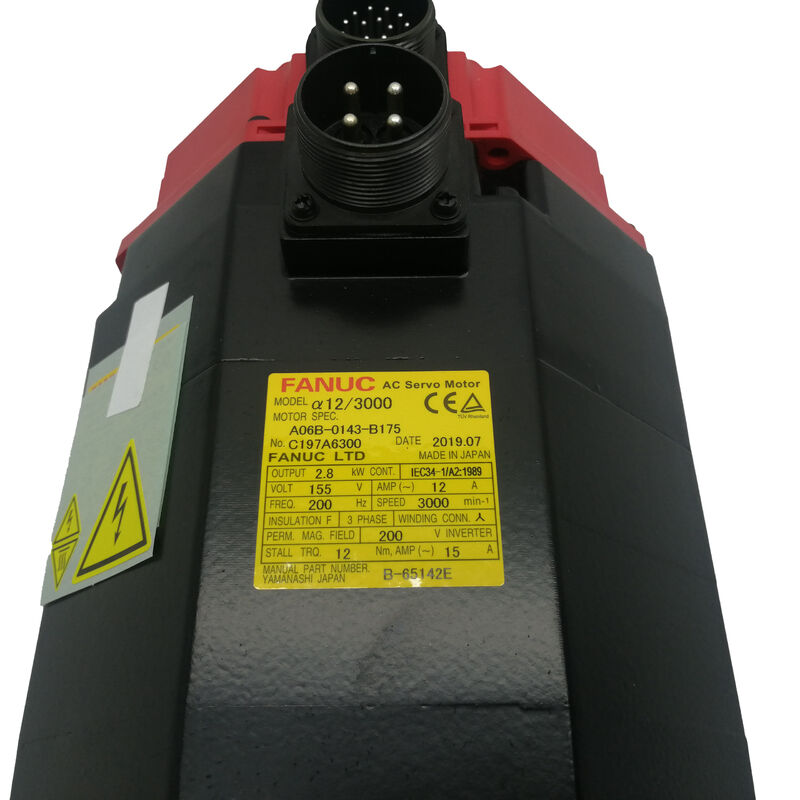
FANUC SERVO MOTOR A06B-0143-B175 A06B0143B175 AO6B-O143-B175
  • FANUC SERVO MOTOR  A06B-0143-B175   A06B0143B175   AO6B-O143-B175
  • FANUC SERVO MOTOR  A06B-0143-B175   A06B0143B175   AO6B-O143-B175

FANUC SERVO MOTOR A06B-0143-B175 A06B0143B175 AO6B-O143-B175

Place of Origin Japan
Brand Name FANUC
Certification CE ROHS
Model Number A06B-0143-B175
Product Details
Condition:
New Factory Seal(NFS)
Item No.:
A06B-0143-B175
Origin:
Japan
Highlight: 

a06b industrial servo motor

,

a06b yaskawa ac servo motor

Payment & Shipping Terms
Minimum Order Quantity
1 pcs
Packaging Details
original packing
Delivery Time
0-3 days
Payment Terms
T/T,PayPal,Western Union
Supply Ability
100 pcs/day
Product Description

Fanuc A06B-0143-B175 | Alpha Series AC Servo Motor α12/3000 — 2.8kW, 12Nm, 3000RPM, 90V DC Brake, A64 Encoder, IP65

Part Number: A06B-0143-B175 (also A06B0143B175)

Series: Fanuc Alpha (α) Series AC Servo Motor

Model: α12 / 3000

Configuration: Straight Shaft with Keyway, 90V DC Spring-Applied Brake, A64 Absolute Encoder, IP65

Rated Output: 2.8 kW

Stall Torque: 12 Nm (at 15A)

Maximum Speed: 3,000 RPM

Motor Voltage: 155 VAC

Rated Running Current: 12 A

Peak Stall Current: 15 A

Rated Frequency: 200 Hz

Phase: 3-Phase

Compatible CNC: Series 0, 15, 16, 18, 20, 21

Condition: New / Refurbished / Surplus


Overview

The Fanuc A06B-0143-B175 is an Alpha series AC servo motor — model α12/3000 — in the brake-equipped B175 configuration.

At 2.8 kW, 12 Nm stall torque, and 3,000 RPM maximum speed, running at 155V three-phase, 12A rated current at 200 Hz, this is one of the most widely encountered motors in the Fanuc Alpha generation.

It combines the torque class that made the α12 the standard primary axis motor on small to medium CNC machining centres with the 90V DC spring-applied brake that any gravity-loaded axis requires, and the A64 absolute encoder that eliminates reference return at every startup.

The B175 configuration is the brake variant of the A06B-0143 family. The spring-applied 90V DC brake holds the shaft mechanically whenever coil voltage is removed — at E-stop, servo alarm, planned servo-off, or power loss. For vertical Z-axes carrying spindle heads, workpiece pallets, or any axis where gravity acts on the load when the servo is switched off, this is not an optional feature.

It is the only mechanism that prevents the load from moving uncontrolled during every servo disable event throughout the machine's life.

The A64 absolute encoder provides position retention through power loss without any reference return requirement.

Combined with the brake's fail-safe engagement, the B175 configuration represents the complete specification for a primary vertical axis on a CNC machining centre: full torque to 3,000 RPM, mechanical holding at rest, and absolute position continuity across power cycles.


Key Specifications

Parameter Value
Rated Output 2.8 kW
Stall Torque 12 Nm
Peak Stall Current 15 A
Rated Running Current 12 A
Maximum Speed 3,000 RPM
Motor Voltage 155 VAC
Rated Frequency 200 Hz
Phase 3-Phase
Shaft Type Straight with Keyway
Brake 90V DC Spring-Applied
Encoder A64 Absolute Pulsecoder (64,000 ppr)
Ingress Protection IP65
Series Fanuc Alpha — A06B-0143
Compatible CNC Series 0, 15, 16, 18, 20, 21

α12/3000 — The Mid-Range Alpha Workhorse

The α12 stall torque class was the practical choice for the middle tier of Alpha generation CNC machine tools. Below it, the α6 class serves the lighter axes of compact machines. Above it, the α22 and α30 handle heavier workloads.

The α12 occupied the sweet spot: 12 Nm and 2.8 kW were sufficient for the primary X, Y, and Z axes of small to medium machining centres without the physical size and cost step-up of the α22 class.

The 3,000 RPM speed rating on the α12/3000 distinguishes it from the α12/2000 (same torque, 2,000 RPM ceiling).

At 10mm ball screw pitch and 1:1 coupling, the α12/3000 achieves 30 m/min rapid traverse against the α12/2000's 20 m/min — a meaningful cycle time advantage on machines with long axis travels.

The trade-off is that the α12/3000's higher operating frequency (200 Hz vs 133 Hz at rated speed) requires the correct motor type parameter in the CNC; using the α12/2000 code on an α12/3000 produces mismatched current loop tuning.

The stall torque of 12 Nm at 15A peak defines the motor's acceleration capability.

At the start of every rapid traverse move, peak current into 12 Nm produces an angular acceleration that determines how quickly the axis reaches the commanded rapid speed.

This brief peak torque phase is what makes fast cycle times possible on heavy-table machines — the axis reaches 30 m/min rapidly rather than spending most of the traverse accelerating toward it.


90V DC Spring-Applied Brake — Fail-Safe by Design

The 90V DC coil in the B175 brake works against a pre-loaded spring that holds the brake disc engaged at all times. When 90V is applied, the coil overcomes the spring and releases the disc, freeing the shaft. Remove the 90V — for any reason — and the spring immediately drives the brake disc back into contact.

There is no electrical command, no control signal, and no software decision required to engage the brake on power loss. 

The spring does it mechanically, faster than any electrical control could respond.

This physics is why spring-applied brakes are the only safe holding mechanism for gravity-loaded vertical axes on production CNC machines.

The moment servo power disappears — at E-stop, at servo alarm, at planned servo-off, at power interruption — the spindle head or pallet must be held by a mechanism that acts without depending on the continuing availability of power or control logic.

The spring-applied brake satisfies this requirement inherently; an electrically-applied brake (one that requires current to engage) would fail to hold on the very events that make holding most necessary.

The 90V DC specification is the Alpha series standard for brake supply voltage.

This is not the same as the 24V DC used on Beta iS and other smaller Fanuc servo motors. The 90V brake supply is provided from the machine's control cabinet, switched by the Alpha servo amplifier's brake interlock output in the servo enable/disable sequence.

Before connecting any replacement A06B-0143-B175, the brake connector voltage should be measured at the machine to confirm 90V DC — applying 24V to a 90V coil leaves the spring only partially overcome and the motor runs against continuous brake drag with no immediate alarm, causing progressive damage.


A64 Absolute Encoder — No Homing, Battery-Backed Retention

The A64 pulsecoder provides 64,000 pulses per revolution of absolute position feedback. With the battery at the Alpha servo amplifier, shaft position is retained indefinitely through power loss.

At each power cycle, the CNC reads the true absolute position from the A64 and the axis has correct position data without traversing to a reference switch.

For the vertical axis application the B175 motor is most commonly installed in, this matters operationally.

A vertical axis that lost position after every E-stop would require careful homing at reduced speed before any production cycle could resume — on a busy machining centre where E-stops are a routine part of setup and tool change operations, this overhead accumulates.

Absolute position retention means the machine resumes from exactly where it was, immediately after the E-stop condition is cleared and the servo is re-enabled.

The A64 battery is housed in the Alpha servo amplifier, not in the motor. Battery replacement is a scheduled maintenance item at the amplifier, typically every one to two years.

A discharged battery means absolute position is lost at the next power interruption and a reference return becomes necessary until the battery is replaced.

Tracking battery replacement dates for all Alpha amplifiers in a machine population is the practical maintenance discipline that prevents unplanned homing requirements at inconvenient moments.


IP65 and the Alpha Generation Red Cap

IP65 sealing — complete dust exclusion and water jet protection — is the standard for the original Fanuc Alpha series motor body and encoder compartment.

On a CNC machine tool axis, the motor is exposed to coolant mist from machining, cleaning spray during maintenance, and the condensation that forms when cold parts enter warm, humid machine enclosures. IP65 covers all of these conditions reliably.

The red cap — the distinctive coloured protective cover over the encoder feedback cable connector — is the visual identifier of the original Alpha generation motor.

It identifies at a glance that this motor uses the Type A feedback interface rather than the FSSB optical interface of the Alpha i generation, and that it carries the A64 encoder rather than the higher-resolution encoders of successor generations.

On a machine that may have received partial upgrades over its service life, the red cap is the quickest way to confirm that the installed motor is the original Alpha generation before ordering a replacement.

The IP67 variant (A06B-0143-B175#7076) provides temporary immersion protection for installations where the motor body may be directly flooded. Both IP65 and IP67 variants share identical electrical and mechanical specifications — only the connector and shaft sealing level differs.


FAQ

Q1: What is the difference between the A06B-0143-B175 and A06B-0143-B075?

Both are α12/3000 Alpha series motors with identical rated output, torque, speed, voltage, current, and encoder. The difference is the brake: the B175 has a 90V DC spring-applied brake; the B075 has no brake.

For vertical or inclined axes where gravity acts on the load when the servo is off, the B175 is required — the B075 provides no mechanical holding at rest. For horizontal axes with no gravitational loading, the B075 is correct and the machine wiring does not need a 90V brake supply to that axis.


Q2: What happens if only 24V is available for the brake supply on this motor?

Applying 24V to the 90V coil generates roughly one-third of the required electromagnetic force. The spring is not fully overcome — the brake disc remains partially in contact with the friction surface.

The motor runs against continuous brake drag, generating heat at the brake pad and imposing abnormal radial load on the motor front bearing.

This does not immediately generate a servo alarm; the early signs are elevated motor temperature and higher-than-normal amplifier current draw. The brake pads wear prematurely and bearing service life shortens. Always confirm the brake supply is 90V DC before commissioning.


Q3: Does the A64 encoder need a battery, and where is it located?

Yes — the A64 absolute pulsecoder requires battery backup to retain position through power loss. The battery is in the Alpha servo amplifier, not in the motor body.

A discharged amplifier battery means absolute position is lost at the next complete power-down, and the CNC will request a reference return on the next startup. Battery replacement should be scheduled before the low-battery alarm appears in the CNC diagnostic screen — by the time the alarm triggers, the battery has already reached the edge of its capacity and a power interruption could cause immediate position loss.


Q4: Is the A06B-0143-B175 compatible with Alpha i amplifiers?

No. The original Alpha series (A06B-6079 SVM, A06B-6096 FSSB-SVM) and the Alpha i series (A06B-6117 αiSVM, A06B-6124 αiSVM) use different motor interface protocols, encoder feedback circuits, and current control algorithms.

Connecting an original Alpha motor to an Alpha i amplifier produces servo alarm conditions at startup or unstable closed-loop behaviour.

If the drive system is being updated to Alpha i amplifiers, the motors must simultaneously be replaced with Alpha i compatible variants.


Q5: What are the priority checks when evaluating a used A06B-0143-B175?

The brake is the first check: apply 90V DC and confirm the shaft rotates freely without drag; remove 90V and confirm the shaft locks immediately and holds firmly under manual torque. Any drag at 90V or any slip when de-energised means brake service is needed before installation.

Rotate the shaft by hand for bearing smoothness. Inspect the keyway shaft surface for fretting or scoring.

Check the red-cap encoder connector for pin integrity and confirm the connector cap engages cleanly. Measure three-phase winding resistance for balance and take an insulation resistance reading to earth with a megger.

A bench run with brake cycle verification, current monitoring, and absolute encoder position confirmed across a full shaft revolution is the appropriate final check before the motor is installed on a production axis.


FANUC SERVO MOTOR  A06B-0143-B175   A06B0143B175   AO6B-O143-B175 0

Contact Us at Any Time

+86 18620505228
10/F,Jia Yue Building, Chebei Road,Tianhe district,Guangzhou,China
Send your inquiry directly to us