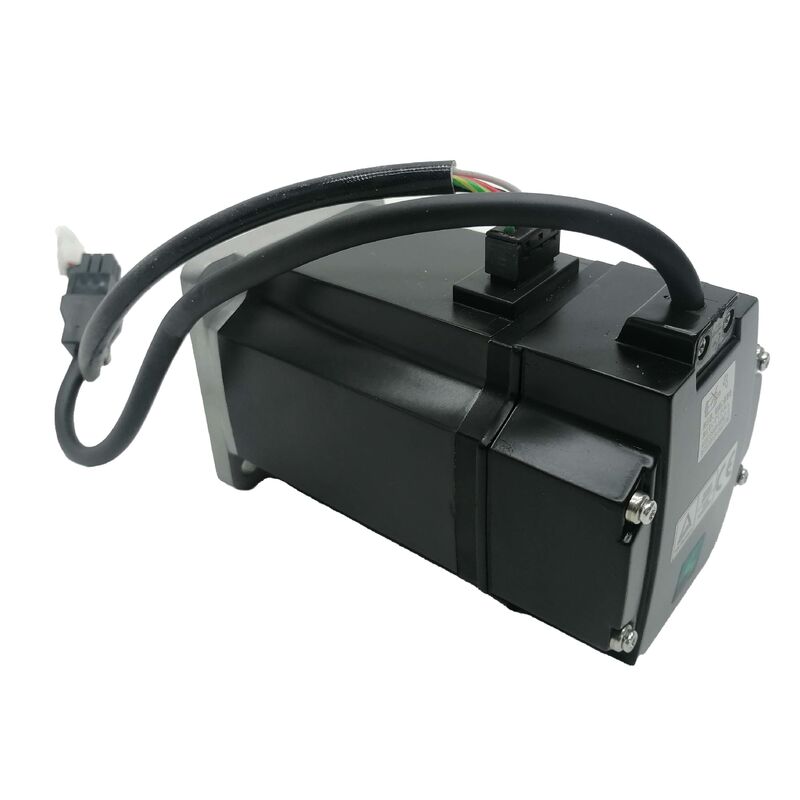
New Mitsubishi HC-MFS23 Low-Inertia Small-Frame AC Servo Motor
MITSUBISHI ELECTRIC • AC SERVO MOTOR • HC-MFS SERIES • NEW UNIT
Product Overview
The Mitsubishi HC-MFS23 is a 200W low-inertia brushless AC servo motor from Mitsubishi Electric's HC-MFS series, designed for precision automation applications requiring rapid acceleration, tight positional accuracy, and reliable continuous-duty performance. This listing offers a brand new unit in original factory condition.
This is a new factory unit with zero service hours - not a rebuild, refurbished pull, or remanufactured core.
Technical Specifications
| Parameter |
Value |
| Model Number |
HC-MFS23 |
| Condition |
New |
| Rated Output |
200W |
| Motor Type |
Brushless AC Servo |
| Series |
HC-MFS (Low Inertia, Small Frame) |
| Inertia Class |
Low |
| Feedback System |
Incremental Encoder |
| Drive Compatibility |
MR-J2S Series (MELSERVO) |
| Cooling Method |
Self-Cooled (Natural Convection) |
| Mount Type |
Flange Mount |
| Application Focus |
High-Speed Precision Automation |
Key Performance Characteristics
- Low-inertia rotor for rapid dynamic response - Enables quick acceleration/deceleration and precise position tracking
- Incremental encoder for reliable position feedback - Provides high-resolution data for accurate servo control
- Compact frame for space-constrained installations - Ideal for multi-axis systems with tight structural envelopes
MELSERVO Platform Integration
The HC-MFS23 is designed for seamless integration with Mitsubishi's MR-J2S servo amplifier series, featuring auto-tuning capabilities, parameter management through MR Configurator software, and specific encoder cable requirements for optimal performance.
Typical Applications
- Pick-and-place unit rotary and linear axis drives
- Small Cartesian robot X and Y axis positioning
- Precision dispensing and fluid application equipment
- Label applicator and print-and-apply registration axes
- Electronic assembly station servo-driven tooling
- Compact conveyor indexing and positioning drives
- Vision-guided alignment and inspection stage positioning
- Small-format packaging machine registration and cut drives
- Semiconductor component handling and tray positioning
- Winding and coil-forming equipment traverse axes
Installation & Replacement Guidelines
- Match the full part number - Include suffix and option codes for complete specification
- Back up amplifier parameters before removing the failed motor using MR Configurator
- Inspect encoder cable during planned replacement to prevent future issues
- Run manual verification before automatic operation to confirm proper installation
Frequently Asked Questions
What servo amplifier is the Mitsubishi HC-MFS23 compatible with?
The HC-MFS23 is designed for use with Mitsubishi MR-J2S series servo amplifiers within the MELSERVO platform. The encoder interface and connector specification are matched to the MR-J2S amplifier family.
What is the practical benefit of purchasing a new HC-MFS23 versus a remanufactured unit?
A new unit has factory-original bearings, encoder, and windings with no accumulated service hours or wear. For production axes where a second failure would cause significant downtime, new condition eliminates service history uncertainty.
Is the HC-MFS23 compatible with newer Mitsubishi servo amplifiers such as the MR-J4 or MR-JE series?
The HC-MFS23 uses an encoder interface matched to the MR-J2S amplifier generation. Compatibility with MR-J4 or MR-JE amplifiers depends on available encoder conversion or interface options. Consult Mitsubishi Electric's compatibility documentation for cross-generation configurations.
Does the MR-J2S amplifier need to be reconfigured after installing a replacement HC-MFS23?
Axis-specific parameters stored in the MR-J2S amplifier must be restored from a parameter backup taken before motor removal. After parameter restoration, running the amplifier's auto-tuning procedure with the machine load attached is recommended.
What should be verified before returning the machine to production after a motor replacement?
Restore amplifier parameters from a current backup, then jog the axis manually through its full travel range at low speed. Confirm correct direction of motion, smooth velocity, absence of encoder alarms, and verify software travel limit behavior before enabling automatic cycle operation.


 Your message must be between 20-3,000 characters!