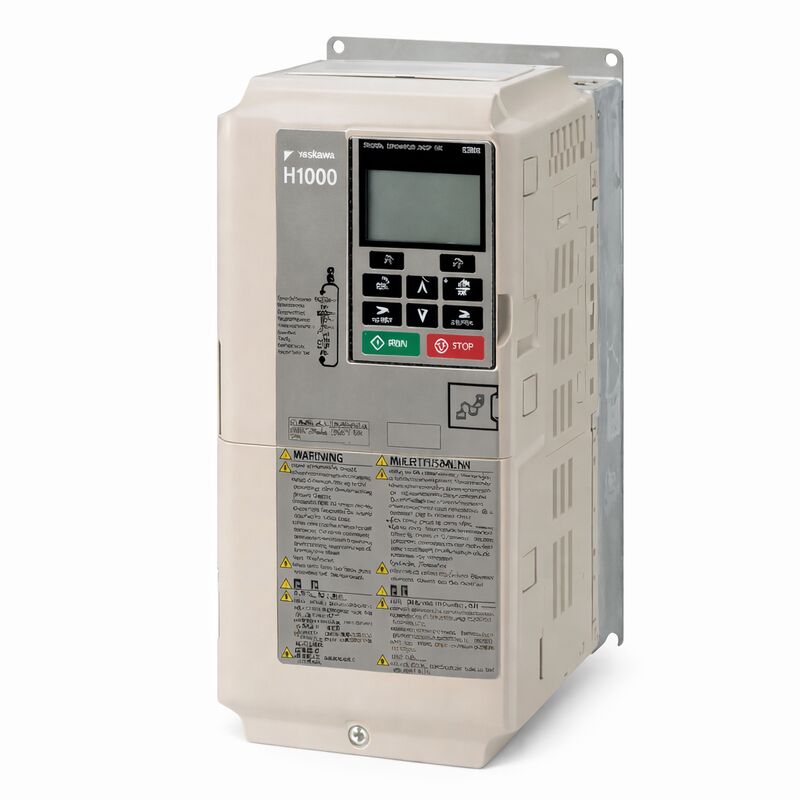
Yaskawa CIMR-HB4A0006FBC H1000 AC Drive
Product Overview
The CIMR-HB4A0006FBC is a Yaskawa H1000 series AC drive. Published product data identifies it as a 3-phase, 380–480 VAC model in the H1000 family, with NEMA Type 1 enclosure, humidity- and dust-resistant environmental specification, and compact panel-drive dimensions.
A drive in this class is typically chosen because the machine needs controlled motor behavior rather than direct line-start operation. In real industrial systems, that usually means better control of speed, torque response, and machine-side operating consistency.
The H1000 family identity and enclosure style make this model especially relevant for panel-mounted drive replacement and structured industrial control cabinets rather than ad hoc motor-control retrofits.
This application view is an engineering inference based on the model’s H1000 AC-drive identity, voltage class, and enclosure format.
Technical Data
| Parameter |
Value |
| Part Number |
CIMR-HB4A0006FBC |
| Manufacturer |
Yaskawa |
| Product Type |
AC Drive |
| Series |
H1000 |
| Input Power Class |
3-phase, 380–480 VAC |
| Model Configuration |
Standard model |
| Enclosure Type |
NEMA Type 1 |
| Environmental Version |
Humidity- and dust-resistant |
| Dimensions |
16.4 × 14 × 26 cm |
| Weight |
3.4 kg |
| Product Position |
Panel-mounted industrial drive |
Application Value
The CIMR-HB4A0006FBC is well suited to industrial machinery, controlled motor systems, retrofit drive panels, and installations that need structured AC drive control in a 380–480 VAC environment.
Because it is sold as an H1000 series drive rather than as a bare power module, it makes the most sense where the system already expects a complete adjustable-speed drive with enclosure and environmental considerations built into the part choice.
These applications are reasoned from the product’s published voltage class, NEMA Type 1 configuration, and H1000 positioning.
The enclosure and environmental details also matter in practice.
A NEMA Type 1 drive intended for panel installation gives maintenance teams a clearer path for replacement when the original system was built around that enclosure style.
The stated humidity- and dust-resistant environmental specification is also relevant in real plant conditions, where the drive must operate reliably inside industrial cabinets rather than in ideal laboratory conditions.
Replacement and Selection Perspective
For replacement work, this model should be selected as a drive-system component, not merely as a voltage-matching converter.
The input class, enclosure type, environmental version, mounting space, and original machine control architecture all need to align with the installed application.
That matters because AC drives affect not only power conversion but also machine behavior, wiring layout, and control strategy.
This is an engineering recommendation based on the published product data for this exact model.
FAQ
Q1: What kind of product is CIMR-HB4A0006FBC?
It is a Yaskawa H1000 AC drive for 3-phase 380–480 VAC systems, intended for structured industrial motor control.
Q2: What makes this model useful in industrial systems?
Its value comes from being a complete AC drive solution rather than a simple motor-control accessory.
In practice, that supports controlled motor operation, organized panel integration, and more predictable machine behavior.
This is an engineering inference based on the model’s H1000-series AC-drive identity.
Q3: What applications does this drive suit best?
It suits industrial machine panels, retrofit control cabinets, and motor-driven systems that require controlled operation in the 380–480 VAC class.
These examples are inferred from the published voltage class, enclosure type, and AC-drive role.
Q4: Why is enclosure type important for this model?
Because enclosure type affects how the drive fits the panel, how it is protected, and how easily it can replace an existing installed unit.
A correct NEMA Type 1 match can simplify replacement and reduce installation changes. This is an engineering inference based on the model’s published enclosure data.
Q5: What should a buyer verify before ordering?
Check the installed part number, input voltage class, enclosure type, mounting space, and the role the drive serves in the machine.
Those checks usually prevent the most common replacement errors.


 Your message must be between 20-3,000 characters!