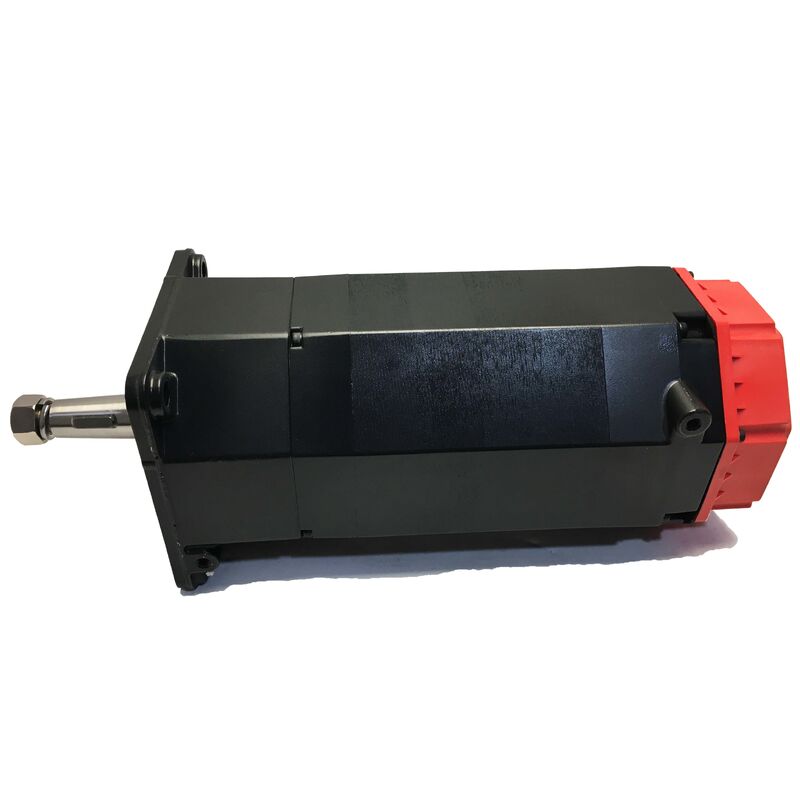
Fanuc A06B-0113-B077 AC Servo Motor — Beta B0.5/3000, Straight Keyed Shaft, i32b Incremental Encoder
Product Overview
Part Number: A06B-0113-B077
Also Searched As: A06B0113B077, FANUC A06B-0113-B077, Fanuc A06B0113B077
Motor Model: Beta B0.5/3000
Series: Fanuc Beta Series AC Brushless Servo Motor Classification: Fanuc Beta Series AC Servo Motor — 0.2 kW, 3,000 rpm Maximum Speed, Straight Shaft with Keyway, No Brake, i32b Incremental Encoder, IP65
Technical Specifications
| Parameter |
Value |
| Part Number |
A06B-0113-B077 |
| Motor Model |
Beta B0.5/3000 |
| Rated Output |
0.2 kW |
| Maximum Speed |
3,000 rpm |
| Motor Input Voltage |
49V (3-phase) |
| Inverter Supply |
200V |
| Frequency |
200 Hz |
| Encoder Type |
i32b (incremental, 32,000 ppr) |
| Shaft Type |
Straight with keyway (ST, KEY) |
| Electromagnetic Brake |
None |
| Protection Rating |
IP65 |
| Insulation Class |
Class F |
| Operating Temperature |
0°C to +40°C |
| Compatible Amplifiers |
Fanuc βi series servo amplifiers (βiSV) |
| Compatible Controls |
Fanuc Series 0i, 16i, 18i, 21i, 30i, 31i, 32i |
| Origin |
Japan |
The Fanuc Beta Series — Purpose-Built for Compact, Cost-Efficient Axes
The Fanuc motor catalogue organises its servo motors into performance tiers, and understanding where the Beta series fits helps explain why this motor exists alongside the more prominent αiS and αiF families.
The Alpha i series motors — αiS, αiF, αiF HV — are engineered for peak servo performance: maximum encoder resolution, tight servo bandwidth, and the demanding positional accuracy of precision five-axis machining centres, large-format turning centres, and high-performance manufacturing equipment. These are the right motors where performance is the primary specification.
The Beta series occupies a different design brief. Built on the same Fanuc βi amplifier platform and compatible with the same CNC generation, Beta motors are designed for axes where solid, reliable servo operation matters but the extreme performance ceiling of the Alpha i series is not required — and where the system cost of using an αiSV amplifier and αiS/αiF motor would not be justified by the application.
Small machining centres, compact CNC lathes, gang-tool turning machines, secondary auxiliary axes on larger equipment, and cost-sensitive automation platforms are where the Beta series earns its place. The B0.5/3000 at the base of the Beta range delivers exactly the performance profile these applications need: a compact, light motor with a consistent 3,000 rpm ceiling and 0.2 kW output, running from a 200V inverter supply through a βiSV amplifier, providing closed-loop position control adequate for the tolerances and surface finishes the machines in this class are designed to produce.
Straight Shaft with Keyway: Positive Torque Transmission in a Compact Package
The A06B-0113-B077 carries a straight shaft with a machined keyway — the ST, KEY configuration that appears consistently across the B0xx suffix variants in the A06B-0113 series.
At 0.2 kW rated output, the torque being transmitted through this shaft is modest. The key's function here is not to carry torque at the limit of its shear capacity — it is to ensure that torque transmission is through positive mechanical engagement rather than relying purely on friction clamping between the hub bore and shaft OD. On a small servo axis that reverses frequently, changes load direction regularly, and experiences vibration from the machine structure, a friction-clamped smooth shaft coupling can work loose over time. The keyed configuration prevents this mode of deterioration entirely.
The straight shaft geometry — as opposed to the taper shaft found on other Fanuc motor families — means coupling hub installation and removal is straightforward: the hub slides onto the shaft, the key engages, and the hub is secured axially. Removal requires a puller on the hub face. No draw bolt, no taper geometry to seat. For a small motor in a compact machine where access is limited and maintenance needs to be fast, this simplicity has practical value.
When the A06B-0113-B077 is used as a replacement, the coupling hub from the original motor transfers to the new one without modification — same shaft diameter, same keyway geometry. The only hardware consideration is confirming that the hub's axial retention fastener is retightened to the correct specification after transfer.
i32b Incremental Encoder: What It Means in Daily Operation
The i32b fitted to the A06B-0113-B077 is a 32,000 pulse-per-revolution incremental encoder — serial protocol, providing position and speed feedback to the βi series servo amplifier.
Incremental means homing is required on every CNC power-up. The i32b does not retain shaft position through power-off events. When the CNC is powered up — at the start of a shift, after an alarm recovery, after a planned shutdown — the axis controlled by this motor does not know its position in the machine coordinate system until it executes a reference-return (homing) traverse to find its reference marker. Only after the reference marker is detected does the CNC establish the axis coordinate and allow the machine to enter automatic operation.
For the machines this motor typically serves — compact CNC lathes, small machining centres, drill-tap machines — this homing behaviour is standard and is already programmed into the machine's startup sequence. Operators on these machines are accustomed to the reference-return cycle as a normal part of starting the machine for the day. It is not a malfunction or a deficiency; it is the expected operational behaviour for an incremental encoder system.
The i32b distinguishes the A06B-0113-B077 from the absolute encoder variants in the same B0.5/3000 family. The B075 uses the A32B absolute encoder at 32,000 ppr — it retains position through power-off, eliminating the homing requirement, but at higher system cost. The B077 is the lower-cost incremental option for applications where the homing cycle is acceptable and the absolute encoder's position-retention benefit is not worth the price difference.
32,000 ppr resolution. On a 5mm pitch ball screw in direct coupling, 32,000 counts per revolution gives a position loop resolution of approximately 156 nanometres per count. For the positioning accuracy requirements of compact CNC lathes and small machining centres, this resolution provides adequate feedback quality for the tolerances these machines are designed to hold.
No Brake: The Standard Configuration for Horizontal Axes
The B077 base number carries no electromagnetic brake. Position at rest is maintained by the βi servo amplifier's servo lock — the position loop active, the i32b feeding back 32,000 counts per revolution continuously, and the amplifier correcting to the commanded shaft angle.
On the horizontal axes and low-inclination feed axes that the B0.5/3000 typically serves, servo lock provides reliable position holding while the amplifier is active. There is no drift between commanded positions when the servo is live.
The no-brake configuration keeps the motor compact and lightweight — appropriate for machines designed with a tight motor envelope. It also simplifies the machine's electrical panel: no 24V brake circuit, no brake relay, no brake timing in the startup and shutdown sequences.
Where a vertical axis or inclined feed is involved and mechanical holding at servo-off is required, the brake variant of this motor applies. The A06B-0113-B178 family carries a 90V spring-applied brake with the same B0.5/3000 motor body. Never fit the no-brake B077 on a vertical axis application designed for a braked motor — servo lock cannot provide mechanical holding when the amplifier is de-energised.
A06B-0113 Series: Key Variants at a Glance
All variants in the A06B-0113 series share the Beta B0.5/3000 motor body — 0.2 kW, 3,000 rpm, straight shaft geometry. Shaft configuration, brake, and encoder type are the differentiating factors across the suffix range.
| Part Number |
Shaft |
Keyway |
Brake |
Encoder |
Sealing |
| A06B-0113-B075 |
Straight |
Yes |
None |
A32B absolute |
IP67 |
| A06B-0113-B078 |
Straight smooth |
No |
None |
i32b incremental |
IP65 |
| A06B-0113-B077 |
Straight |
Yes |
None |
i32b incremental |
IP65 |
| A06B-0113-B077#7076 |
Straight |
Yes |
None |
i32b incremental |
IP67 |
| A06B-0113-B178 |
Straight |
Yes |
Brake (90V) |
A8B absolute |
IP65 |
The B077 sits at the base of the sealed/no-brake range: standard IP65, keyed shaft, incremental encoder, no brake. The #7076 suffix upgrades sealing to IP67 for environments with direct coolant exposure, keeping all other specifications identical.
Amplifier and CNC Compatibility
The A06B-0113-B077 operates with Fanuc βi series servo amplifiers (βiSV) — the compact drive modules designed for the Beta motor family. The βiSV accepts the i32b incremental encoder protocol and is parameterised for the Beta motor type family. Compatible CNC platforms include Fanuc Series 0i-D, 0i-F, 16i, 18i, 21i, 30i-A, 30i-B, 31i-A, 31i-B, and 32i.
The motor is not compatible with αiSV amplifiers, which are designed and parameterised for the Alpha i motor series. While both βiSV and αiSV operate within the same Fanuc αi/βi drive ecosystem and communicate with the CNC via the same FSSB serial bus, the motor type parameters and current ratings differ between the two amplifier families.
When fitting the A06B-0113-B077 as a replacement, confirm the CNC axis parameters are correctly set for the Beta B0.5/3000 motor type. On machines where this motor has been in service since original build, the parameters are already in place — verify they have not been altered before returning the machine to production.
Typical Applications
Compact CNC lathe feed axes. X and Z axis drives on small CNC turning centres and gang-tool lathes where the workpiece envelope, axis mass, and cutting force demands fall well within the B0.5/3000 torque-speed range, and the system cost of the βiSV/Beta motor combination suits the machine's market position.
Small machining centre auxiliary and feed axes. Secondary axis drives on compact VMCs, drill-tap centres, and small horizontal machining centres where the axis load is light and the βi series motor provides reliable closed-loop servo operation at a competitive price point.
CNC grinding machine feed axes. Wheel infeed and cross-slide drives on small CNC cylindrical and surface grinders where precise incremental positioning within a defined working range is the axis requirement, and the homing cycle at startup is a standard part of machine operation.
Fanuc-controlled specialty and automation axes. Secondary positioning axes on Fanuc-controlled special-purpose machines, transfer equipment, and automation platforms where the βi series drive system was specified for cost-optimised servo control and the B0.5/3000 motor fits the axis kinematic requirements.
Like-for-like replacement on existing Beta-series equipped machines. Any Fanuc 0i or 30i series controlled machine currently running A06B-0113-B077 motors on one or more axes, where a failed unit requires a direct replacement to restore production.
FAQ
Q1: Why does this motor require a homing cycle on every power-up when many other Fanuc motors do not?
The i32b is an incremental encoder — it counts pulses from an arbitrary reference, with no memory of absolute shaft position when power is removed. Every time the CNC powers up, the axis has no positional reference until it finds its machine reference marker through a homing (reference-return) traverse. The absolute encoder variants in this motor family — B075 uses the A32B, B178 uses the A8B — retain position through power-off and eliminate this requirement. The B077 with i32b trades that convenience for lower system cost. On machines built around the B077, the homing cycle is already part of the standard startup procedure.
Q2: What is the difference between the B077 and the B077#7076 — which one is correct for my machine?
The base A06B-0113-B077 carries IP65 sealing — protection against dust and directed water jets. The #7076 variant upgrades to IP67 — protection against temporary water immersion, adequate for direct coolant spray and flood. All other specifications are identical: same 0.2 kW output, same 3,000 rpm ceiling, same i32b encoder, same straight keyed shaft, no brake. Specify the #7076 if the motor is mounted in a position regularly exposed to direct coolant contact; the base B077 is correct for protected environments where coolant exposure is indirect.
Q3: Can the A06B-0113-B077 be driven by an αiSV amplifier instead of a βiSV?
No — not as a direct substitution. The αiSV amplifier is designed and parameterised for the Alpha i motor family (αiS, αiF series). The βiSV is the correct amplifier for Beta series motors including the B0.5/3000. While both amplifier families connect to Fanuc CNC platforms via FSSB, the motor type parameters, current ratings, and encoder interface parameters differ. Using an αiSV to drive a Beta motor requires a machine-level drive system redesign, not a simple parameter change. The B077 requires a βiSV amplifier as the correct paired drive.
Q4: Is the A06B-0113-B077 still in production, or is it a legacy part?
The Beta B0.5/3000 motor family with i32b encoder occupies an established position in Fanuc's product line for cost-optimised machine tool axes. For machines currently running this motor, the part remains available through Fanuc authorised distributors and the broad aftermarket network that supports Fanuc components globally. For long-term maintenance planning, facilities that run multiple machines with this motor may benefit from keeping a spare unit in inventory — lead times on small-frame Fanuc motors can vary by region and season, and having a replacement available the moment a failure occurs eliminates the production impact of waiting for sourcing.
Q5: Can the B077 (no brake, incremental encoder) be substituted with a B075 (absolute encoder) for better operational convenience?
The B075's absolute encoder eliminates the homing requirement and is otherwise compatible at the motor body level — same physical envelope, same shaft geometry. However, substituting the encoder type between variants is not a parameter-only change. The CNC axis parameter set for an incremental encoder motor and an absolute encoder motor differs in encoder type, feedback resolution interpretation, and position retention behaviour. A direct swap from B077 to B075 requires updating the axis parameters in the Fanuc CNC to match the absolute encoder configuration, and a one-time absolute position reference establishment. If these parameter changes are correctly made and the axis zero point is re-established, the B075 will function correctly and provide the operational benefit of absolute position retention. It is an upgrade, not an interchangeable substitution — confirm with the machine's service documentation before proceeding.


 Your message must be between 20-3,000 characters!