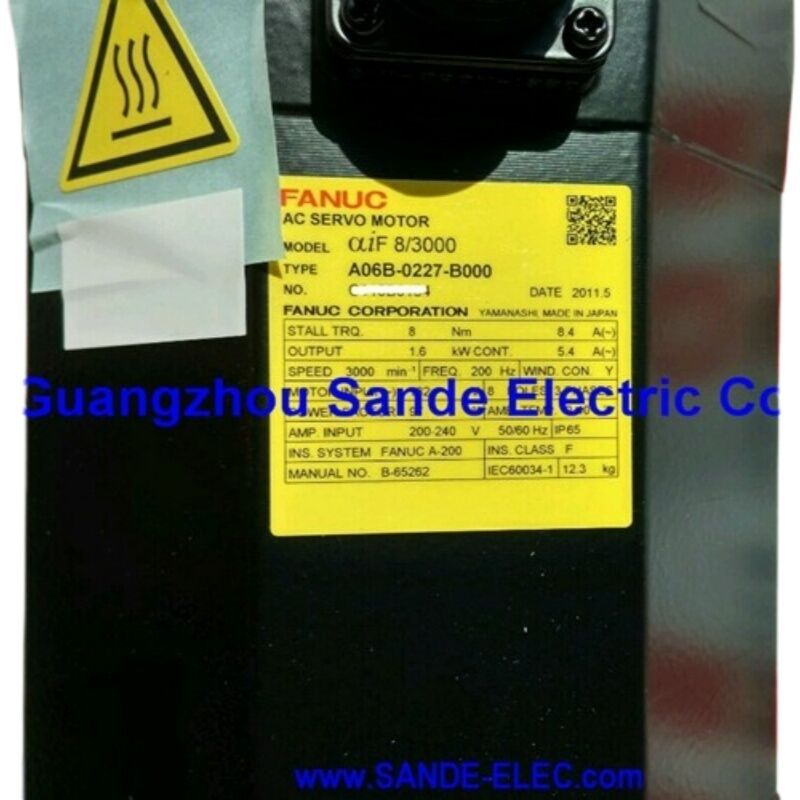
GE Fanuc A06B-0227-B000 AC Servo Motor — αiF 8/3000, Taper Shaft, A1000 Absolute, No Brake
Product Overview
Part Number: A06B-0227-B000
Also Searched As: A06B0227B000, GE Fanuc A06B-0227-B000, FANUC A06B0227B000
Motor Model: αiF 8/3000 (Alpha iF 8/3000)
Brand: GE Fanuc / Fanuc
Classification: Fanuc Alpha iF Series AC Brushless Servo Motor — 8 Nm Stall Torque, 1.6 kW, 3,000 rpm, Taper Shaft with Key, No Brake, Alpha i A1000 Absolute Pulse Coder, IP65
Technical Specifications
| Parameter |
Value |
| Part Number |
A06B-0227-B000 |
| Motor Model |
αiF 8/3000 |
| Brand |
GE Fanuc / Fanuc |
| Stall Torque |
8 Nm |
| Rated Output |
1.6 kW |
| Stall Current |
8.4 A (rms) |
| Maximum Speed |
3,000 rpm |
| Motor Input Voltage |
182V AC (3-phase) |
| Frequency |
200 Hz |
| Torque Constant |
0.95 Nm/A (rms) |
| Rotor Inertia |
0.00257 kg·m² |
| Pulse Coder |
Alpha i A1000 (serial absolute, A860-2000-T301) |
| Encoder Resolution |
1,000,000 pulses/rev |
| Shaft Type |
Taper with key (TPR) |
| Electromagnetic Brake |
None |
| Protection Rating |
IP65 |
| Insulation Class |
Class F |
| Operating Temperature |
0°C to +40°C |
| Compatible Amplifiers |
Fanuc αi series servo amplifiers (αiSV) |
| Compatible Controls |
Fanuc Series 0i, 15i, 16i, 18i, 21i, 30i, 31i, 32i |
| Origin |
Japan |
GE Fanuc — The Brand Behind the Part Number
Some sourcing confusion surrounds the GE Fanuc designation on this motor. To be clear: GE Fanuc was a joint venture between General Electric and Fanuc Ltd. that operated primarily in the North American CNC and automation market. The motors produced under the GE Fanuc branding — including the A06B-0227-B000 — are identical to their Fanuc-branded counterparts. Same motor body, same encoder, same electrical characteristics, same amplifier compatibility. The GE Fanuc nameplate simply reflects the commercial arrangement under which the product was sold in certain markets.
For maintenance and sourcing purposes, a motor listed as GE Fanuc A06B-0227-B000 and one listed as Fanuc A06B-0227-B000 are the same physical part, compatible with the same amplifiers, and replaceable by the same replacement motor regardless of which brand name appears on the label.
Eight Newton-Metres at 3,000 RPM — Understanding the Performance Envelope
At 8 Nm stall torque and 1.6 kW continuous rated output, the αiF 8/3000 occupies a genuinely productive position in the Fanuc αiF servo motor range. It is not the smallest motor in the family, and it is not the largest. It sits at a point where the torque output is substantial enough to drive mid-size machine tool feed axes under realistic cutting loads, while the 3,000 rpm ceiling and compact frame keep the motor physically manageable and the system cost reasonable.
On a 10mm pitch ball screw with 90% mechanical efficiency, 8 Nm sustains approximately 4.5 kN of continuous axial thrust force. That covers the X and Z axis loads of a medium CNC turning centre handling typical bar stock diameters, the table drive of a compact vertical machining centre, and the feed axes of a broad range of mid-format production machines. The 1.6 kW continuous output provides the power budget for sustained cutting passes without thermal overload, even in high-duty-cycle production environments.
The torque constant of 0.95 Nm/A tells a complementary story: this motor generates close to 1 Nm per amp of stall current, which reflects an efficient electromagnetic design for its frame size. The rotor inertia of 0.00257 kg·m² sets the motor's dynamic character — low enough to respond quickly to servo loop corrections without the sluggishness of heavier rotors, high enough that the motor does not become unstable under the sharp acceleration demands of short-stroke rapid traverse moves. Both figures matter for servo system engineers designing or troubleshooting axis dynamic performance.
Taper Shaft with Key — The Machine Tool Standard
Every A06B-0227-B000 ships with a precision-ground taper shaft with a machined keyway. This coupling interface has been the default for machine tool servo motors across decades of Fanuc motor generations — and the reasons remain as relevant now as when the taper shaft was first adopted.
The taper geometry creates an automatic self-centering effect during hub installation. As the coupling hub is drawn onto the tapered shaft using the draw bolt at the shaft end, the conical contact between the hub bore and the shaft automatically aligns the hub concentrically to the motor shaft axis. No shimming, no runout measurement, no iterative adjustment. The hub seats in the correct position every time. On a CNC axis where the motor-to-screw alignment directly affects following error and surface finish quality, this repeatable coupling geometry is worth the slightly more complex installation procedure compared to a straight shaft design.
The key in the matching keyway transmits torque through positive mechanical engagement. At 8 Nm stall torque, the key is comfortably within its load capacity — the keyway is not there because 8 Nm requires it for structural reasons, but because the combination of taper plus key provides reliable torque transmission under reversing loads, vibration, and thermal cycling without the risk of fretting or progressive loosening that can affect purely friction-clamped couplings over long service intervals.
For replacement purposes, the hub already on the machine's drive mechanism is already matched to this taper geometry. Remove it with a proper gear puller, inspect the taper surfaces for fretting or damage, fit the new motor, reinstall the hub with the draw bolt torqued to specification. The axis coupling geometry returns to the pre-failure state without realignment.
Alpha i A1000 Absolute Encoder — No Homing, Every Morning
The Alpha i A1000 pulse coder is the standard absolute encoder across the Fanuc αiS and αiF motor families, and its operational implications are the same on the A06B-0227-B000 as on any other A1000-equipped motor: the axis coordinate is known immediately on every CNC power-up, without any homing movement.
Multi-turn shaft position is retained through power-off by the backup battery in the Fanuc αi series servo amplifier. When the CNC powers on — at the start of a shift, after an E-stop recovery, after an overnight shutdown — every axis fitted with an A1000 encoder reports its position immediately. The machine enters automatic mode ready to run. No supervised reference-return traverses, no waiting for axes to find their markers, no production delay at startup.
For a production facility running multiple CNC machines with multiple axes each, this operational characteristic translates to real time savings that accumulate across every shift and every working day. And for machines that stop mid-program on an alarm or power event, the absolute encoder means the axis resumes from exactly the stopped position — no repositioning uncertainty, no scrapped part from an axis that did not know where it was after recovery.
The A1000 delivers 1,000,000 pulses per revolution. On a 10mm pitch ball screw, each count corresponds to 10 nanometres of linear displacement — the resolution at which the Fanuc CNC closes the position loop. This is what underpins the dimensional accuracy and surface finish quality that modern CNC machining centres are built to achieve.
Battery maintenance: the backup battery is in the αiSV servo amplifier, not in the motor. Replace it when the Fanuc CNC issues a low battery alarm. A fully depleted battery resets the multi-turn counter, requiring a one-time axis re-referencing to restore the machine coordinate system — preventable with timely battery maintenance.
No Brake — When Servo Lock Is the Right Answer
The B000 designation confirms this motor carries no electromagnetic brake. On the overwhelming majority of horizontal axes and any axis where gravity does not act along the shaft rotation direction, this is the correct and appropriate specification.
With the αiSV amplifier active and the servo loop closed, the A1000 encoder reports position at 1,000,000 counts per revolution while the amplifier continuously corrects to the commanded shaft angle. Axis position at rest is held with the same accuracy as axis position during motion — the servo lock is not a degraded holding mode but the same closed-loop control that governs motion. On horizontal axes, this hold is reliable, accurate, and requires no additional hardware.
The no-brake configuration keeps the motor body lighter and shorter than the equivalent braked variants, simplifies the machine's electrical panel by eliminating the brake supply circuit and associated relay logic, and removes the brake disc as a wear component that accumulates service hours.
Where an axis carries a gravitational load — vertical quill drives, inclined feeds, tilting tables — servo lock alone at servo-off is insufficient, and a braked motor is required. Within the A06B-0227 series, the B300 (taper shaft, 24V spring brake, A1000 absolute) is the braked equivalent for vertical axis applications. The B000 is correctly and confidently specified for all confirmed horizontal axis applications.
A06B-0227 Series: Configuration Reference
All variants in the A06B-0227 series share the αiF 8/3000 motor body — 8 Nm stall, 1.6 kW, 3,000 rpm, A1000 absolute encoder. Shaft type, brake, and sealing differentiate the variants.
| Part Number |
Shaft |
Keyway |
Brake |
Sealing |
| A06B-0227-B000 |
Taper |
Yes |
None |
IP65 |
| A06B-0227-B000#0100 |
Taper |
Yes |
None |
IP67 |
| A06B-0227-B100 |
Straight smooth |
No |
None |
IP65 |
| A06B-0227-B200 |
Straight |
Yes |
None |
IP65 |
| A06B-0227-B300 |
Taper |
Yes |
24V spring |
IP65 |
| A06B-0227-B400 |
Straight smooth |
No |
24V spring |
IP65 |
The B000 is the taper-plus-key, no-brake, standard IP65 baseline — the most common configuration for horizontal mid-axis CNC applications. The #0100 sealed variant upgrades to IP67 for high-coolant environments. Always confirm the exact original motor configuration before ordering a replacement.
Amplifier and CNC System Compatibility
The A06B-0227-B000 operates with Fanuc αi series servo amplifiers (αiSV) — the αiSV 20 or αiSV 40 module depending on the specific drive cabinet configuration for this motor's current class. Compatible CNC platforms include Fanuc Series 0i-D, 0i-F, 15i, 16i, 18i, 21i, 30i-A, 30i-B, 31i-A, 31i-B, and 32i.
The motor is not compatible with original α (non-i) series amplifiers, which use a different serial encoder protocol, or with Fanuc β series drives. After fitting a replacement, confirm the CNC axis parameters match the αiF 8/3000 motor type specification — specifically motor type code, maximum speed, and current limit — before returning the machine to production.
Typical Applications
Mid-format CNC machining centre primary feed axes. X, Y, and Z table, saddle, and spindle head drives on vertical and horizontal machining centres where the 8 Nm stall torque handles the combined axis mass and cutting force demands of a mid-size production machine.
CNC turning centre carriage and cross-slide drives. Z-axis carriage and X-axis cross-slide drives on medium CNC turning centres handling typical production turning loads, where the αiF 8/3000 provides the torque and speed for productive feed rates across the machine's workpiece range.
Multi-axis machining centres — secondary axis drives. B-axis rotary drives, auxiliary linear axes, and secondary positioning mechanisms on multi-axis machining centres where the 8 Nm torque class correctly matches the secondary axis load budget.
Fanuc-controlled automation and handling equipment. Primary positioning drives on Fanuc-controlled automation platforms, parts transfer systems, and integrated machining cells where the αiSV/αiF 8/3000 combination provides reliable closed-loop servo performance with absolute position retention.
FAQ
Q1: Is there any difference between a motor labelled "GE Fanuc" and one labelled "Fanuc" for this part number?
No functional difference. GE Fanuc was the commercial joint venture name under which Fanuc products were sold in North American markets for a period. The motors are manufactured by Fanuc to the same specification regardless of which brand name appears on the nameplate. A GE Fanuc A06B-0227-B000 and a Fanuc A06B-0227-B000 are the same motor, compatible with the same amplifiers, and interchangeable as replacements for each other.
Q2: Does this motor require homing after every CNC power cycle?
No. The Alpha i A1000 is a serial absolute encoder — multi-turn position is retained through power-off by the backup battery in the Fanuc αiSV servo amplifier. When the CNC powers up, the axis coordinate is immediately available without any reference-return movement. The only exception is if the backup battery depletes fully, which resets the multi-turn counter. Replace the battery promptly when the CNC issues a low battery alarm to avoid this.
Q3: When should the IP67 sealed variant (#0100) be specified instead of the base B000?
The base A06B-0227-B000 carries IP65 — protection against directed water jets. The #0100 variant upgrades to IP67 — protection against temporary immersion. Specify the IP67 variant when the motor is mounted in a position exposed to direct coolant flood, high-pressure coolant spray impingement, or coolant accumulation in the motor mounting area. For motors mounted away from the direct cutting zone in a standard protected panel location, IP65 is adequate.
Q4: What amplifier module is needed for the A06B-0227-B000, and which CNC systems support it?
The motor requires a Fanuc αi series servo amplifier (αiSV) — the specific αiSV current rating should be confirmed from the machine's drive cabinet documentation, as the 8 Nm / 8.4A stall current of this motor places it in the mid-range of the αiSV product line. Compatible CNC platforms include Fanuc Series 0i-D, 0i-F, 16i, 18i, 21i, 30i, and 31i. The motor is not compatible with original α-series (non-i) SVU amplifiers, which use a different encoder interface protocol.
Q5: Can the B000 (no brake, taper shaft) replace a B300 (24V brake, taper shaft) on the same machine?
Not safely on a vertical axis or any axis where gravity acts along the shaft rotation direction. The B300 carries a spring-applied brake providing mechanical holding at servo-off — a safety function required when the axis mass would otherwise descend under gravity when the amplifier is de-energised. The B000 has no such mechanism and relies on servo lock for position holding, which disappears when the amplifier is inactive. On a confirmed horizontal axis where the original motor was a B300 and the brake was never actually needed for safety, the engineering case for a B000 substitute exists — but this determination requires a formal review of the machine's axis load conditions, not an assumption. When in doubt, use the brake variant.


 Your message must be between 20-3,000 characters!