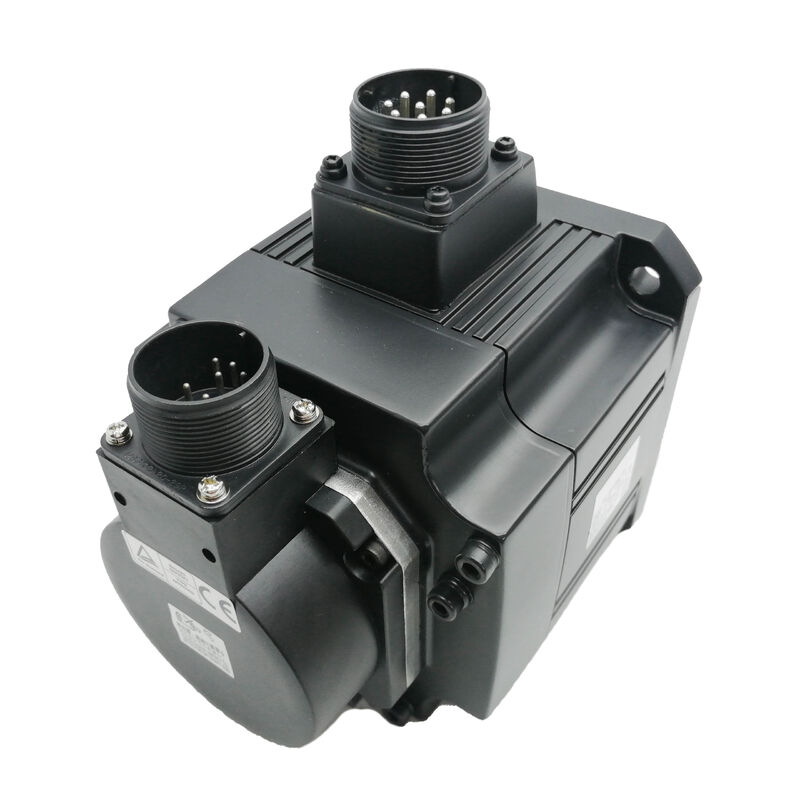
Mitsubishi HC-SF52BK-S2 800W Medium-Inertia AC Servo Motor
The Mitsubishi HC-SF52BK-S2 is an 800W medium-inertia brushless AC servo motor designed for 480V AC industrial power environments. This motor features a factory-integrated holding brake, making it ideal for vertical axis drives and applications requiring mechanical position holding when de-energized.
Important Note: This motor has been discontinued by the manufacturer. While new old-stock and remanufactured units remain available through industrial distributors, lead times are less predictable than current-production parts.
Key Specifications
| Model Number |
HC-SF52BK-S2 |
| Rated Output |
800W |
| Rated Speed |
2000 RPM |
| Supply Voltage |
480V AC |
| Motor Type |
Brushless AC Servo |
| Series |
HC-SF (Medium Inertia) |
| Integrated Brake |
Yes (BK) |
| Inertia Class |
Medium |
| Feedback System |
Incremental Encoder |
| Drive Compatibility |
MR-J2S Series (MELSERVO) |
| Cooling Method |
Self-Cooled (Natural Convection) |
| Mount Type |
Flange Mount |
| Status |
Discontinued by Manufacturer |
Motor Characteristics & Applications
Medium Inertia Design Benefits
The HC-SF series medium-inertia motors deliver stable, controllable motion on axes with moderate to substantial load inertia. This design provides favorable inertia ratios for heavier driven loads, resulting in firm position holding under load and predictable response across the operating speed range.
Holding Brake Functionality
The integrated holding brake automatically engages when motor power is removed, clamping the motor shaft to hold the axis stationary against gravity or static loads. This safety-critical feature prevents uncontrolled movement on vertical axes and loaded machine components.
Brake Power Requirements: The holding brake requires a separate 24V DC supply, controlled through the machine's sequence logic via CNC controller or PLC relay outputs.
Critical Installation Checks
- Brake Release Verification: Confirm axis moves freely with normal servo torque when energized
- Brake Hold Verification: Verify axis holds stationary without servo torque when de-energized
Typical Applications
- CNC machining center Z-axis spindle head drives
- CNC lathe main feed and cross-slide axis positioning
- Rotary table and indexing head drive axes
- Industrial robot joint actuators requiring brake-held park
- Gantry loader vertical axis positioning
- Transfer line pallet and fixture positioning
Drive Compatibility & System Integration
The HC-SF52BK-S2 is designed for Mitsubishi MR-J2S series servo amplifiers, with the MR-J2S-80A being the typical 800W pairing. Parameter management is handled through Mitsubishi's MR Configurator software for backup, adjustment, and diagnostics.
Compatibility Note: The HC-SF series encoder interface is matched to MR-J2S amplifiers. Direct compatibility with current MR-J4 or MR-JE amplifiers is not guaranteed.
Sourcing Guidance for Discontinued Motor
- Verify complete part number HC-SF52BK-S2 for brake and connector compatibility
- Consider new old-stock for lowest uncertainty or qualified remanufactured units
- Inspect and potentially replace aging cable assemblies during motor swap
- Maintain on-site spares for production-critical equipment
Frequently Asked Questions
What servo amplifier is compatible with the Mitsubishi HC-SF52BK-S2?
The HC-SF52BK-S2 is designed for Mitsubishi MR-J2S series servo amplifiers, typically the MR-J2S-80A for 800W applications. Confirm against machine electrical documentation.
Is the holding brake required, and can a non-brake variant be substituted?
The brake is required for vertical axes and safety-critical applications. Non-brake variants cannot be safely substituted where position holding is necessary when de-energized.
What does the 480V rating mean for installation?
The 480V AC rating indicates compatibility with standard North American three-phase industrial supply, eliminating the need for step-down transformers in 480V facilities.
What steps are required after motor replacement?
Back up MR-J2S amplifier parameters before removal, restore after installation, verify axis movement and direction, and critically test brake hold function before enabling automatic operation.



 Your message must be between 20-3,000 characters!